
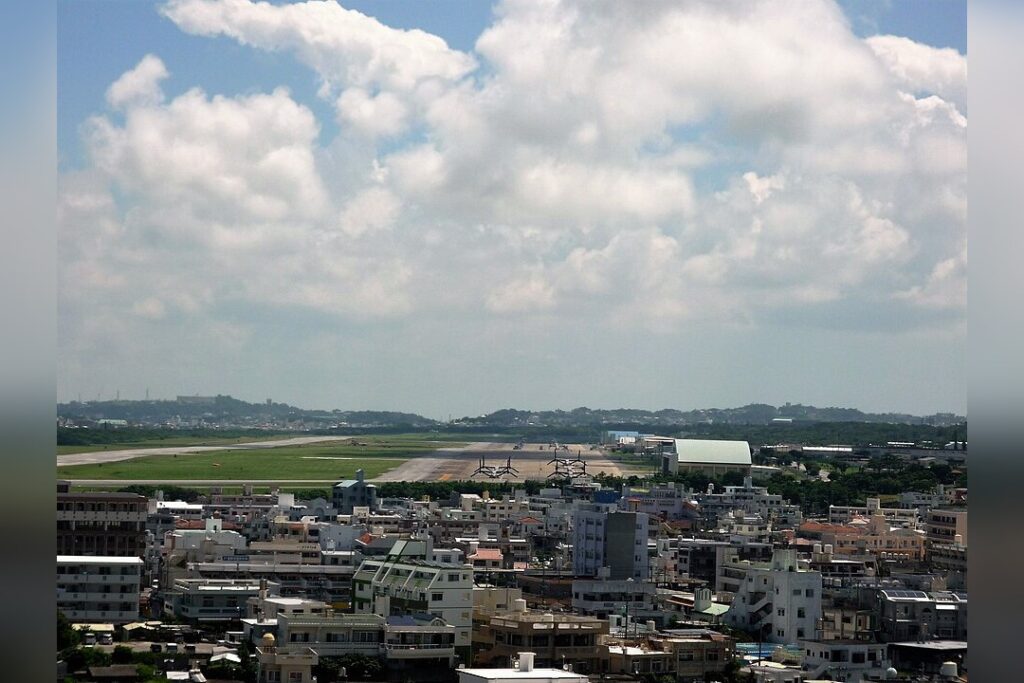
NAHA, September 14 — Okinawa Prefecture remains the fulcrum of the US–Japan security alliance, and the unresolved question of Marine Corps Air Station Futenma has outlasted every deadline set for it since Washington and Tokyo first agreed to move the base in 1996. The relocation plan would shift the air station from densely populated Ginowan City to the less developed coastal area of Henoko in Nago City.
More than two decades on, the project has been stalled by local opposition, environmental concerns and political gridlock, according to state and international reports. Land reclamation work at Henoko has already begun despite protests, and the central government in Tokyo has consistently argued the move is essential for reducing safety risks in Ginowan and for maintaining the US–Japan security alliance.
A Base Burden Concentrated on One Prefecture
Okinawa accounts for less than 1 percent of Japan’s total land area but hosts roughly 70 percent of the US military installations in the country. The US has about 50,000 military personnel stationed in Japan, with the majority in Okinawa. That disparity has fueled long-standing local resentment over noise, crime and the burden of hosting foreign forces.
The US military presence dates back to the 1945 Battle of Okinawa and the subsequent US occupation of Japan, which lasted until 1952. The island was returned to Japanese sovereignty in 1972, but the bases remained.
The 1995 rape of a 12-year-old girl by US servicemen sparked massive protests and led directly to the 1996 agreement to relocate Futenma.
An Election That Cut Both Ways
Okinawa held a gubernatorial election on Sunday, September 30, 2018. Denny Tamaki won with support from opposition parties and pledged to continue opposing the relocation. He succeeded Takeshi Onaga, a staunch opponent of the Henoko move who died in office in August 2018 after winning the 2014 gubernatorial race.
The outcome was read in some quarters as a win for candidates backed by the central government in Tokyo, potentially giving Prime Minister Shinzo Abe’s administration a freer hand to proceed with construction. The same result, however, put an anti-relocation governor in office.
The account indicates the election may have weakened the unified local front against the base move even as it installed a governor pledged to fight it — a tension that has shaped the dispute since. In recent years, protests have intensified, with environmental groups and local residents filing lawsuits to halt the Henoko construction. The central government has proceeded with landfill work, leading to clashes between protesters and police.
What to Watch
Host-nation support payments totaled about 190 billion yen (about US$1.7 billion) in fiscal 2017, and negotiations over the Status of Forces Agreement and those payments remain open questions. The new governor’s stance and the central government’s next moves will determine whether the project accelerates or faces further delays. The result is likely to be closely watched in Washington, where officials have urged Japan to proceed with the relocation to maintain military readiness.




