
Talk of a tariff war often means nothing more than a quarrel over duties. History asks for more. The cases that ended in actual fighting share a pattern: one state used the rules of commerce to squeeze another, the other answered in kind, and somewhere along the way the ships got guns.
Dutch rivals, English rules
Start with the Navigation Acts. The British government of the 1600s and 1700s subscribed to mercantilism, a nationalist school of economics that favoured exports, discouraged imports and aimed to hoard wealth at home. The first act dates from 1651. Parliament broadened it in 1660 and updated it in 1663, 1673 and 1696. The mechanics were plain. As far as possible, trade had to pass through British ports, and a ship carrying exports had to be British-owned with a mostly British crew.
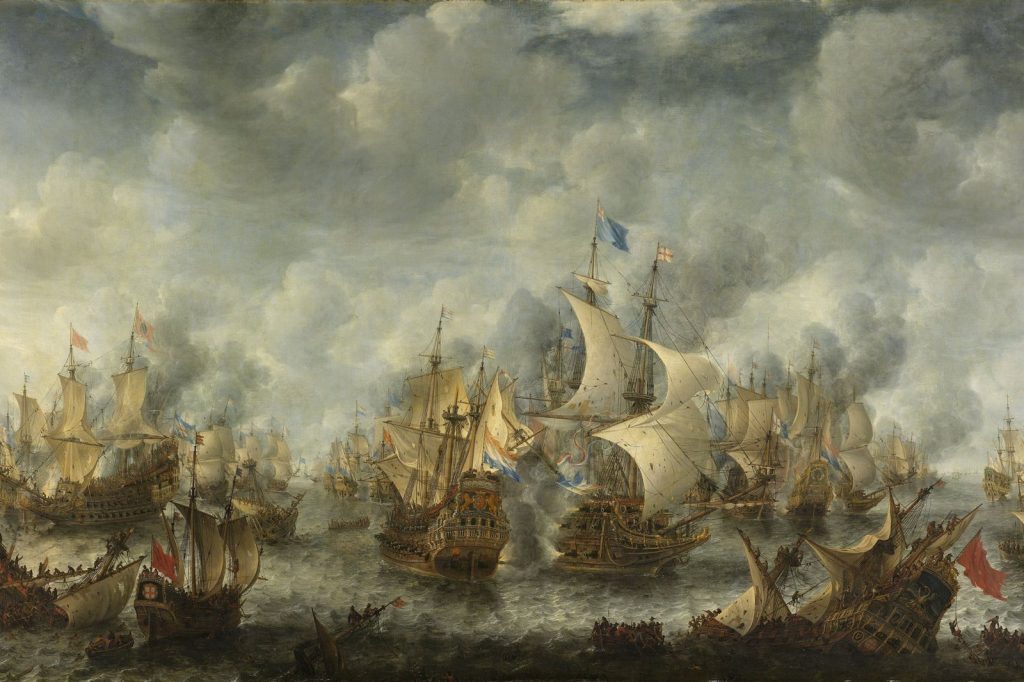
The catch is who was meant to lose. According to a history of the acts on AmericanRevolution.org, the 1651 act was meant chiefly to help Britain compete with the Dutch, who dominated global trade. Open conflict was the result. The First Anglo-Dutch War ran from 1652 to 1654. The acts survived for generations; Britain repealed them in 1849, when it turned from mercantilism to free trade.
Follow the silver
Opium runs on the same logic through a different channel. Britain craved tea and had little that China wanted in exchange. Historic UK explains what followed: silver poured out of Britain, and China gained the nickname “graveyard of silver.” Trade had become dangerously lopsided, with China holding the upper hand. The solution turned out to be opium, a product China’s buyers wanted.
Matters reached breaking point in Canton on 3rd June 1839. Lin seized and destroyed British opium: 20,000 barrels, roughly 1,400 tons, burned and tipped into the sea. After debates in Parliament, Britain went to war in 1840. Critics included the young William Gladstone, and some called the trade immoral. Yet the consensus held that the money was too good to walk away from. By June 1840, 16 warships had reached Hong Kong. China was no match for the British Navy, lost several battles and came to the negotiating table. The war settled little. Smuggling, smoking and tea shipments all carried on, and the same dispute flared again.
When retaliation is the weapon
Not every tariff fight ends in war, and the best-known modern case did not. The Smoot-Hawley Tariff Act pushed up about 900 import duties, by 40% to 60% on average, the Corporate Finance Institute says. Other nations hit back with their own duties, and global trade fell by 65%. US exports were worth $7 billion in 1929; by 1932 they had shrunk to $2.5 billion. Canada, the largest US trading partner, added extra duties on some American goods.
The damage was economic first. Some historians believe the tariff deepened the Great Depression and may have helped extremist politics rise. Then, in 1934, Roosevelt signed a law, the Reciprocal Trade Agreements Act, that brought tariffs down.
Sources
- Navigation Acts | Summary, Effects, Facts
- First Opium War
- Smoot-Hawley Tariff Act – Overview, Legislative History, Impact




