
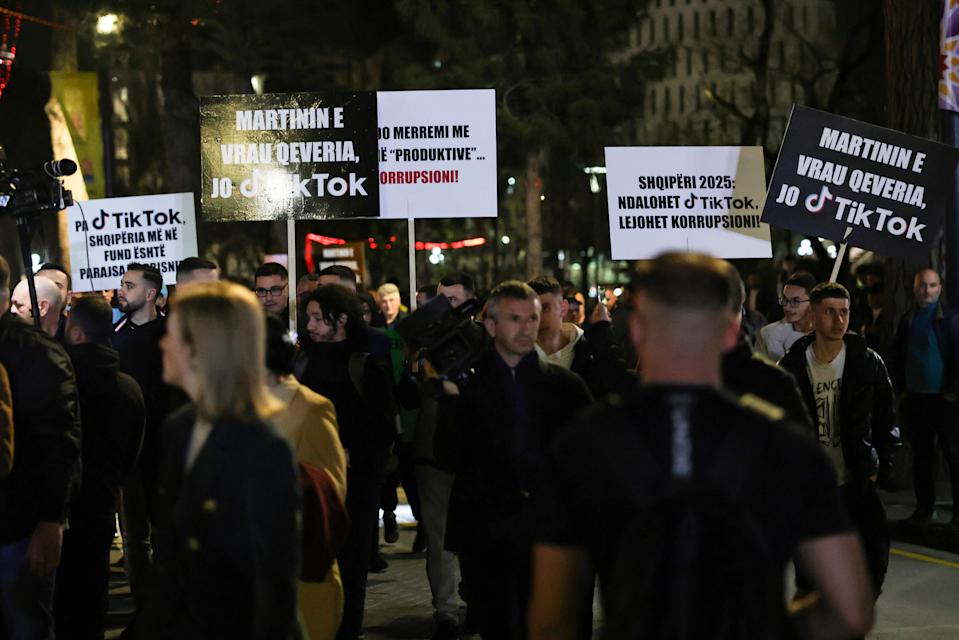
Outside the prime minister’s office in Tirana, a 14-year-old named Martin B. sat on the pavement among hundreds of other teenagers. They were there to object to the order closing TikTok for 12 months. “Banning TikTok will not solve the situation,” he told DW. “On the contrary, it will create bigger problems.”
Now Albania’s Constitutional Court has largely agreed with him.
The judges found that the blanket block on the video platform violated fundamental freedoms. The authorities, they said, had not justified it well enough and had not shown it was the only or a necessary way to deal with the problems they cited. Nor had the government weighed what a ban on this scale would do to the way citizens find information and talk to each other online. The case reached the court after an appeal from journalists’ groups, among them BIRN and the Journalists’ Union of Albania, which argued that the measure struck at press freedom and free expression.
A killing at the root of the ban
The ban traces back to a November stabbing in Tirana. Another 14-year-old boy, also named Martin, was stabbed to death by a schoolmate after a days-long argument on social media. A month later Prime Minister Edi Rama announced the ban. In March 2025, Education Minister Ogerta Manastirliu confirmed that a 12-month suspension had been approved and would start within days. Rama insisted the decision was not rushed. It rested, he said, on a poll of about 65,000 parents, and nine in ten of them wanted the app shut down.
Not everyone accepted the link between the app and the death. Engjell Cani, the victim’s father, told DW that his son had no TikTok account and that the app was not why he died. “Our family condemns the use of our son’s murder for political purposes,” he said. TikTok said the videos that preceded the stabbing were posted on another platform. ByteDance’s own figures from early 2024 counted 1.53 million Albanian users aged over 18.
The opposition saw politics. The announcement came in the midst of an election campaign, and critics said it was meant to limit TikTok’s presence online before the vote. The government rejected the accusation. Democratic Party leader Sali Berisha called a national protest against the closure.
Rama’s reply
The prime minister did not take the ruling quietly. On X, he wrote that the court “seems to think that 90% of Albanian parents and teachers were wrong” to ask for the shutdown. He said TikTok was reopened only because the company agreed to extra safety measures, and that those came as a result of the closure. Left to the court, he argued, the platform would never have been shut.
The ban itself was set for a single year and has already run its course. What the court has settled is narrower and longer-lasting: a government that wants to block a platform must show that nothing less will do.
Sources
- Albania's Constitutional Court rules TikTok ban unconstitutional (Himara.gr)
- Rama Reacts to the Constitutional Court's Decision on the Closure of TikTok (Euronews Albania)
- Protest in Tirana at Albanian government's TikTok ban (DW)
- Albanian Ministry Confirms One-Year Ban on TikTok (Balkan Insight)




