
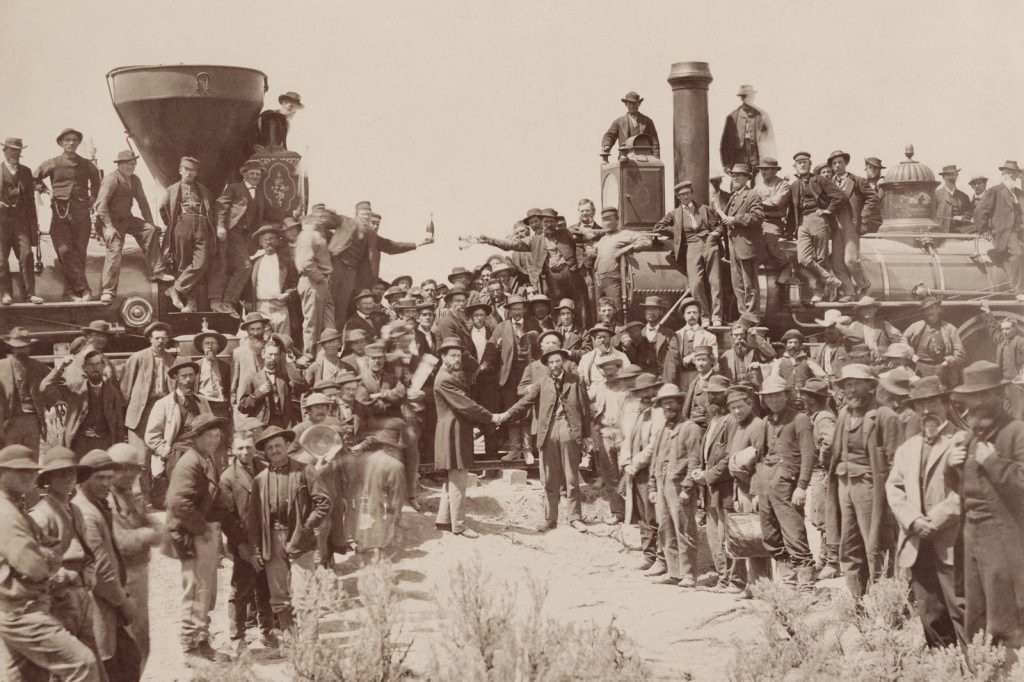
A pair of ceremonial spikes, one gold, one a mix of iron, silver and gold, were tapped into a laurel tie in the Utah desert on May 10, 1869. Then they were pulled out again. A plain iron spike did the real work. Leland Stanford swung the maul and missed. Still, a wire wrapped around the hammer carried the blow along the telegraph, and W.N. Shilling sent a single word east and west: DONE.
Years of paperwork, politics and money lay behind that moment, and most of it began with a single law.
What Congress offered
In July 1862, Lincoln put his name to the Pacific Railway Act. Southern senators had left Washington, so the central route was finally possible. It created the Union Pacific as a federal corporation and let the Central Pacific build east from Sacramento. Each railroad got a strip 200 feet wide either side of the track. The land grants came as a checkerboard, five alternating sections per mile. Then came the bonds. Washington issued $1,000 bonds paying 6 percent over thirty years: $16,000 a mile on flat ground, and $48,000 in the mountains. The land grant was 6,400 acres per mile of track laid.
Technically the bonds were a loan, nothing more. They also sat first in line, and that was the problem. Think of it like a house: no bank wants a second mortgage behind the government’s, so private money stayed away, and construction lagged.
The fix came on July 2, 1864. Congress raised the land grant to 12,800 acres per mile of track and, more important, allowed the companies to issue first-mortgage bonds of their own, up to the same amounts. The United States slid to second place. For each mountain mile, a promoter could show $48,000 of federal paper and a matching $48,000 of the company’s own. That makes $96,000, a figure that still floats around in popular histories. What it described was a pile of securities. No check left the Treasury.
The land, by the numbers
The arithmetic is tempting. At 12,800 acres a mile, across 1,779 miles, the paper total comes to 22.8 million acres. Reality was messier. Mineral land was excepted, settlers already sat on some odd-numbered sections, and the surveys trailed the track by years. Later the Pacific Railway Commission put the real total above 26 million acres, spread over every bond-aided Pacific road, the Kansas Pacific and other branches among them. Government bonds issued to those roads came to about $64.6 million by its tally. The companies repaid principal and plenty of interest in the 1898-99 settlements. For the wider picture, John Stover’s atlas of American railroads counts about 170 million acres offered to some eighty projects from 1850 to 1871. Of that, roughly 131 million acres were taken up, and the lines built on it ran about 18,700 miles.
Two armies and a ceremony
The Central Pacific belonged to the group known as the Big Four: Huntington, Hopkins, Stanford and Crocker. The engineer who made them possible, Theodore Judah, died of yellow fever, picked up crossing Panama, in November 1863, aged thirty-seven, never having ridden over the summit of the railroad he had mapped.
The ceremony was set for May 8, but washouts and workers demanding their pay held up Durant’s special train, and the date slipped to Monday, May 10. Roughly a thousand people crowded onto the alkali flat. The golden spike itself, commissioned by David Hewes of San Francisco, was about six inches long and 17.6-karat gold. Eight Chinese men had laid the last rail; they were moved aside before the famous photograph. The men who took the Central Pacific through the Sierra are not in the frame.
Even then the job was not finished. The first railroad bridge between Omaha and Council Bluffs did not open until March 27, 1872. Until then, passengers crossed the Missouri by ferry.
Sources
- The first transcontinental railroad (American-Rails.com): the acts, the land, and the paper
- The first transcontinental railroad (American-Rails.com): Promontory and after
- The Railroads Are Coming 1860-1873 (FoundSF)




