
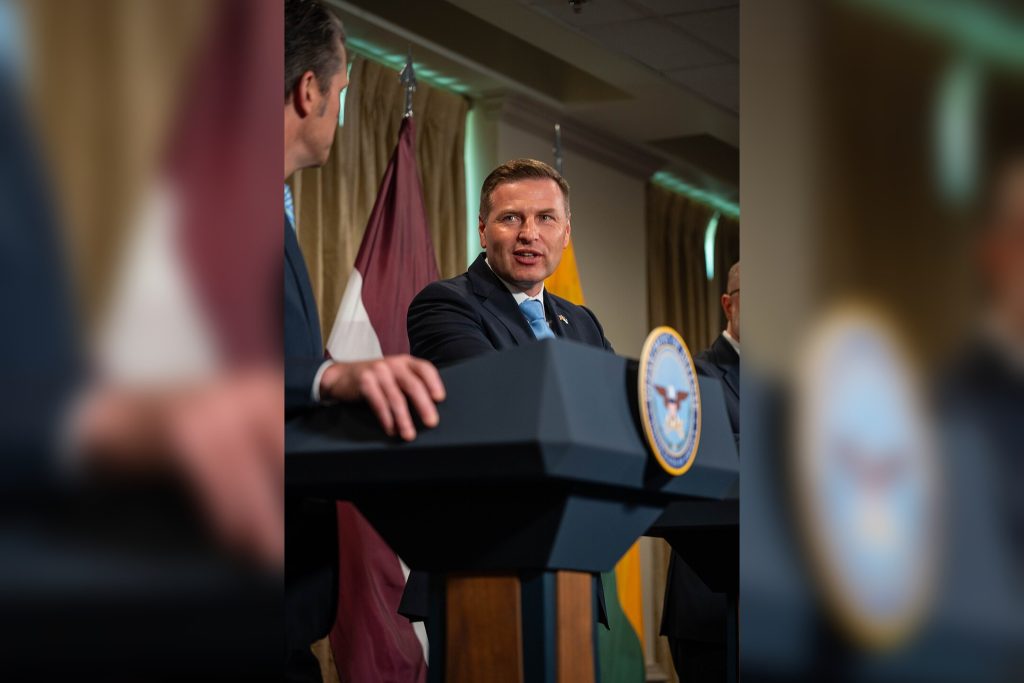
Since taking office in January 2025, Secretary of Defense Pete Hegseth has navigated a tenure defined by both policy continuity and internal administration clashes. A former Army National Guard officer who served in Iraq and Afghanistan, Hegseth brought to the Pentagon a worldview shaped by direct combat experience.
That background has manifested most clearly in his early opposition to a controversial proposal within the Trump administration: a cargo fee on vessels transiting the Strait of Hormuz.
A Warning Against Provocative Economic Policy
Hegseth’s most significant intervention to date came when he warned that such a fee could provoke Iranian military retaliation against commercial shipping. His assessment was grounded in a straightforward military calculus: retaliatory strikes would compel an increased U.S. naval presence in the Persian Gulf to protect vessels and maintain freedom of navigation.
That prospective escalation, Hegseth argued, would force the Navy into a reactive posture, undermining long-standing Department of Defense priorities. The Pentagon’s institutional position has consistently held that the Strait of Hormuz must remain open for global energy security. Hegseth’s objections aligned squarely with that doctrine. The internal debate over the fee culminated in its abandonment on January 15, 2025, marking an early victory for the defense secretary’s view that economic policy should not create direct military risks.
The episode illustrates a defense chief willing to push back against economic proposals he judged would increase the burden on U.S. forces.
Background and the Strategic Chokepoint
Before assuming the role of Secretary of Defense, Hegseth built a public profile as a Fox News commentator and as CEO of Concerned Veterans for America. Born on June 6, 1980, his military service in Iraq and Afghanistan, combined with his advocacy work, gave him a background that appealed to the Trump administration’s base. That service has informed his approach to risk assessment, particularly in the volatile waters of the Persian Gulf.
The Strait of Hormuz itself is a narrow waterway connecting the Persian Gulf to the Gulf of Oman. Iran borders the northern coast, while Oman and the United Arab Emirates border the southern coast.
It is the only sea route from the Persian Gulf to the open ocean, making it a permanent strategic chokepoint. Iran has occasionally threatened to close the waterway or prepare mines, though the strait remained open during most Middle East conflicts prior to the 2026 Iran War. The waterway’s significance for global energy security cannot be overstated. A large share of the world’s seaborne oil and liquefied natural gas passes through these waters annually.
The strait is a primary route for petroleum products heading to Asian and European markets, and several Gulf countries rely on it as their only maritime exit. Any blockade would create severe supply shortages, disrupting energy markets worldwide.
Implications for U.S. Military Posture
Under Hegseth, the Pentagon’s priorities appear to focus on deterrence and presence in key maritime corridors. The abandonment of the cargo fee was a victory for the department’s view that the U.S. Navy should not be forced into a reactive posture by a policy that could be seen as provocative.
By objecting to the fee, Hegseth reinforced the doctrine that freedom of navigation in the strait is a core national security interest that should not be jeopardized by economic measures. The question moving forward is whether Hegseth will face similar internal battles as the administration continues to weigh economic and military strategies in the Middle East. His record so far suggests he will not hesitate to object when he believes a policy could increase the burden on U.S. forces.
The technical reality of the strait — a narrow chokepoint through which a significant portion of the world’s oil passes — makes any disruption a matter of national security, and Hegseth’s early tenure signals a defense secretary attuned to those risks.




