
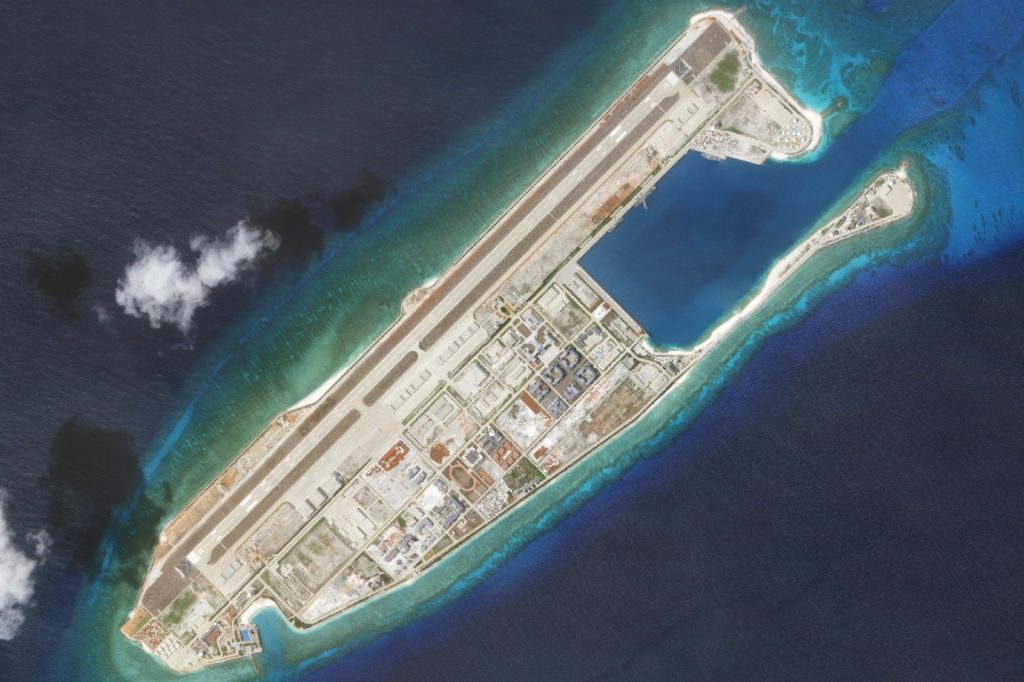
MANILA, July 20 — Some of the world’s most contested real estate is underwater, and the pace of construction there has been anything but slow.
Since 2014, China has carried out large-scale land reclamation on features in the Spratly Islands, including Mischief Reef, Subi Reef, and Fiery Cross Reef. The U.S. Defense Department estimates that this effort has added over 3,000 acres of artificial land. On these newly-built foundations, China has installed airstrips, hangars, radar systems, and missile batteries.
The effect has been to transform scattered rocks and reefs into what are effectively military outposts, hundreds of miles from China’s mainland.
China’s Coast Guard: The World’s Largest
What researchers found intriguing about the Chinese presence is not just the fixed infrastructure, but the fleet that enforces it. China’s Coast Guard is now the world’s largest, consisting of hundreds of vessels. Many of these ships are equipped with water cannons and sonar — tools that allow for aggressive interdiction of rival vessels without escalating to outright naval conflict.
The science behind the water cannon tactic is straightforward: high-pressure jets can disable electronics, damage small craft, and injure crews, all while remaining below the threshold of a military attack. China has used this capability repeatedly against Philippine supply ships and fishing boats in disputed waters.
Philippine Modernization and the Role of the US
The Philippines has not been idle in response. Manila has been modernizing its armed forces under the Revised AFP Modernization Program, with Horizon 2 (2013-2017) and Horizon 3 (2018-2022) phases. The program has allocated about 126 billion pesos for new equipment, including frigates, patrol aircraft, and radar systems. That is a significant investment for a country that has long struggled to match China’s naval reach.
The U.S. provides direct assistance through the Enhanced Defense Cooperation Agreement (EDCA), which allows access to five Philippine bases.
In 2024, the U.S. and Philippines conducted the Balikatan exercises, involving over 16,000 troops. That scale of joint training is unusual for the region, and it signals a deliberate effort to demonstrate interoperability and deterrence.
The U.S. Indo-Pacific Command has also increased surveillance and patrols in the region. This means more aircraft, ships, and drones monitoring Chinese activity in the Spratlys, particularly around the features China has fortified.
The Standoff at Second Thomas Shoal
One of the flashpoints in this ongoing contest is the standoff at Second Thomas Shoal. The situation there involves Philippine Navy ships and China Coast Guard vessels. So far, there has been no direct Chinese naval involvement, but the presence of the Coast Guard alone has been enough to restrict Philippine access to the shoal.
The dynamic is revealing: China uses a civilian law-enforcement force to impose control over waters that Manila considers within its exclusive economic zone. It is a way of projecting power without triggering a formal military confrontation.
What to watch next is whether the pattern holds. The U.S. has increased its presence, the Philippines is upgrading its forces, and China continues to expand its footprint. Each side is betting on a different timeline — Beijing on the permanence of its artificial islands, Manila and Washington on the durability of their alliance. The science of land reclamation is well understood. The political outcome is not.
Sources
{“@context”: “https://schema.org”, “@type”: “NewsArticle”, “headline”: “China bolsters South China Sea fortifications and Philippines’ military”, “description”: “MANILA, July 20 — Some of the world’s most contested real estate is underwater, and the pace of construction there has been anything but slow….”, “datePublished”: “2026-07-20T09:30:00+00:00”, “author”: {“@type”: “Person”, “name”: “Henry Thomas”}, “publisher”: {“@type”: “Organization”, “name”: “InfoPulse Today”, “url”: “https://newsfeed.infopulsetoday.com/”}, “citation”: [{“@type”: “CreativeWork”, “url”: “https://en.wikipedia.org/wiki/Spratly_Islands”}]}




