
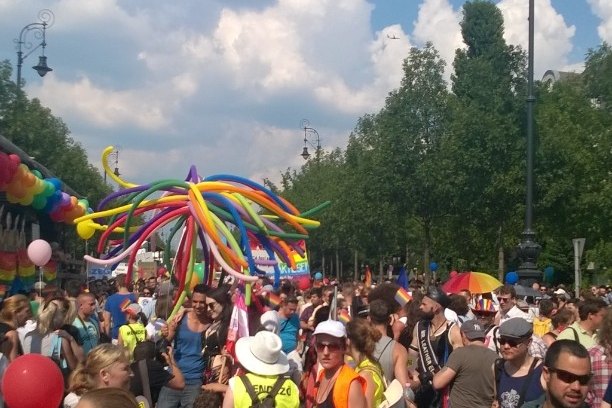
Police put the crowd in the thousands. Organisers said it was bigger. Either way, the June 27 Budapest Pride march was the first since Viktor Orban’s party lost the 2026 election, and the first since the government that banned Pride events was voted out.
The march happened. It was permitted.
No major incidents. That last fact is the one worth holding onto. Under Orban, Budapest Pride did not simply face opposition.
It faced legal blockage. In 2025 the government passed a law that effectively banned Pride events outright.
The European Union condemned it. Human rights groups condemned it. The marches went ahead anyway, under restrictions, under reroutes, under the constant threat of police action.
This year, the new coalition government granted permission without the legal obstacles that marked previous years. The difference is concrete. It is measurable.
It is the difference between a march that happens and a march that does not. The march drew participants from across the country.
They carried banners and rainbow flags. Speakers addressed the crowd from a stage at the endpoint. They praised the political change.
They also warned that social attitudes would take longer to shift. That is a sober note, and a realistic one.
A single election does not remake a society. Orban’s party held power for more than a decade. The laws it passed did not vanish the day it lost.
The 2025 ban on Pride was among the measures the new government moved to repeal after taking office, but repeal takes time. The march itself was the first test of whether the new administration meant what it said. The test passed.
No major incidents. Heavy police presence, but the kind that protects a permitted assembly, not the kind that breaks one up.
That is a shift in posture. It is also a shift in what Hungarians can expect from their government on a basic question: whether they can assemble peaceably to express an identity. One organiser told reporters that the turnout was substantial.
Crowds filled the designated route from early afternoon. The numbers matter, but the context matters more.
This was not a protest against a hostile government. It was a celebration of a government’s defeat, and a demonstration that the defeat was real. The new administration signalled a different approach to social policy.
The march was the first public test of that signal. It passed. What comes next is not a matter for this article.
The organisers themselves said social attitudes would take longer to shift. That is a warning worth heeding.
A march is one day. The law is permanent until it is changed. The new government has moved to repeal the 2025 ban, but the repeal is not yet complete.
The European Union and human rights groups are watching. So are the thousands who marched.
The march itself was the story. It was the first Budapest Pride since Orban’s defeat. It was the first in years that did not face legal obstacles from the start.
It was the first in years that did not require participants to wonder whether they would be blocked, rerouted, or dispersed. That is a change. It is a concrete change.
It happened on June 27, in the streets of Budapest, under police protection, with no major incidents. That is the fact that matters.




