
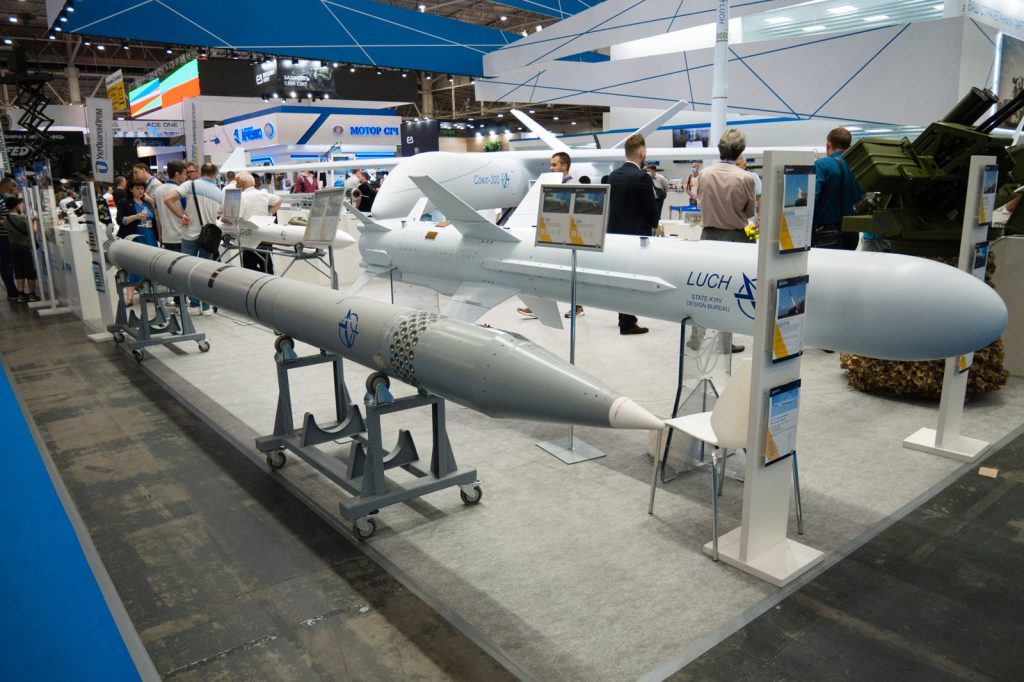
KYIV, July 9 — The R-360 Neptune, a Ukrainian anti-ship cruise missile developed by the Luch Design Bureau in Kyiv, has fundamentally altered the strategic calculus of the Black Sea since it entered service with the Ukrainian Navy in 2020. Military analysts continue to study the weapon’s combat performance, particularly its role in the sinking of the Russian cruiser Moskva in April 2022. The Neptune is a subsonic missile with a stated range of up to 300 kilometers and carries a 150-kilogram warhead.
Development began in 2013, and first flight tests were conducted in 2016. According to the record, the missile was designed for coastal defense, intended to strike surface vessels operating in Ukraine’s exclusive maritime zone.
The Moskva Strike
The missile gained global attention on April 14, 2022, when two Neptune missiles struck and sank the Russian cruiser Moskva. The Moskva was the flagship of the Black Sea Fleet, a Slava-class cruiser displacing 11,500 tons and armed with 16 P-500 Bazalt anti-ship missiles. Officials confirmed that the sinking represented the largest loss of a naval vessel in combat since World War II.
The strategic context is significant. The Moskva was not merely a large warship; it was the command hub of Russia’s naval power projection in the region.
Its loss forced a recalculation of Russian naval operations, pushing surface combatants further from the Ukrainian coast and reducing their ability to support amphibious operations or conduct sustained blockade activities.
Evolution of the System
Ukraine has since produced an improved variant, the Neptune-M, with a range of up to 1,000 kilometers. According to the statement from Ukrainian defense officials, the upgraded missile was tested in 2024. The extended range shifts the weapon from a purely anti-access/area-denial asset into a platform capable of striking targets deep within contested territory or naval bases far from the launch point.
The development timeline shows a steady progression. Work began in 2013, well before the full-scale invasion.
First flight tests occurred in 2016. The missile entered service in 2020. The combat debut came in 2022.
The upgraded variant was tested in 2024. This pace suggests a deliberate, sustained investment in indigenous cruise missile capability.
The Luch Design Bureau, based in Kyiv, has been the lead developer throughout. The bureau’s work on the Neptune family represents a significant achievement for Ukraine’s defense industrial base, which has had to operate under wartime conditions, including repeated missile strikes on production facilities and power infrastructure. The Neptune system is typically deployed in mobile coastal defense batteries.
The launchers are truck-mounted, allowing for rapid repositioning and camouflage. This mobility is a critical survivability feature, as fixed launch sites would be vulnerable to preemptive strikes. The missile uses inertial navigation with terminal active radar homing, a standard configuration for anti-ship missiles of its generation.
The warhead, at 150 kilograms, is relatively modest compared to the 500-kilogram warheads carried by some Soviet-era anti-ship missiles. However, the Neptune’s accuracy and the placement of the strike—hitting the Moskva near the waterline, reportedly in the area of the ammunition magazine—demonstrated that warhead size is not the sole determinant of lethality.
A well-placed smaller warhead can cause catastrophic damage if it triggers secondary explosions. The sinking of the Moskva also highlighted vulnerabilities in naval air defense. The Moskva was equipped with the S-300F Fort long-range surface-to-air missile system, designed to engage aircraft and anti-ship missiles at significant distances.
The fact that two subsonic Neptune missiles penetrated this defense envelope raised questions about crew readiness, electronic warfare capabilities, and the effective integration of layered defenses.
Regional Implications
The Neptune’s combat effectiveness has had direct operational consequences. Russian naval vessels have largely withdrawn from the western Black Sea, reducing their ability to interdict commercial shipping or conduct shore bombardment. This has allowed Ukraine to establish a maritime corridor for grain exports, a development with global economic implications.
The Neptune-M variant, with its 1,000-kilometer range, extends the threat envelope further. From launch positions in southern Ukraine, the missile could potentially reach naval targets in the eastern Mediterranean or the Caspian Sea, depending on basing and overflight permissions.
This extended reach complicates Russian naval planning across multiple theaters. The missile’s development and combat use also demonstrate a broader trend in modern warfare: the ability of a smaller power to challenge a larger adversary’s naval dominance through relatively inexpensive, precision-guided weapons. The Neptune is far cheaper than the vessels it can threaten, creating an asymmetric advantage for the defender.
The Neptune program is not operating in isolation. Ukraine has also developed longer-range strike drones and other cruise missiles, creating a family of systems that can saturate enemy defenses.
The coordination between these systems—using drones to suppress air defenses while missiles strike high-value targets—represents a sophisticated operational approach. The Luch Design Bureau continues to refine the Neptune platform. Future upgrades may include improved seekers, better electronic warfare resistance, and integration with targeting data from unmanned aerial vehicles or satellite reconnaissance.
The open-source intelligence community has tracked multiple test launches and deployment patterns, indicating an active development program.




