
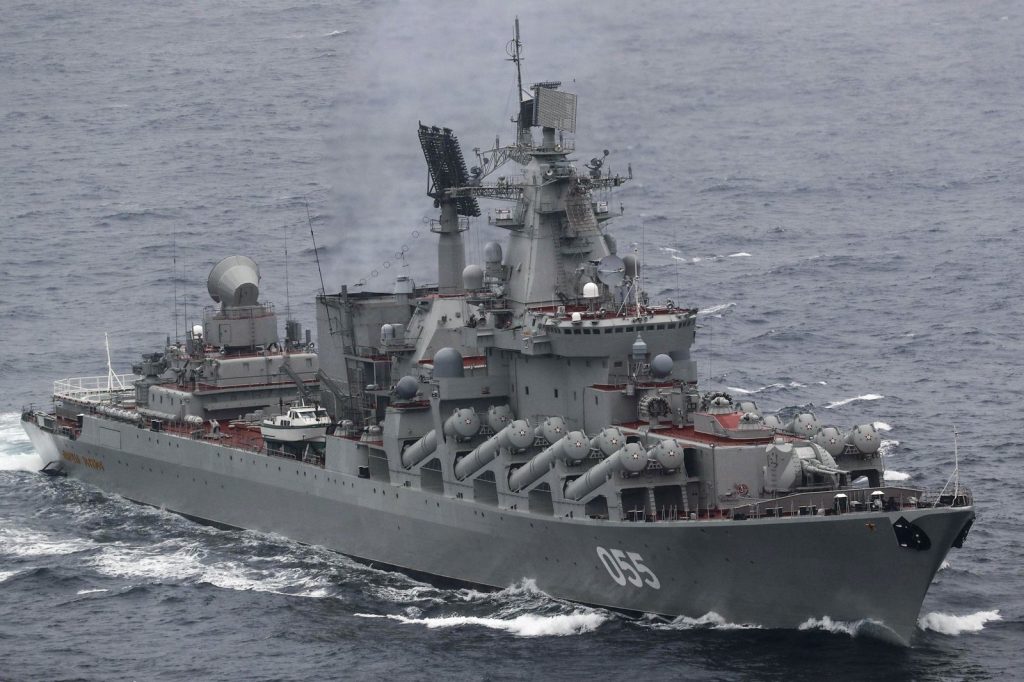
The Russian Defence Ministry’s own account fits in two sentences. A fire broke out on the cruiser Moskva, ammunition detonated, and the ship went down while under tow in “stormy conditions.” Ukraine’s account is shorter still: two Neptune missiles.
The ministry confirmed the loss on Thursday, April 14, 2022. The flagship of the Black Sea Fleet was gone.
What the ship was
Moskva was a Soviet-era cruiser, 186 meters long and displacing 11,500 tons, first launched in 1979 at a shipyard in what was then the Ukrainian Soviet republic. Its main armament was a battery of 16 Vulcan anti-ship missiles, said to reach at least 700 km, and it also had a version of the S-300 anti-aircraft system. In 2015 it commanded the Russian squadron in the Mediterranean for the Syria campaign. A dock stay for scheduled repairs began in 2018; it came back in September 2020. Viktor Kravchenko, a former top Russian naval commander, had described it as “the most serious ship in the Black Sea.”
It also had a place in the early days of the war. DW noted that the ship had faced Ukrainian soldiers on Snake Island, a confrontation that came to stand for Ukrainian defiance.
Two versions
Ukrainian officials said the warship was hit late on Wednesday off the port of Odesa. DW reported that Kyiv described a sequence: Bayraktar drones, made in Turkey, went after the ship’s radar, and a missile strike followed. The Neptune, developed in Ukraine and in service since August 2020, reaches roughly 300 kilometers, DW said, and its warhead can weigh up to 150 kilograms.
Moscow spoke only of a fire. It said the crew of more than 500 had been evacuated, and it did not mention an attack. Later the ministry added that hull damage from the blaze, plus rough seas, sank the ship.
Outside observers were cautious but skeptical of Moscow. John Kirby, the Pentagon spokesman, told CNN that a fire and a missile strike were both “possible.” A senior US defence official, however, said Washington believed the cruiser took a hit from a Ukrainian anti-ship missile, at minimum, as Kyiv claimed. A US official placed the burning ship 60 to 65 nautical miles south of Odesa and said it still seemed to be moving under its own power, despite Russia’s claim that it was being towed.
Naval News, in an analysis published on April 17, pointed to gaps in the Russian story. It said wave height was about 1 meter and wind about 14 knots at the time, mild conditions rather than a storm. It also noted that the fire reports from Russian state media came just hours after Ukraine claimed the ship had been fired upon. The same analysis raised an open question: Ukraine’s defense ministry had announced in December 2021 that Neptune deliveries were due in April 2022, and the missile had not been seen in use during the first 45 days of the war.
The cost
On April 17 the Russian ministry put out video of a ceremony for the cruiser’s company. It showed some 240 survivors, about half the crew. Cloud cover had made ordinary satellite pictures useless; a radar image credited to H I Sutton shows a vessel believed to be Moskva, ringed by smaller vessels.
The loss reduced Russian firepower in the Black Sea considerably. The Sydney Morning Herald, citing the timing, called it a crushing blow to Russian prestige as troops regrouped for a push in the east.
Sources
- Russian warship 'Moskva' has sunk — What do we know?
- Analysis: Chain of Negligence caused the loss of the Moskva cruiser
- Russia-Ukraine: Explosions heard in Kyiv after Russian flagship Moskva sunk




