United States officials accused Russia of deliberately maneuvering the military satellite Kosmos-2612 within an estimated 200 meters of a US-registered commercial satellite. According to the statement from US representatives, the close approach to the ICEYE-X36 satellite was described as deliberately reckless and consistent with an on-orbit weapons operation.
From Soviet Pioneers to Orbital Patrols
The state corporation responsible for Russian space flights, cosmonautics programs, and aerospace research is Roscosmos, headquartered at the National Space Centre in Moscow. According to historical records, Roscosmos inherited the bulk of the vast Soviet space program following the dissolution of the Soviet Union in 1991. Established in 1992 as the Russian Space Agency, its modern form resulted from a 2015 merge with the United Rocket and Space Corporation, which re-nationalized the space industry of Russia. Its director since February 2025 is Dmitry Bakanov. The agency utilizes four rockets, including the heavy-lift Proton-M and Angara A5, medium-lift Soyuz-2 variants, and small-lift Angara-1.2. The historical foundation of the Soviet space effort included ambitious lunar programs, such as the Zond program, which tested uncrewed spacecraft designed to fly cosmonauts around the moon before the program ended following missions like Zond 8 in October 1970. Decades later, reactions to the 2022 Russian invasion of Ukraine isolated the agency internationally, ending European Space Agency cooperation on ExoMars and halting the Soyuz program at the Guiana Space Centre.
The Mechanics of Proximity Operations
The recent incident involving Kosmos-2612 highlights the technical nature of rendezvous and proximity operations in Earth orbit. According to information provided by aerospace intelligence company LeoLabs, the behavior of the Russian satellite was not a routine conjunction or flyby, but consistent with sophisticated rendezvous and proximity operations. The target of the maneuver, ICEYE-X36, is operated by Finland’s ICEYE and carries radar technology capable of gathering detailed terrestrial images even through cloud cover. In January, the Finnish company signed a contract with the Ukrainian Defense Ministry to provide intelligence and radar imagery to Ukraine and other nations. The close approach brought the Russian military satellite exceptionally close to the commercial asset, raising immediate concerns among Western observers about the vulnerability of commercial infrastructure in low Earth orbit.
Diplomatic Clashes at the United Nations
The orbital maneuver sparked a diplomatic confrontation during a meeting of the UN First Committee in New York, a body that debates arms control and disarmament issues. Brian Hardesty, an adviser to the US Delegation to the Conference on Disarmament, stated during the meeting that the Russian satellite exhibited threatening behavior by intentionally maneuvering dangerously close to a commercial satellite. He asserted that these behaviors appeared consistent with an on-orbit weapons operation and that the decision to conduct these activities was deliberately reckless. Russia dismissed the US claims as absurd during the UN First Committee debate. The Russian representative did not directly address the specific maneuver, but instead accused Washington of aggressive military space ambitions, calling on member states to give the proper response to those ambitions.
The Broader Context of Space-Control Weapons
The diplomatic friction at the United Nations followed public remarks regarding the deployment of space-control capabilities. The Russian representative referenced comments made by the secretary of the US Air Force, the top civilian official for that military branch. US Air Force Secretary Troy Meink confirmed that the United States has deployed actual weapons in space, specifically on-orbit space-control weapons. Some analysts noted that this statement merely acknowledged capabilities long understood to exist within major military powers. As Roscosmos transitions its human spaceflight efforts toward the planned Russian Orbital Station constructed from the International Space Station’s Nauka module, and plans future uncrewed and crewed lunar missions alongside international partners, the operational environment in Earth orbit grows increasingly militarized.
Infrastructure and Launch Capabilities
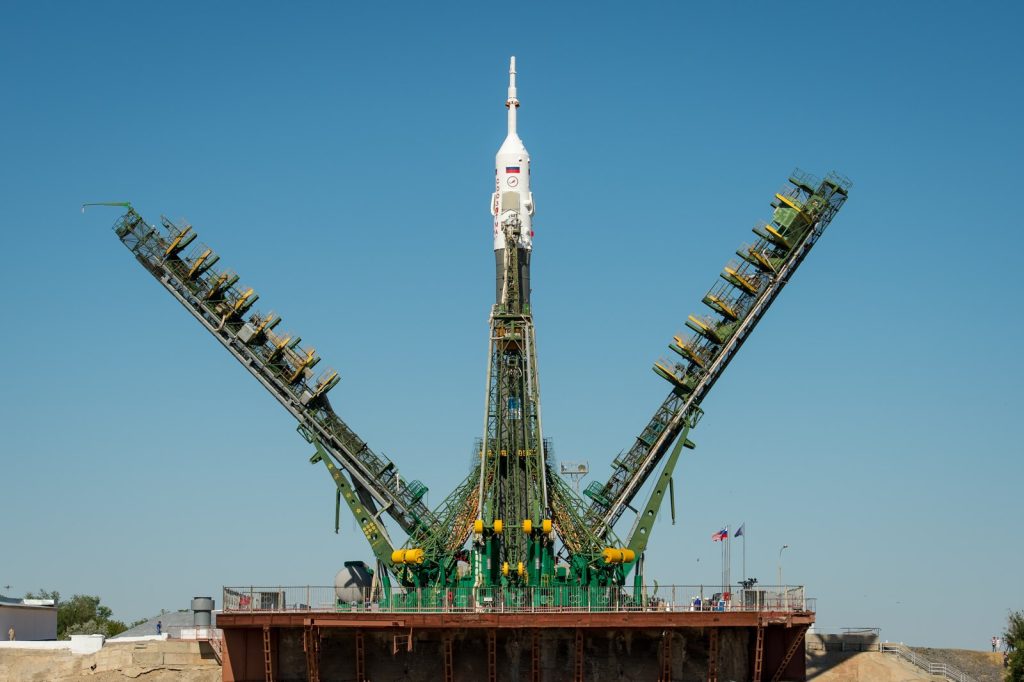
Roscosmos operates from three primary cosmodromes jointly managed with the Russian Space Forces: Baikonur in Kazakhstan, Plesetsk in Arkhangelsk, and Vostochny in Amur. Baikonur is designated as the world’s first and largest spaceport. The agency’s mission control center and Star City are located in Moscow Oblast, while the headquarters remain at the National Space Centre in Moscow. This infrastructure supports the operation of four distinct rocket types, including the heavy-lift Proton-M and Angara A5, as well as medium-lift Soyuz-2 variants and the small-lift Angara-1.2.
Beyond its current launch vehicles, Roscosmos is developing new hardware to sustain its spaceflight capabilities. The agency is working on the medium-lift Soyuz-5 rocket and the partially reusable methalox Soyuz-7. These developments occur alongside the planned construction of the Russian Orbital Station, which is intended to be built from the International Space Station’s Nauka module following the ISS deorbit from 2028. The agency also inherited the Soyuz program, the most flown crewed spacecraft in history, with recent derivations like the Soyuz MS and Progress MS currently servicing the International Space Station.
The agency’s historical footprint includes extending operations aboard Mir, the first modular space station, ten years beyond its original design life, with its last crewed mission departing in 2000. Roscosmos also constructed seven modules of the Russian Orbital Segment on the International Space Station, founding the station with the Zarya module in 1998. These operational assets form the backbone of Russia’s current space activities as it navigates international isolation and shifting strategic priorities.
Unrealized Lunar Ambitions and Modern Revival
The Soviet space program’s lunar ambitions were defined by the Zond program, which utilized uncrewed spacecraft designed to fly cosmonauts around the moon. While the first three Zond missions explored Venus and Mars, subsequent missions focused on circumlunar trajectories. Zond 8, launched on October 20, 1970, served as a test flight for the L1 spacecraft, approaching within 1,120 kilometers of the lunar surface. Although the mission suffered a solar attitude sensor failure that altered its reentry path, it safely splashed down in the Indian Ocean on October 27, 1970, marking the end of the Soviet moon landing program.
Decades later, Roscosmos has sought to revive these efforts through the Luna-Glob program, which aims to succeed previous Soviet missions. The program faced a setback when the Luna 25 lander failed in 2023 due to an onboard engine controller malfunction. Future plans under this initiative include an orbiter, polar landers, and a sample return mission. Additionally, Roscosmos is developing the Orel spacecraft and the Yenisei super heavy-lift rocket to support planned crewed Moon missions. These efforts are part of a broader strategy to construct the International Lunar Research Station alongside the Chinese space program and 11 other countries.
Sources
- US Accuses Russia Of ‘Deliberately Reckless’ Move With Military Satellite Flyby
- Roscosmos
- On this day in space! Oct. 20, 1970: The Soviet Union launches last-ever Zond moon mission
Photo: Bill Ingalls (Public domain)