
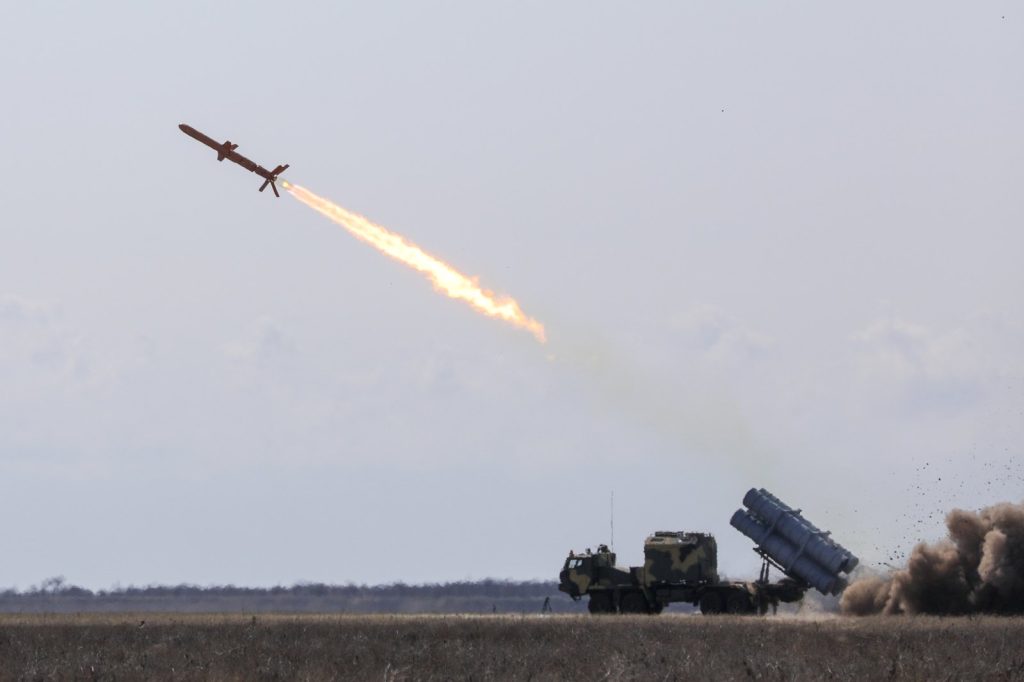
KYIV, July 9 — Against this backdrop of grinding attrition along the Black Sea coastline, a weapon system originally designed for coastal defence has evolved into an instrument of strategic reach. The R-360 Neptune, a Ukrainian anti-ship cruise missile developed by the Luch Design Bureau, first entered testing in 2016 and officially entered service in 2021. It has a range of up to 300 kilometres, carries a warhead of 150 kilograms, and flies at subsonic speed at low altitude.
The missile is based on the Soviet Kh-35 design but with improved electronics and guidance. The Neptune gained global fame in April 2022 when it sank the Russian cruiser Moskva, the flagship of the Black Sea Fleet.
The Moskva was a significant warship sunk in combat, and the Neptune became a symbol of Ukrainian ingenuity in the face of a larger navy.
The System and the Strategy
The Neptune is produced by the Ukrainian state-owned company Artem. Production rates are classified, but Ukraine has claimed to have a steady supply. The missiles are launched from ground-based mobile launchers, making them difficult to target — a crucial advantage in a conflict where Russian reconnaissance and strike drones hunt high-value assets.
The launchers can be moved, hidden, and fired from unpredictable positions, presenting a constant threat to Russian vessels operating near the coast. In the corridors of defence ministries across Europe, the Neptune is studied as a model of asymmetric warfare.
A subsonic missile flying at low altitude is not a technological marvel by global standards, but when combined with a mobile launch platform and a determined operator, it becomes a formidable weapon. The 150-kilogram warhead is sufficient to cripple or sink a major warship, as the Moskva demonstrated. What is at stake in the Black Sea is not merely the safety of individual ships, but the wider picture of maritime access and economic pressure.
Russia has used its naval dominance to blockade Ukrainian ports, threatening global grain supplies and choking Ukraine’s export economy. The Neptune, along with other systems, has forced the Russian Black Sea Fleet to operate at greater distance from the coast, reducing its ability to interdict shipping.
A Complementary Arsenal
Ukraine also uses the Storm Shadow, a Franco-British air-launched cruise missile with a range of over 250 kilometres and a 450-kilogram warhead. Storm Shadow missiles were supplied to Ukraine by the United Kingdom in May 2023 and have been used against naval targets in Sevastopol. The combination of these missiles allows Ukraine to strike ships in port and at sea.
The two systems operate in different domains. The Neptune is ground-launched and designed primarily for anti-ship missions.
The Storm Shadow is air-launched from Ukrainian aircraft, typically Soviet-era platforms adapted to carry Western munitions. The Storm Shadow’s larger warhead makes it particularly effective against hardened targets such as command centres, ammunition depots, and ships in dock. The synergy between the two missile types has been demonstrated in operations against the Russian naval base at Sevastopol, in occupied Crimea.
Storm Shadow strikes have damaged or destroyed submarines, landing ships, and headquarters buildings, while Neptunes have threatened vessels attempting to operate in open water. This layered threat complicates Russian naval planning and forces the fleet to disperse.
Design and Development
The Neptune’s lineage traces back to the Soviet Kh-35 anti-ship missile, a design from the 1980s that was widely exported. The Luch Design Bureau took that basic airframe and propulsion system and replaced the electronics, guidance, and control systems with modern Ukrainian components. The result is a missile that retains the aerodynamic simplicity of the original but gains improved accuracy, resistance to electronic countermeasures, and better target discrimination.
The guidance system uses inertial navigation with mid-course updates and an active radar seeker for terminal homing. The low-altitude flight profile, skimming the sea surface at an altitude of a few metres, makes detection difficult for shipboard radars.
The missile can be programmed with multiple waypoints, allowing it to approach from unexpected directions. Production of the Neptune is a state secret, but analysts believe that Ukraine has maintained a sufficient flow of missiles to sustain operations. The Artem plant, located in Kyiv, has been a target of Russian missile strikes, but production has continued.
Ukraine has also sought to increase the missile’s range and to develop a land-attack variant, though those programmes remain unconfirmed.
What to Watch Next
The Neptune’s role in the conflict is likely to expand as Ukraine develops new variants and as Western allies provide additional support. The missile’s success has already prompted interest from other navies, though export restrictions and the ongoing war limit foreign sales. For now, the Neptune remains a weapon of immediate necessity, defending Ukrainian waters against a larger adversary.
The wider picture is one of technological adaptation under fire. Ukraine has taken a Soviet-era design, improved it with modern electronics, and used it to achieve one of the most dramatic naval strikes of the 21st century.
Whether the Neptune can continue to threaten the Black Sea Fleet as Russian air defences and electronic warfare improve remains an open question. But for the moment, the missile has earned its place in the history of naval warfare.




