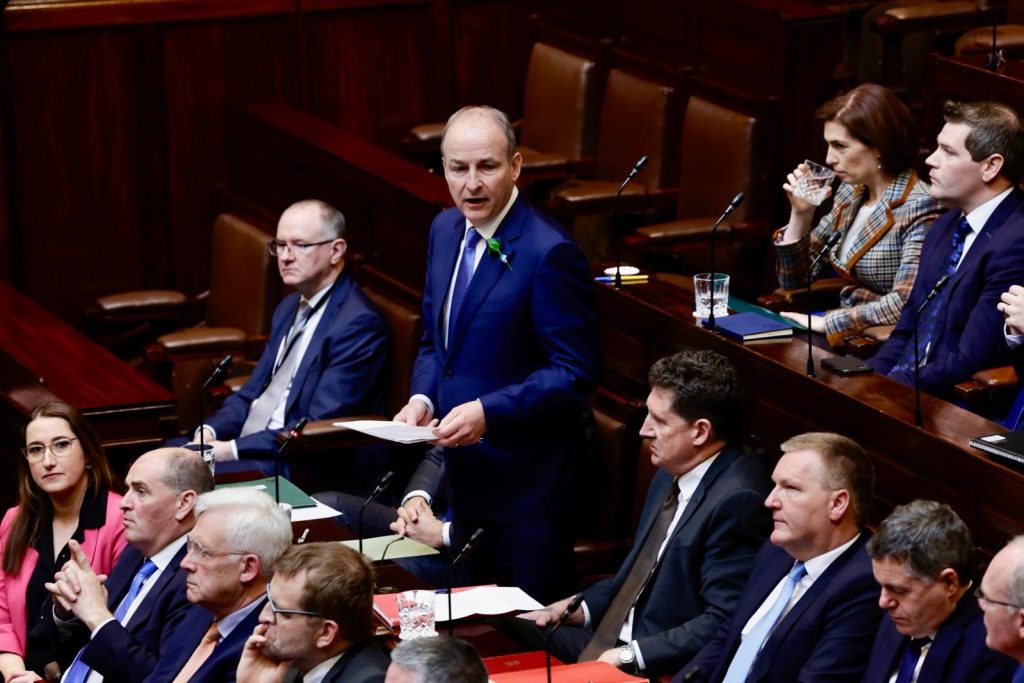
The fractious Dáil debate on Wednesday night ended 79 votes to 71 in the Government’s favour, and with it the first hurdle fell for a bill that would end Ireland’s triple lock. The measure now moves to committee stage. It has not become law, and the fight over it has barely started.
What the triple lock is
The triple lock is a legal provision that requires three things before Irish troops can be sent abroad: a decision of the Government, a majority in the Dáil, and authorisation from the United Nations. Its statutory roots lie in the Defence (Amendment) (No. 2) Act 1960 and the Defence (Amendment) Act 2006. It is often spoken of as a constitutional safeguard, but it is a statutory mechanism. Neutrality itself is a matter of government policy, and the 1937 constitution does not set it out as an aim of the state.
Ireland joined the UN in 1955 and sent its first observers, to Lebanon, in 1958. Its policy of military neutrality means staying out of alliances and defence pacts. The Seville Declarations on the Treaty of Nice acknowledge Ireland’s “traditional policy of military neutrality”.
The Government’s case
Ministers say the UN Security Council, long the body that approved missions, has authorised no new ones since 2014, so permanent members effectively hold a veto over Irish deployments. Opponents answer that the General Assembly could approve a mission instead. Diplomats call that far-fetched.
John O’Brennan, professor of European politics at Maynooth University, put the argument bluntly. Why, he asked, should Ireland need the agreement of the leader of Burundi, or of a hundred other states, rather than the people it elects? Ben Tonra of UCD says Ireland “will be as neutral after the triple lock as it was before”. Cathal Berry, a former Army Ranger and Independent TD, says the vast majority of the military and defence community want it gone. Without peacekeeping missions, he argues, soldiers lose both experience and a chance to save for a house deposit, and retention would suffer. Sources close to the Government add that Ireland’s EU partners are losing patience. “We are regarded as complete freeloaders,” said one.
Taoiseach Micheál Martin once called the triple lock “central to our neutrality”. He now says removing it leaves neutrality untouched, on the grounds that the world has changed. Opposition members were quick to remind him.
The opposition
The left was angry but not entirely aligned. Social Democrats TD Sinéad Gibney called the bill “an absolute nail in the coffin of Irish neutrality”. Labour’s Duncan Smith was more measured. The triple lock, he said, is not the full expression of neutrality, but it is an important part of it. People Before Profit’s Richard Boyd Barrett reached for history, calling the bill “a historic betrayal of this country’s tradition of neutrality” and naming Wolfe Tone, James Connolly, Patrick Pearse and Constance Markievicz.
Karen Devine, an assistant professor of politics at Dublin City University, argues that the Government wants to send troops abroad without UN cover to take sides in wars. Sinn Féin leader Mary Lou McDonald said earlier this year that she would never see her son deployed “to fight an imperialist war of aggression on any people.”
Such warnings are familiar. Defenders of neutrality have said each stage of EU integration would finish it: the 1972 accession treaty, Nice and Lisbon, the Pesco defence projects, Partnership for Peace, and US military use of Shannon Airport. Critics note that conditions on foreign military aircraft there were waived after the September 11 attacks under UN Security Council Resolution 1368. Irish governments have always said that does not amount to taking part in a conflict.
Public opinion and what comes next
Attachment to neutrality is strong, though people define it differently. An Ipsos B&A poll for The Irish Times last month found 44 per cent in favour of keeping the triple lock, 34 per cent for removing it and 22 per cent undecided.
There is unease on the Fianna Fáil benches. John McGuinness and Willie O’Dea missed the vote, with permission, the chief whip’s office confirmed, but nothing suggests a full rebellion yet. The Government should be able to pass the bill through the Oireachtas by Christmas. “We’ll delay it there as much as we can,” one Opposition TD said. Sara O’Rourke of the Irish Neutrality Alliance points to constitutional considerations, and some campaigners expect President Catherine Connolly, a fierce defender of the triple lock as a TD, to refer the bill to the Supreme Court. Others think a private legal challenge is likelier. Paul Murphy of People Before Profit-Solidarity expects the eight-vote gap to narrow as TDs return to their constituencies, and the Irish Neutrality League is planning street campaigns to demand, at the least, a referendum.
Sources
- ‘Nail in the coffin of Irish neutrality’ or global reality check? The triple lock war rages on
- Irish neutrality
- Ireland’s Triple Lock: Can Irish Troops Deploy Without UN Approval?
Photo: Houses of the Oireachtas (CC BY 2.0)