
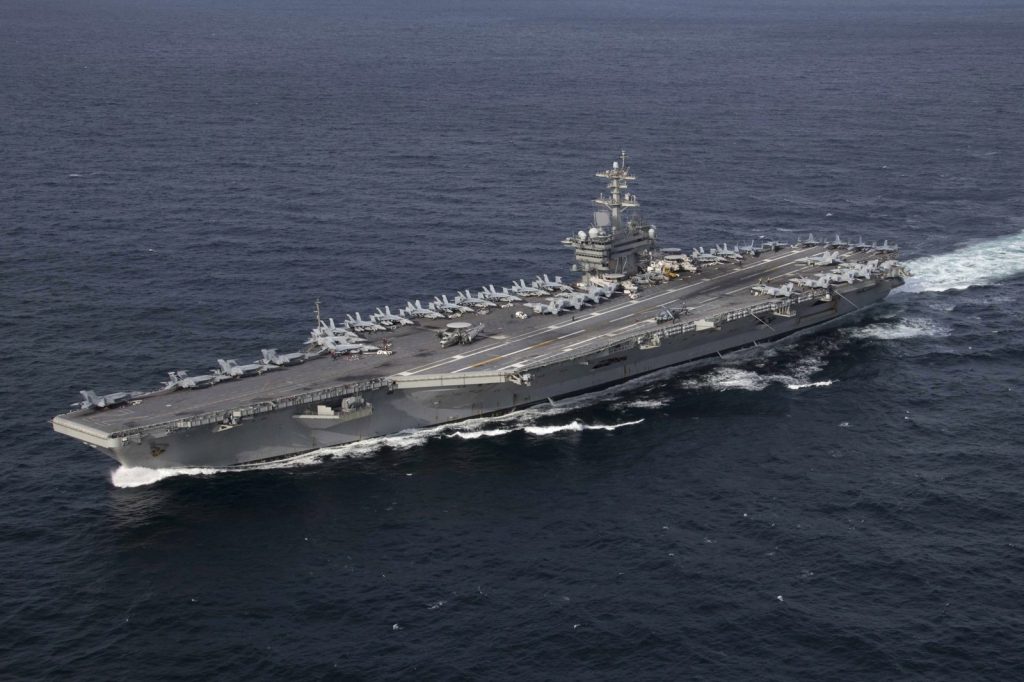
For the past 15 months, the United States Fifth Fleet has maintained a heightened operational posture that marks a strategic recalculation by Washington in one of the world’s most consequential maritime chokepoints. The fleet, based at Naval Support Activity Bahrain and operating under U.S. Central Command, serves as the Navy’s primary combat force across the Persian Gulf and Arabian Sea. Its area of responsibility encompasses the Persian Gulf, Gulf of Oman, Arabian Sea, and Red Sea — waters that function as arterial routes for global energy supplies.
The current posture traces directly to the March 30, 2025, crisis. In response, the Fifth Fleet increased patrols near the Strait of Hormuz.
Vice Admiral Brad Cooper, the fleet commander, stated on March 31, 2025, that the United States is “ready to protect freedom of navigation.” That statement amounted to a signal of intent backed by significant naval firepower, including an aircraft carrier strike group, amphibious assault ships, and destroyers.
The Strait of Hormuz Calculus
Strategically, the fleet’s mission centers on the Strait of Hormuz, the narrow passage through which roughly 20 million barrels of oil pass daily. That figure alone frames the broader stakes: any disruption to that flow would send shockwaves through energy markets and test the resilience of allied economies. The fleet’s layered deterrent posture — carrier-based air power for long-range strike, amphibious capability for potential crisis response, and destroyers for anti-surface and anti-mine warfare — signals a comprehensive capability to Tehran.
The Fifth Fleet traces its origins to World War II, when it was created in 1944 to project American naval power across the Central Pacific. It played a decisive role in major island campaigns, including the Mariana Islands, Iwo Jima, and Okinawa, demonstrating the strategic value of sustained carrier operations and amphibious assaults.
After the war, the fleet was inactivated in 1947, only to be reactivated in 1995 as a permanent presence in the Middle East. This shift reflected the growing importance of the Persian Gulf following the 1979 Iranian Revolution and the subsequent tanker wars of the 1980s, when regional tensions repeatedly disrupted shipping lanes. The fleet shares leadership with U.S. Naval Forces Central Command and reports directly to U.S. Central Command, integrating naval operations with broader military and diplomatic strategy in the Middle East.
Iranian Threats and Historical Precedent
The calculus behind the increased patrols is not hypothetical. The fleet’s presence is intended to deter Iranian threats to shipping, which have included mine-laying and small boat attacks. These tactics are not new.
In 2019, the Fifth Fleet intercepted Iranian vessels suspected of targeting oil tankers in the region. That 2019 incident established a pattern: Tehran has demonstrated a willingness to use asymmetric naval tactics — fast attack craft, naval mines, and proxy forces — to challenge freedom of navigation without triggering a full-scale conventional engagement.
The Fifth Fleet’s layered response is designed to counter exactly that kind of gray-zone aggression. The fleet does not operate alone. It works with allied navies, including the United Kingdom’s Royal Navy and France’s Marine Nationale, under the International Maritime Security Construct, or IMSC, established in 2019.
That coalition framework allows for coordinated patrols, shared intelligence, and a unified deterrent posture — a strategic multiplier in waters where the United States cannot afford to operate unilaterally.
What This Signals for Regional Stability
For analysts watching the geopolitical chessboard, the Fifth Fleet’s posture since March 2025 represents something beyond routine presence. It is a deliberate demonstration that the United States remains committed to securing the maritime lines of communication that underpin global energy security, even as Washington’s strategic focus shifts toward the Indo-Pacific.
The broader stakes are clear: the Strait of Hormuz is the single most important oil transit chokepoint in the world. A sustained disruption would not merely raise prices — it would fundamentally alter the strategic calculus of every major economy reliant on Gulf crude. Vice Admiral Cooper’s March 31 statement was a public commitment.
The fleet’s actions since then — the increased patrols, the carrier strike group rotations, the allied integration under IMSC — have been the operational follow-through. What to watch next is whether Tehran tests the boundaries of that commitment.
The Fifth Fleet has positioned itself to respond. The question is whether the deterrent holds.




