The approval arrived quietly from Washington on a late November afternoon, a $621.9 million commitment to keep Ukraine’s F-16 fleet flying, funded entirely by four European capitals and not a dollar from the American treasury.
The Role of the F-16 in Ukrainian Air Defense
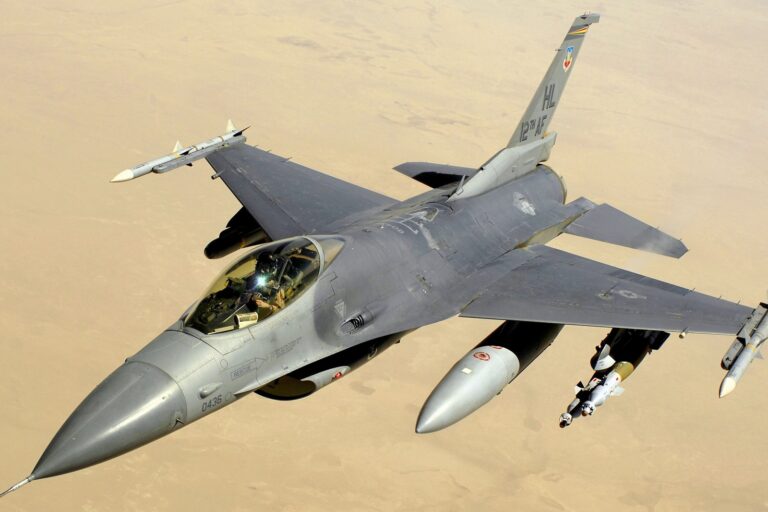
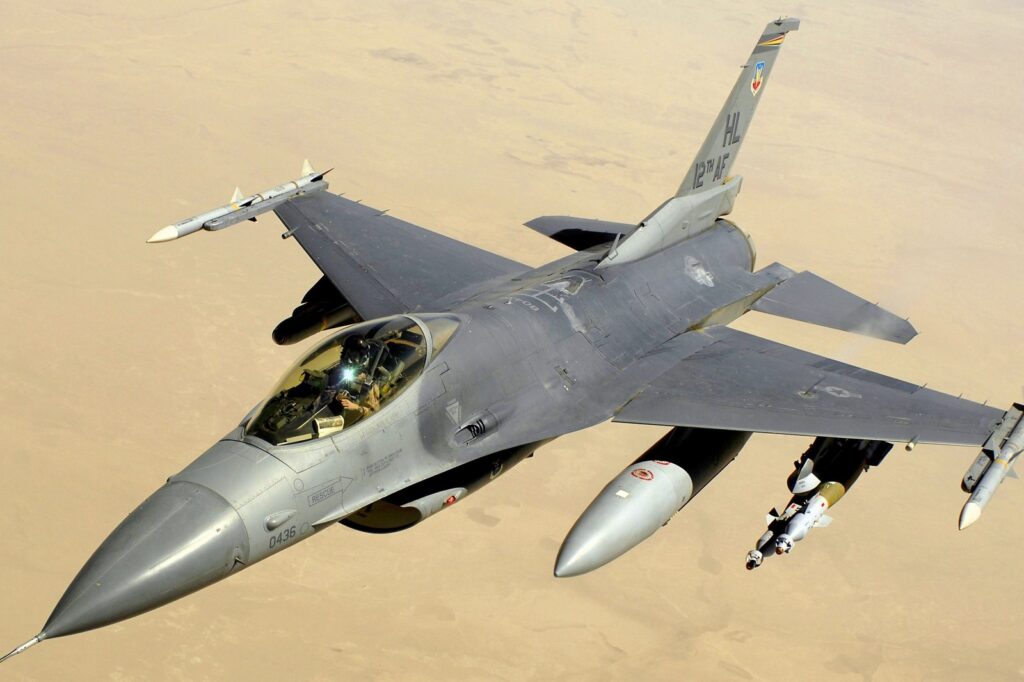
Against this backdrop of a war entering its third winter, the Fighting Falcon has become the backbone of Kyiv’s air defense architecture. Since the first jets touched down in 2024, Ukrainian pilots have used them to intercept Russian missiles and drones, turning a Cold War design into a modern shield for cities and infrastructure. The aircraft, originally developed by General Dynamics in the 1970s and now produced by Lockheed Martin, was conceived as a daylight air-superiority fighter; over four decades it evolved into an all-weather multirole platform, its frameless bubble canopy and fly-by-wire flight control system giving pilots the agility that has proved decisive in contested skies.
More than 4,600 airframes have rolled off production lines since 1976, equipping the air forces of 25 nations. In Ukrainian service, the F-16 fills a gap that Soviet-era MiGs and Sukhois could not: a platform compatible with NATO weapons, data links, and training pipelines, allowing Kyiv to plug directly into the alliance’s logistics and intelligence streams.
Logistics of the $621.9 Million Maintenance Package
The State Department’s notification, issued November 25, describes a Foreign Military Sale built around sustainment rather than new airframes. The package covers cartridge-actuated and propellant-actuated devices, the critical components that drive ejection seats and canopy jettison systems, alongside laboratory equipment and transportation support. In the corridors of the Pentagon, officials stressed that Ukraine would integrate the gear without difficulty and that no additional U.S. government or contractor personnel would need to deploy to Ukrainian soil.
Contractors will be chosen through a competitive procurement process, a detail that underscores the administrative machinery humming behind the headline figure. The sale supplements an earlier assistance agreement that fell below the congressional notification threshold, allowing the administration to move without the standard 30-day review for transfers valued at $50 million or more.
A Collaborative Funding Model
What is at stake here extends beyond spare parts. The financing model — Belgium, Denmark, the Netherlands, and Norway pooling resources through the Joint Ukraine Multinational Program — Services, Training and Articles Rapid Timeline, or JUMPSTART — marks a shift in how European partners underwrite Kyiv’s long-term capacity. These four nations are also the ones that pledged the F-16 airframes themselves. By funding the sustainment tail, they acknowledge that a fighter jet without a maintenance chain is a static display, not a weapon.
The wider picture reveals a European defense industrial base learning to coordinate at speed. No U.S. funds are involved, a point the State Department emphasized twice in its announcement, framing the move as advancing American foreign policy objectives without affecting domestic readiness.
Technical Challenges of Aging Fourth-Generation Fighters
The F-16s arriving in Ukraine are not new builds. They are veterans, many pushing forty years of service, their airframes stretched by thousands of flight hours. The maintenance burden grows exponentially with age. Colorado Air National Guard maintainers, flying Block 30 jets of similar vintage, report averaging 15 to 20 maintenance man-hours for every hour of flight — triple the ratio when the aircraft were young. What once took an hour now takes three. Fatigue cracks, obsolete avionics, and the sheer wear of high-G maneuvering over decades turn each sortie into a negotiation with metal fatigue.
For Ukraine, operating in a high-tempo combat environment against a peer adversary’s air defenses, that calculus is unforgiving. The package approved this week targets the sinews of that negotiation: safety systems, emergency gear, the laboratory capacity to diagnose faults before they ground an aircraft.
Strategic Impact on Regional Security
The State Department’s determination is direct: the sale strengthens Ukraine’s ability to respond to current and future security threats, supports air defense and regional security missions, and will have no adverse impact on U.S. defense readiness. In the corridors of Brussels and The Hague, the same logic reads as an investment in the continent’s own eastern flank. A sustainable Ukrainian F-16 fleet complicates Russian strike planning, forces dispersion of air defense assets, and preserves the option of offensive counter-air operations should the strategic calculus shift.
The next step is the competitive contract award, after which components begin moving through the logistics chain the four European nations have built.
Sources
- US approves $621.9 million F-16 equipment and maintenance support package for Ukraine
- General Dynamics F-16 Fighting Falcon
- U.S. F-16 Fighting Falcons takeoff in CENTCOM AOR
- Fresh off deployment, Colorado Air Guard leaders talk about aging fleet – Reserve & National Guard
- US OKs $621.9 Million in F-16 Maintenance Gear for Ukraine
Photo: Master Sgt. Andy Dunaway (Public domain)