
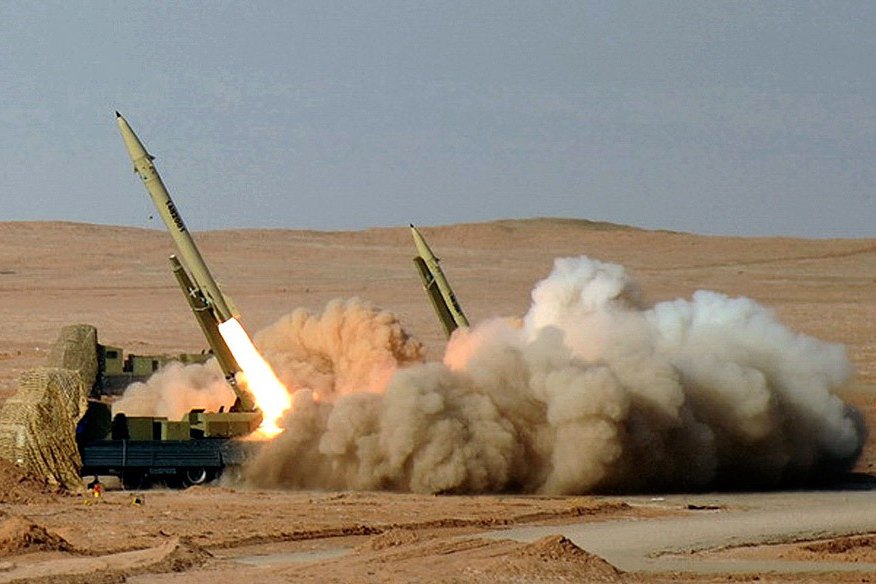
TEHRAN, July 30 — Iran’s Islamic Revolutionary Guard Corps, already the driving force behind the country’s missile program, now stands at the center of a new confrontation with the United States after a surprise attack that Washington says triggered American retaliation.
The IRGC Aerospace Force, which commands Iran’s ballistic and cruise missile forces as well as its growing drone fleet, appears to have orchestrated the latest strike — a combination of short-range ballistic missiles and one-way attack drones, launched either from Iranian soil or from proxy forces in Iraq and Syria.
The attack, whose full details remain under assessment by intelligence analysts, comes as no surprise to those who have tracked the IRGC’s decades-long push to build what is now one of the largest and most diverse missile arsenals in the Middle East. Despite years of sanctions and export restrictions, Iran has developed these systems indigenously. The Shahab-3, a liquid-fueled workhorse with a range of up to 1,500 kilometers, can reach Israel.
The Emad is a precision-guided variant of that same platform. The Khorramshahr, with a reported range of 2,000 kilometers, is believed capable of carrying multiple warheads.
And the Qiam-1 — a solid-fueled missile used in the January 2020 attack on Iraq’s Al Asad airbase — has proven its battlefield utility before.
The commander and the corps
General Amir Ali Hajizadeh leads the IRGC Aerospace Force, the branch responsible for these operations. His command oversees not only ballistic missiles but also a growing cruise missile program — including the Hoveyzeh and Soumar, both with a range of 1,350 kilometers — and a fleet of loitering munitions, most notably the Shahed-136, a one-way attack drone that has seen extensive use in Russia’s war against Ukraine. The combination of missiles and drones gives the IRGC multiple ways to strike targets across the region.
That regional capability now includes anti-ship missiles such as the Noor and Qader, which Iran has deployed along the Persian Gulf and near the Strait of Hormuz, a critical chokepoint for global oil shipments. The latest attack, while still being assessed for exact yield, accuracy, and number of projectiles fired, fits a pattern of escalating IRGC operations that have drawn a firm U.S. response.
What Washington knows
U.S. intelligence agencies have been watching this build-up for years. In a 2023 assessment, the American intelligence community concluded that Iran already possesses the technical capacity to produce intercontinental-range ballistic missiles should its leadership choose to pursue them. That assessment underscores how far the IRGC’s aerospace arm has come — from a program once reliant on foreign assistance to one that now fields a diverse array of systems largely built at home.
For the moment, the exact composition of the missile salvo that prompted U.S. retaliation remains under review. But the attack itself shows that the IRGC retains both the will and the means to strike at American forces and allies in the region.
Whether the next phase of this conflict brings further missile exchanges — or pushes Iran closer to that ICBM threshold — is the question analysts will be watching in the days ahead.




