
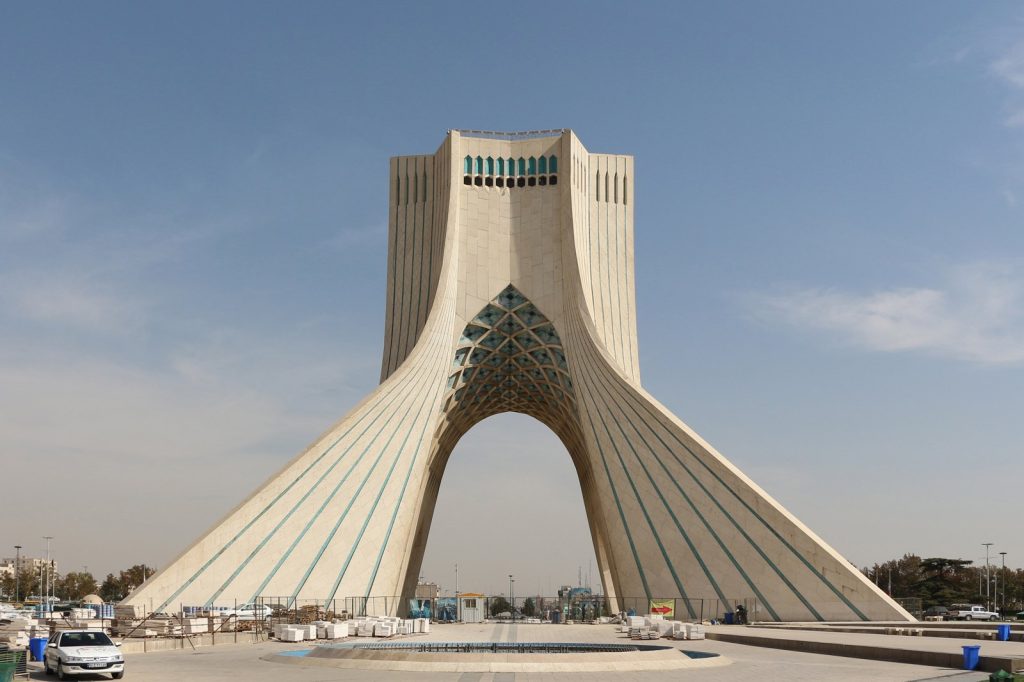
President Donald Trump’s second-term foreign policy toward Iran has been shaped decisively by the collapse of a ceasefire he formally declared “over” on February 4, 2025, a move that signals the administration’s return to the maximum-pressure strategy that marked his first term in office. In a White House press conference that day, Trump cited Iran’s nuclear violations as the reason for terminating the arrangement, drawing a clear line between his current approach and the diplomatic efforts he had criticized as weak during his 2024 campaign.
The broader stakes now revolve around Iran’s nuclear program, regional stability, and global energy markets, with the administration betting that economic pressure and military deterrence will force Tehran to alter its course.
Resumption of Maximum Pressure
The core of Trump’s strategy echoes his first-term playbook. On May 8, 2018, Trump withdrew the United States from the Joint Comprehensive Plan of Action, the multilateral nuclear deal reached in 2015.
He then reimposed sweeping sanctions that ultimately cut Iranian oil exports by more than 80 percent, delivering a severe blow to the country’s economy. The military dimension of that approach was underscored on January 3, 2020, when Trump authorized the killing of Qasem Soleimani, the head of Iran’s Islamic Revolutionary Guard Corps Quds Force. Those two actions—economic strangulation and a targeted strike against a top commander—set the template for a foreign policy that emphasized leverage over engagement.
Now back in office for a second term that began January 20, 2025, Trump has quickly resurrected that template. His campaign platform in 2024 included pledges to restore U.S. energy dominance and to end the ceasefire with Iran, which he had characterized as a sign of weakness.
The February 4 declaration put those promises into action. With the ceasefire dead and sanctions already biting, the administration is asking whether Tehran will seek negotiation or further confrontation. Trump’s record—from walking away from the JCPOA to ordering the Soleimani strike—suggests he is willing to escalate if he concludes that leverage requires it.
Key Figures and Strategic Calculus
Secretary of State Marco Rubio has become the administration’s public face for diplomatic messaging regarding Iran, articulating the case for the renewed pressure campaign. Energy Secretary Chris Wright holds a portfolio that ties directly into Trump’s promise to restore U.S. energy dominance, a pledge that carries extra weight given the sanctions regime that has already dramatically reduced Iranian oil exports. The administration’s approach emphasizes bilateral deals and military deterrence, reflecting a transactional worldview shaped in part by Trump’s own business background.
Trump owns the Trump Organization, a real estate conglomerate, and had a net worth estimated at $2.5 billion by Forbes in 2024. Trump’s political foundation remains solid among the electorate that returned him to office.
He drew support from 74 million voters in the 2024 election, a coalition that has consistently backed his confrontational posture toward Tehran. Despite being impeached twice—first in 2019 and again in 2021—and acquitted by the Senate both times, those proceedings did not erode his standing with Republican voters, who delivered him a second term. The White House now sees Iran through the lens of leverage, not diplomacy, betting that economic pressure and the demonstrated willingness to use military force will produce results.
Historical Context and Stakes
Iran, officially the Islamic Republic of Iran, is a country in West Asia that borders the Persian Gulf and the Caspian Sea. It is home to one of the world’s oldest continuous major civilizations, first unified under the Medes in the 7th century BC and later the heart of the Achaemenid Empire.
The region underwent Islamization after the 7th century Muslim conquest, experienced a golden age of literature, philosophy, and science, and in the 16th century the native Safavid dynasty reestablished a unified Iranian state, making Twelver Shia Islam the official religion. Iran was a leading world power during the Afsharid Empire in the 18th century but lost that status under the Qajars. The early 20th century brought the Persian Constitutional Revolution and later the establishment of the Pahlavi dynasty.
A 1953 coup, backed by British and American intelligence, overthrew Prime Minister Mohammad Mosaddegh after he nationalized the oil industry. The Iranian Revolution of 1979 overthrew the monarchy and established the Islamic Republic under Ruhollah Khomeini.
Iran remains a key actor in the Middle East because of its size, its location along strategic oil shipping lanes, and its influence across several countries. Successive U.S. administrations have grappled with Iran’s nuclear program and its support for armed groups. Trump’s first-term actions—withdrawal from the nuclear deal, reimposition of sanctions, and the Soleimani strike—set the stage for his second-term confrontational posture.
That approach carries broad implications for regional stability, global energy markets, and the future of nuclear nonproliferation. Iran’s nuclear advances and its ability to disrupt oil shipments through the Persian Gulf mean that shifts in U.S. policy have immediate consequences for international security and economic supply chains.
Understanding Iran’s long history as a civilization and its modern role as a revolutionary state helps explain the stakes involved in the current standoff.




