
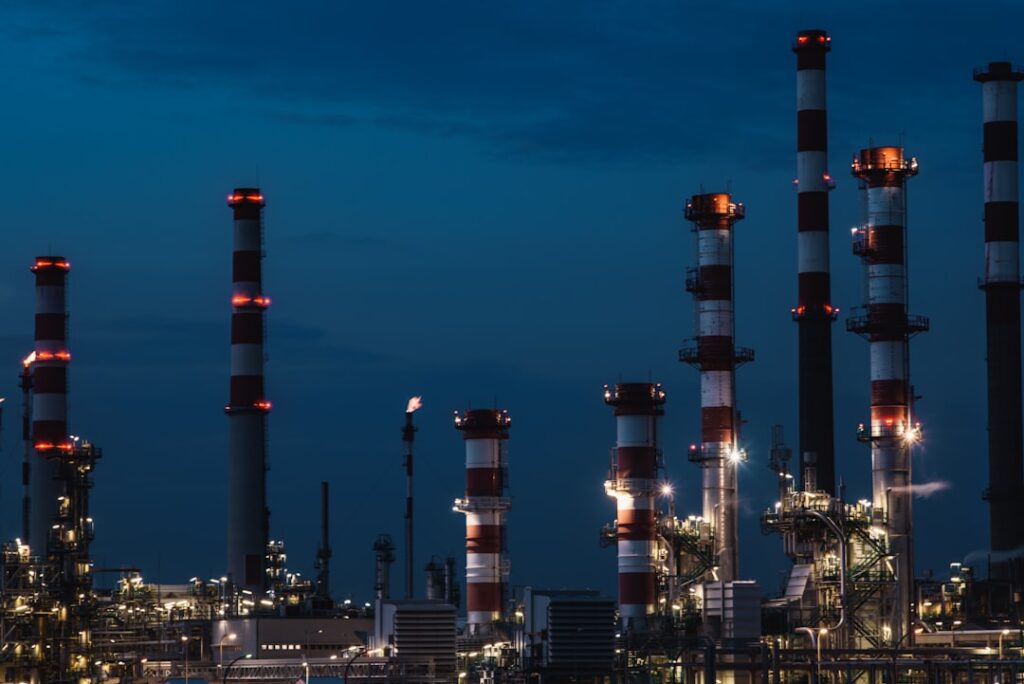
What happens when a refinery burns 200 kilometers from Moscow is not just a fire. It is a signal. For two straight days now, Ukrainian drones have reached deep into Russian territory, hitting the Rosneft plant in Ryazan Oblast and forcing air defense crews to scramble near the Kirishi oil refinery outside St. Petersburg.
The Kirishi facility sits roughly 700 kilometers north of the Ukrainian border. That is not a rounding error.
That is range. The immediate consequence is a fire at the Ryazan refinery. Governor Pavel Malkov confirmed emergency crews are working to contain it.
He did not say how bad the damage is. He did not say how long the plant will be offline.
Refineries do not just bounce back from a direct hit. They shut down. They undergo repairs.
They lose production capacity for weeks or months. Every barrel not refined is a barrel the Russian war machine does not burn in its tanks or sell on the global market. Ukraine has said repeatedly that it views these oil and gas facilities as legitimate military targets.
The logic is blunt: they fund the war. Hit the money, slow the army.
But the consequences ripple beyond fuel supplies. Russian President Vladimir Putin went on television and accused Ukraine of trying to disrupt the country’s presidential election, scheduled for March 15-17. He offered no evidence.
The claim fits a familiar Kremlin script: blame external enemies for internal problems. The election is not competitive.
All major opposition candidates are jailed, exiled, or barred. Putin is expected to win another six-year term. The drone strikes do not change that math.
But they do change the atmosphere. A fire burning at a major refinery, air defense scrambling near St. Petersburg — these are not images of a secure state. They are images of vulnerability.
And vulnerability, in an authoritarian system, is a dangerous thing to project. The attacks also reset expectations about what Ukraine can do.
The Kirishi plant is in Leningrad Oblast. That is the northwest. That is far from the front lines.
A drone was shot down near the facility, Russian officials said. One was shot down.
That means at least one got close enough to be a threat. The Ryazan refinery is southeast of Moscow. Two days of strikes, two different regions, two different types of targets.
This is not a one-off. It is a pattern. Kyiv is building a long-range campaign.
The question is how far it can go, and how often. There is a political consequence here too.
Putin framed the strikes as election interference. That narrative works domestically. It rallies support.
It justifies crackdowns. But it also admits something: the war is not contained to the front lines.
It is inside Russia. Civilians see the fires. They hear the air defense sirens.
The Kremlin can control state television, but it cannot control what people smell on the wind or see on the horizon. The strikes are a demonstration of reach. They tell the Russian public that no place is truly safe.
That is a different kind of weapon. What comes next is anyone’s guess.
Ukraine has not publicly claimed responsibility for these specific strikes. It does not need to. The pattern speaks for itself.
The attacks will likely continue, targeting energy infrastructure as long as Kyiv has drones and launchers. Russia will respond, probably with more long-range missile strikes on Ukrainian power grids.
That is the cycle. Escalation begets escalation. The fires in Ryazan and the scramble near St. Petersburg are not isolated events.
They are the latest turn in a war that keeps expanding its geography.




