Russian forces lost ground for a second consecutive month in October while absorbing casualties at a rate Ukraine’s General Staff puts at 54,400 killed or seriously wounded, the highest monthly figure since the full-scale invasion began. That combination, men and territory both draining away as winter sets in, is what a hard winter war means for Russia: a military that has lost the initiative across most of the front, and a Kremlin that must decide whether to pay for its war with another mobilization or watch its numbers erode.
The Map Behind the Rhetoric
The Institute for the Study of War, whose frontline mapping is watched closely in allied capitals, assessed that Russian forces consolidated or captured 53 square miles in October. Their only gains came in the Sumy and Zaporizhia regions; every other sector of the front registered losses, including the Donetsk region that Moscow has made its priority. The ISW’s map shows Ukrainian units clearing Russian forces from 11 settlements covering 1.25 square miles, against Russian capture of 10 settlements totalling 2.26 square miles.
Those figures are small in absolute terms, and that is the point. The ISW concluded that Russian forces “have lost the initiative and their offensive capabilities in much of the theater.” Near Dobropillya in Donetsk, Russian troops have committed resources and made marginal advances, but the think tank judged that taking the town would not open the sweeping manoeuvre needed to encircle the heavily defended Fortress Belt, the ring of cities whose capture is the precondition for seizing the Donbas. Ukraine’s completed Operation Vivaldi in the Lyman direction broke up Russian attempts to envelop that belt. Ukrainian forces have seized the initiative in the Kupiansk, Lyman and Oleksandrivka directions and are contesting it in western Zaporizhia.
A Casualty Bill That Outruns Recruitment
The October casualty figure was the fourth month in a row above 40,000, according to Ukraine’s General Staff. Major Robert Brovdi, commander of Ukraine’s Unmanned Systems Forces, said on Telegram that Russia’s heaviest losses came in the Dobropillya, Oleksandrivka and Hulyaipole directions. The ISW’s assessment of record losses, running at almost 2,000 a day by Ukraine’s count, sits alongside months of speculation that the Kremlin would declare a mobilization because losses now exceed the rate at which new soldiers can be recruited.
That arithmetic is the core of the winter problem. A force that loses more men than it enlists must either narrow its front, accept slower gains, or find new bodies. The third option carries political cost at home, which helps explain why Moscow has looked abroad. Amnesty International’s briefing published on 10 September, “Russia: Trafficking of Foreign Nationals to Fight in Ukraine,” documented recruitment of people from African countries through deception, coercion and the exploitation of economic hardship, in many cases amounting to trafficking. Ahead of the Russia-Africa Summit in Moscow on 28 and 29 October, the organization’s African section directors urged attending leaders to demand an immediate end to the practice and to insist on investigations and prosecutions where state officials or others acting with Russian authorities’ acquiescence are involved.
Strikes Timed to the World’s Distraction
On the ground, the response to stalemate has been to hit civilians harder. On the eve of the US midterm elections, Ukrainian President Volodymyr Zelenskyy said Kyiv had intelligence that Russia was preparing a new massive attack “primarily targeting energy and logistics,” on the assumption that “tomorrow the world will be watching the American midterms” and Ukraine’s difficulties with air defence and Patriot missiles would be overlooked. Hours earlier, Russian forces struck a school being used to distribute humanitarian aid in Komyshuvakha in the Zaporizhzhia region, killing at least 26 people including police officers and first responders, injuring five and leaving others missing, according to Ukrainska Pravda.
The same weekend, the digital layer of the war briefly slipped its moorings. Ukraine’s Air Alert app, built by Ajax Systems and Stfalcon with support from the Ministry of Digital Transformation, began pushing false warnings of radiation, chemical attack, nuclear strike and street fighting in Kyiv at 10:47 p.m. local time on Sunday. The Ukrainian Air Force confirmed ten minutes later that the notifications were false and that the app had suffered hostile interference. A few hours on, Russia’s Emergencies Ministry app was hacked and false alerts reached users in 33 regions, warning of nuclear warheads and telling residents to stock food for three weeks; the ministry said attackers had exploited a vulnerability in its administrative panel. Yurii Ihnat, a Ukrainian Air Force spokesman, said the hack had no impact on security operations and that Air Alert is not connected to military command systems.
The European Flank
Against this backdrop, Moscow’s pressure has moved outward. The Atlantic Council’s UkraineAlert notes that US intelligence officials reported in August that a Russian incursion into NATO territory could potentially take place within a matter of months, and that several European countries have reached similar conclusions about a localized offensive. Skeptics doubt an overstretched Russian military would risk war with NATO, but few question that the threat is growing. The attempted bombing of Leipzig airport in August was widely read as a watershed, and a series of sabotage operations on sensitive communications hubs across Europe has since been linked to Russia, feeding concern that the Kremlin may be preparing bolder attacks on civilian infrastructure.
The logic, as the Atlantic Council frames it, is that Putin hopes to break the deadlock by bombing Ukraine’s population into submission while intimidating Europe into withholding support for Kyiv. For European readers the practical question is resilience: the same winter that tests Ukraine’s grid tests the willingness of governments in the corridors of Brussels and Berlin to keep supplying air defence when the headlines move on.
What Washington Holds
Kyiv’s answer is leverage. Zelenskyy told Fox News on Sunday that Ukraine would suspend strikes on Russian oil refineries for a month if Washington supplied Patriot interceptor missiles over the same period, and he argued that Russia’s oil revenues are the pressure point: “We must not play games with Russia’s oil or gas revenues.” The State Department approved the potential sale of 500 Patriot PAC-3 interceptors to Ukraine for an estimated $2.1 billion. President Donald Trump has pursued a negotiated end to the war through special envoy Steve Witkoff and Jared Kushner.
For Russia, then, a hard winter war means fighting on three ledgers at once: a front where it is ceding ground in most sectors, a manpower pool that Ukrainian estimates say is shrinking faster than it fills, and an economy whose oil earnings Western capitals are debating how hard to squeeze. The next test arrives with the US midterms on 3 November, the date Zelenskyy named for the attack he says Moscow has planned.
Sources
- Russia
- Russia: African leaders must use summit to call for an end to trafficking of Africans into Russian military
- European infrastructure is vulnerable as Putin escalates Russia’s hybrid war
- Russia plotting 'massive strike' during midterms, Zelenskyy warns, urges US to stop Putin
- Ukraine and Russia's emergency alert apps both hacked, residents warned of fake nuclear, chemical strikes
- Map shows Russia losing ground amid heaviest casualties since start of war
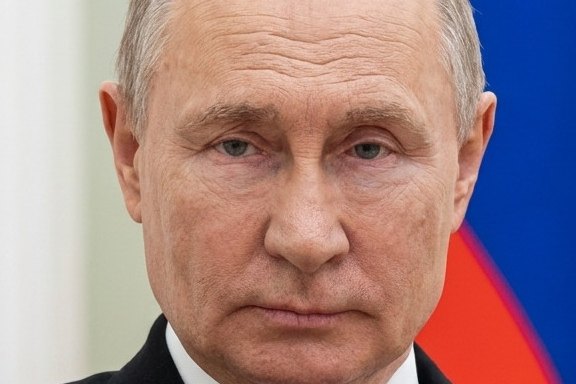
Photo: Kremlin.ru (CC BY 4.0)