
The story begins with a headcount. In August 2021, Defense Minister Sergey Shoigu told a youth forum outside Moscow that the Russian army had 168 battalion tactical groups, and he called it “a very high figure.” These were the forces, he said, that could deploy within an hour of an alert signal.
What exactly was he counting? Not regiments. Popular Mechanics reported that the reorganization began in 2012, when the ground forces dropped the division and the regiment altogether. Brigades replaced them, each able to organize as many as two battalion tactical groups, or BTGs.
What the old system looked like
The Soviet army ran on a triangle. Each division held three regiments, and each regiment three battalions. A tank or motorized infantry regiment counted about 2,000 troops. That design made training and supply simple, but it was stiff. A tank regiment that blundered into a forest or a town could be mauled even by lightly armed infantry, and a unit that wanted more anti-tank strength had to borrow it from somewhere else.
Mark Cancian of the CSIS think tank gave two reasons for the change. The army had shrunk, so it needed fewer big headquarters and did not have the seasoned officers to run them. And conscripts, roughly a third of the troops, cannot legally serve beyond Russia’s borders, so a BTG crewed by a brigade’s volunteers gave commanders something deployable abroad.
A BTG in the field
The Royal United Services Institute traces the idea further back. Russia’s lowest levels able to fight with mixed arms were once the regiment or brigade, but 1980s experiments produced a lasting, though not permanent, mixed formation at battalion level. The Soviets had learned that units trained to fight together performed better than ones stitched together shortly before a battle.
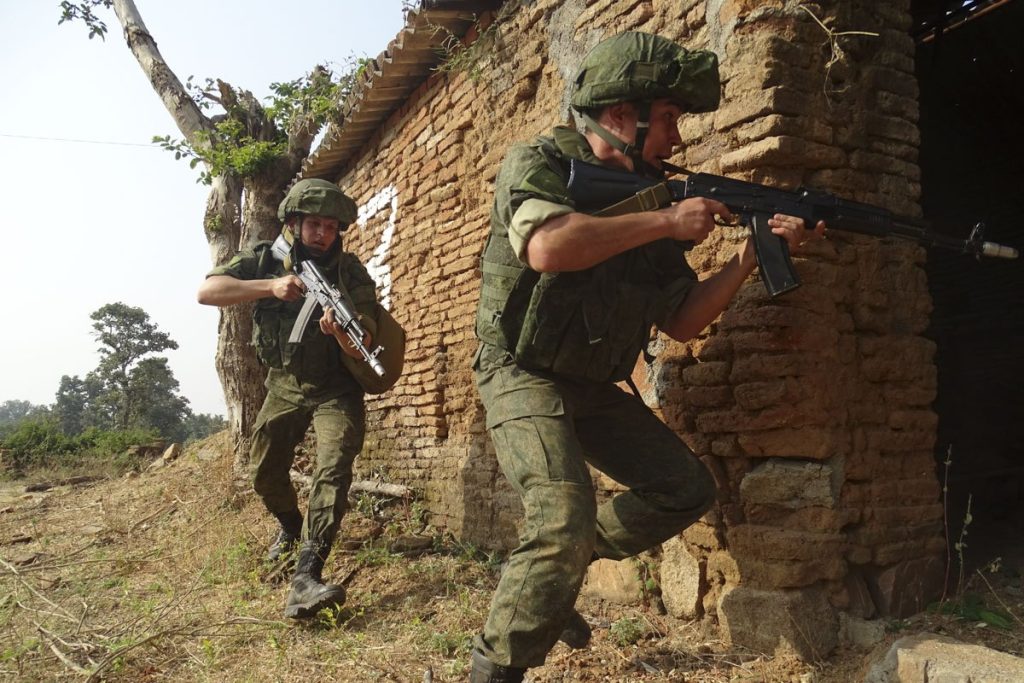
TASS described a BTG as a temporary formation built on a battalion, with artillery, air defense, engineers and supply units attached, operating inside motor rifle and tank brigades. Popular Mechanics gave a typical makeup: three motorized infantry companies riding thirty BMP-2 or BMP-3 vehicles, plus one or two tank companies with ten tanks apiece, plus mortars, howitzers, rocket launchers and Pantsir-S1 air defense trucks. Add ambulances, wreckers and supply trucks, and the group can push 155 miles on its own.
One thing the old reorganization story leaves out: the shift was never total. RUSI noted that in the 2022 invasion the brigade or regiment may be the main unit of maneuver, with BTGs spun off for particular jobs such as advance guards, raiding detachments or urban assault. Large-scale combat, it argued, needs large-scale combined-arms operations. The BTG suited the earlier fighting in Donetsk and Luhansk.
The numbers moved fast once the invasion neared. Popular Mechanics counted 83 BTGs massed near Ukraine in January, and more were arriving from across the country.
Sources
- chevron-right
- Russian Army operates around 170 battalion tactical groups — defense chief – Military & Defense – TASS
- https://www.popularmechanics.com/military/weapons/a39193732/russian-battalion-tactical-groups-explained/




