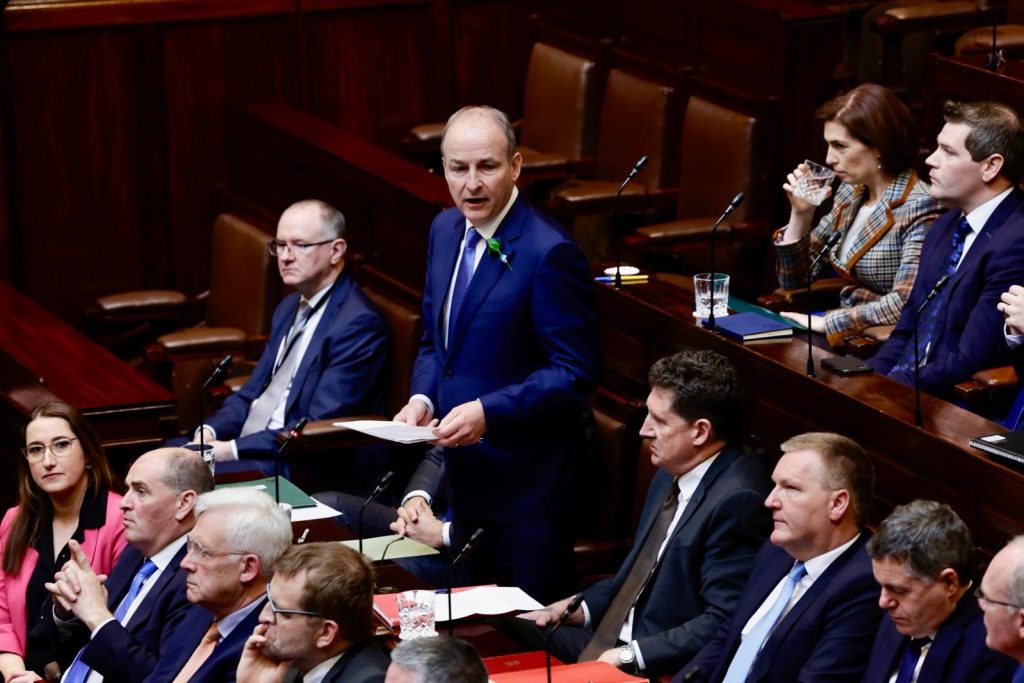
DUBLIN, October 24, 2026 — The Dáil has passed legislation removing the UN approval requirement for military deployments, a move critics call a betrayal of Irish neutrality. This development has sparked a neutrality crisis, with opponents arguing that the removal of the triple lock will undermine Ireland’s long-standing policy of military neutrality.
Understanding The Triple Lock
The triple lock is a statutory provision that requires three hurdles to be cleared before Irish troops can be deployed abroad: a decision of the Government, a majority in the Dáil, and the authorization of the United Nations. According to the Defence (Amendment) Acts, the triple lock is a statutory authorization system governing the deployment of Defence Forces personnel to specified international military operations. The system combines three elements: a qualifying UN resolution, Government approval, and authorization by Dáil Éireann where required. Ireland joined the United Nations in 1955 and began contributing military personnel to UN operations in 1958, when Irish observers were deployed to Lebanon.
Historical Context And Neutrality
Ireland has a longstanding policy of military neutrality, which has meant not joining military alliances or defence pacts, or taking part in international conflicts. The Irish Free State declared itself a neutral country in 1922, and Ireland remained neutral during the Second World War. Ireland is one of four European Union countries that are not members of NATO; the others are Austria, Cyprus, and Malta. The compatibility of neutrality with Ireland’s EU membership has been a point of debate in EU treaty referendum campaigns since the 1990s. The Seville Declarations on the Treaty of Nice acknowledge Ireland’s “traditional policy of military neutrality”. The Irish Defence Forces have been involved in many UN peacekeeping missions.
Government Rationale And Opposition Views
The Government argues that the UN Security Council has not authorized new missions since 2014 due to stalemate, and therefore, the requirement for UN approval should be removed. However, opponents argue that UN authorization is a safeguard against involvement in controversial military missions. Social Democrats TD Sinéad Gibney described the bill as an ‘absolute nail in the coffin of Irish neutrality’. Labour’s Duncan Smith took a more nuanced view, stating that the triple lock is part of Irish neutrality but not the full manifestation of it. Taoiseach Micheál Martin previously stated that the triple lock was “central to our neutrality”, but now argues that its removal will not affect neutrality.
Geopolitical And Economic Consequences
Against this backdrop, the geopolitical and economic consequences for Ireland if it abandons its long-standing policy of military neutrality are significant. What is at stake is Ireland’s ability to maintain its independence and neutrality in international affairs. The wider picture suggests that Ireland’s decision to remove the triple lock may have implications for its relationships with other European countries and its participation in international organizations. In the corridors of the UN, Ireland’s decision may be seen as a shift towards a more proactive role in international peacekeeping and conflict resolution. However, the numbers suggest that Ireland’s defence force is relatively small, with approximately 10,500 personnel, and its ability to contribute to international missions may be limited. Ultimately, the consequences of Ireland’s decision will depend on how it navigates the complex web of international relationships and alliances, and how it balances its commitment to neutrality with its desire to play a more active role in global affairs.
Legislative History And Internal Dissent
The legislative foundation for the triple lock rests on the Defence (Amendment) (No. 2) Act 1960 and the Defence (Amendment) Act 2006. While the mechanism is frequently described as a constitutional safeguard, it is primarily a statutory authorization system. The recent Dáil vote to abolish this requirement passed 79-71 on Wednesday, following a fractious debate. During these proceedings, People Before Profit TD Richard Boyd Barrett characterized the bill as a “historic betrayal of this country’s tradition of neutrality,” invoking historical figures such as Wolfe Tone, James Connolly, Patrick Pearse, and Constance Markievicz.
The debate also revealed internal pressures within the governing coalition. While the Government maintains that the UN Security Council’s stalemate since 2014 necessitates the change, the move has caused unease on the Fianna Fáil benches. Notably, TDs John McGuinness and Willie O’Dea were absent for the vote. The chief whip’s office confirmed these absences were granted with permission, though observers note the lack of a full-scale rebellion at this stage. Critics of the bill argue that the Government is seeking to bypass the UN to join Western military interests, while others suggest that alternative avenues for UN approval, such as the General Assembly, remain available, though diplomats have described relying on such paths as far-fetched.
Constitutional Status And Legal Boundaries
Irish neutrality is generally a matter of government policy rather than a requirement of statute law, as the 1937 constitution does not define neutrality as an aim of the state. Consequently, the triple lock is principally a statutory authorization system rather than a constitutional safeguard. Its abolition would change the conditions under which Ireland participates in certain international forces, but it would not automatically alter the country’s constitutional position or establish a new military alliance. Such deployments would remain subject to Irish constitutional law, statutory authorization, and international rules governing the use of force.
Defenders of neutrality have historically warned that the policy was being eroded by various factors, including the original EU accession treaty in 1972, the Nice and Lisbon treaties, and NATO’s partnership for peace. Critics also point to the use of Shannon Airport by the US military, noting that conditions for foreign military aircraft were waived after the September 11 attacks under UN Security Council Resolution 1368. Despite these pressures, Irish governments have maintained that allowing aircraft to use Irish soil is compatible with a neutral stance.
Sources
- ‘Nail in the coffin of Irish neutrality’ or global reality check? The triple lock war rages on
- Irish neutrality
- Ireland’s Triple Lock: Can Irish Troops Deploy Without UN Approval?
Photo: Houses of the Oireachtas (CC BY 2.0)