Over the past 20 years, a class of cancer drugs called CD40 agonist antibodies has offered great promise and delivered great disappointment. In animals they switched the immune system on and cleared cancer cells. In people, they did little, and they set off dangerous inflammation, low platelet counts and liver toxicity, even at low doses. Early findings suggest a redesigned version may have changed that picture. Rockefeller University researchers have now reported phase 1 results in the journal Cancer Cell: of 12 patients with metastatic cancer, six saw their tumors shrink, and two had them disappear completely.
Redesign, then a different route
In 2018, the lab of Jeffrey V. Ravetch at Rockefeller showed in genetically engineered mice, built to mimic relevant human immune pathways, that the antibody could be reworked to work better and to be given in a way that limited serious side effects. The result was a drug called 2141-V11. It binds tightly to human CD40 receptors and is modified to engage a specific Fc receptor, which strengthens its crosslinking. In the lab it proved 10 times more powerful at drawing an immune attack on tumors.
CD40 sits on the surface of immune cells. When triggered, it prompts the immune system to act, promoting antitumor immunity and tumor-specific T cell responses. That is also the problem with the old approach. CD40 receptors are widespread, so a drug given by infusion is picked up by too many healthy cells, which causes the well-known toxicity. The team injected 2141-V11 straight into tumors instead. “When we did that, we saw only mild toxicity,” Ravetch said.
What the 12 patients showed
The phase 1 trial was designed to find a starting dose and to understand how the drug works. Its patients had a mix of metastatic cancers, including melanoma, renal cell carcinoma and several types of breast cancer. None had the serious side effects seen with other CD40 drugs. Six had tumor reduction throughout the body, and two had a complete response. Those two had melanoma and breast cancer, both known for being aggressive and prone to returning.
“Seeing these significant shrinkages and even complete remission in such a small subset of patients is quite remarkable,” said first author Juan Osorio, a medical oncologist at Memorial Sloan Kettering Cancer Center and visiting assistant professor in Ravetch’s laboratory.
The effect also reached beyond the injected tumor. “The melanoma patient had dozens of metastatic tumors on her leg and foot, and we injected just one tumor up on her thigh,” Ravetch said. “After multiple injections of that one tumor, all the other tumors disappeared.” The same happened in a patient with breast cancer whose tumors were in the skin, liver and lung, though only the skin tumor was injected. “That’s not something seen very often in any clinical treatment,” Ravetch said.
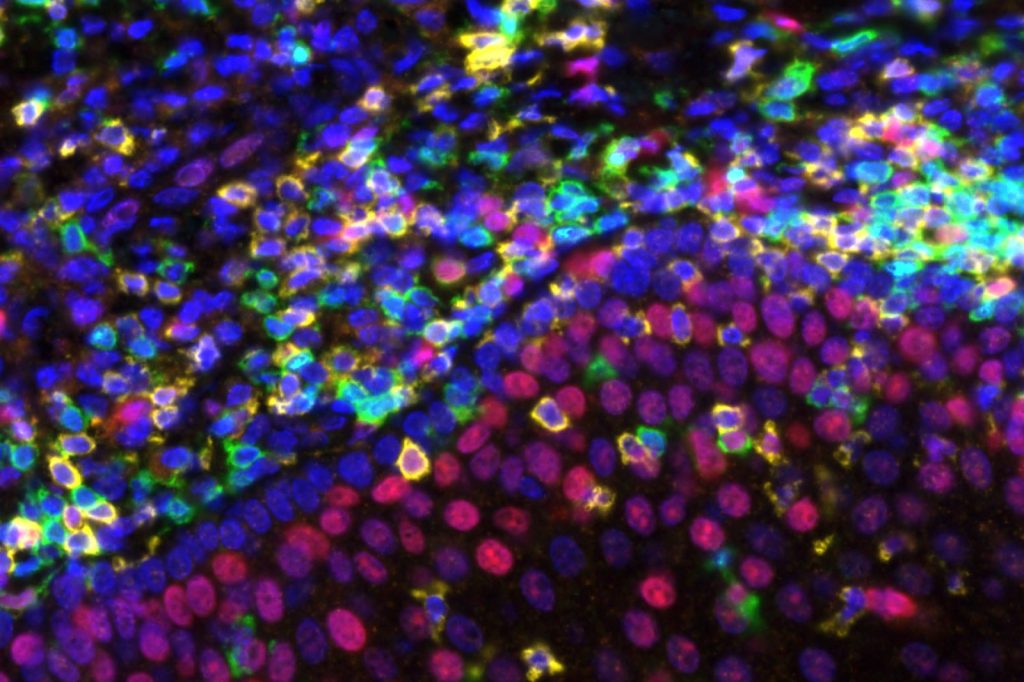
Tissue samples showed treated tumors filled with dendritic cells, T cells and mature B cells, clustered in structures resembling a lymph node. Osorio called them tertiary lymphoid structures, which are linked to better outcomes and stronger responses to immunotherapy. They appeared in tumors that had not been injected as well.
Unanswered questions
Twelve patients is a very small group, and the work needs confirming in larger ones. Nearly 200 people are now enrolled in phase 1 and phase 2 studies, run with Memorial Sloan Kettering and Duke University, in bladder cancer, prostate cancer and glioblastoma. The researchers want to know why some patients respond and others do not. Both complete responders had a high clonality of T cells when they started, which hints that the immune system must meet certain requirements for the drug to work.
“As a general rule, only 25 to 30% of patients will respond to immunotherapy,” Ravetch said, so the central challenge is finding who will benefit. The encouraging part is that those studies are already under way. Patients curious about this research should talk to their doctor or oncologist about what it may mean for them.
Sources
- The rockefeller university
- Scientists inject one tumor and watch cancer vanish across the body
- Cancer immunotherapy
- Immune Checkpoint Inhibitors Market Size, Share, Trends, and Global Forecast to 2030 | Next-Generation Targets and Combination Therapies Create New Growth Opportunities
Photo: NIH Image Gallery (Public domain)