
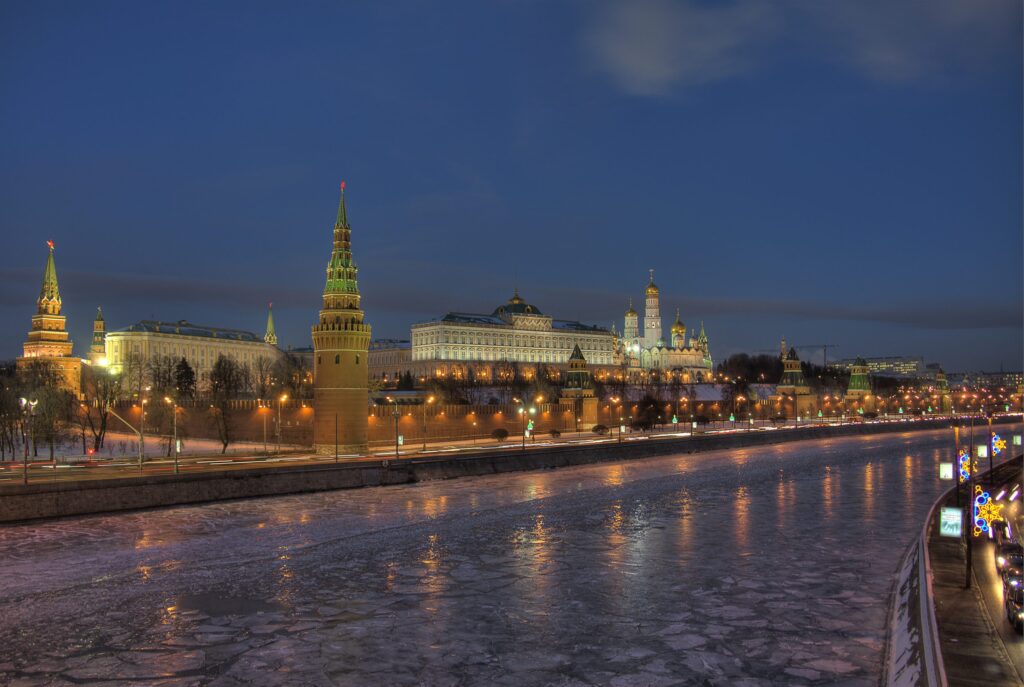
About $300 billion of Russia’s central bank reserves, roughly half the total, sits frozen in Western jurisdictions. The freeze came in the first weeks after the February 2022 invasion and remains the centerpiece of the sanctions on Moscow. Four years on, an analysis by the Novika guide site finds that Russia has neither collapsed nor thrived.
The first shock
The opening wave came within days. Seven major Russian banks, among them VTB, Bank Rossiya and Novikombank, were cut off from the SWIFT messaging system. Sberbank and Gazprombank were first exempted so energy payments could continue. Visa and Mastercard stopped operating in Russia. Export controls hit advanced technology, semiconductors, telecom equipment and dual-use goods, and hundreds of Western companies announced suspensions, departures or sales.
In the second phase, from April to December 2022, the European Union adopted a crude oil embargo effective December 2022, and the G7 set a price cap of $60 a barrel on Russian crude, enforced through limits on insurance and shipping. The EU and G7 banned Russian gold imports, and Sberbank moved onto the most restrictive lists. An EU embargo on petroleum products followed in February 2023, along with anti-circumvention measures aimed at third-country firms, diamond restrictions in 2024 and sanctions on the Arctic LNG 2 project.
What held and what broke
The central bank had used its reserves to steady the ruble in earlier crises, in 1998, 2008 and 2014. This time it could not. The ruble fell past 120 to the dollar in March 2022, then recovered to below 60 by mid-year after capital controls, mandatory foreign currency conversion and sharp interest rate rises. The reserves stayed locked. Russia has since rebuilt holdings in non-Western currencies and gold.
The SWIFT cut-off has made life harder for ordinary people. Sending money to relatives abroad or receiving international payments is now slow and expensive. Russia leaned on its own SPFS system, which has over 500 participants, plus payment arrangements with Chinese banks and workarounds through Turkey, the UAE and Kazakhstan.
The technology bans may do the most lasting damage. Russia lost access to chips below 14nm from makers such as TSMC, Samsung and Intel. Its airlines flew about 800 Boeing and Airbus jets at the start of 2022 and now depend on parallel imports and cannibalized aircraft, with an aging fleet and some parts shortages. Car production fell by roughly 45% in 2022 after Volkswagen, Toyota and others left; Chery, Haval and Geely have taken much of that ground.
Oil and money
The price cap has had limited effect. Russian Urals crude traded above $60 for much of 2024 and 2025, and Russia built a “shadow fleet” of tankers with non-Western insurance. Exports did not collapse. They were redirected, mainly to India and China. India went from almost no Russian crude before 2022 to about 1.5 to 2.0 million barrels a day by 2024.
Oil and gas revenues fell from around 11.6 trillion rubles in 2022 to about 8.8 trillion in 2023, then recovered to an estimated 10.5 trillion in 2024. Novika says that is enough to cover the federal budget’s non-defense spending.
Elsewhere the economy has bent without breaking. Unemployment is near 2.4%, and labor shortages are the main worry. The domestic Mir card replaced Visa and Mastercard. Online sales reached about 8 trillion rubles in 2024. Agricultural export revenue hit around $45 billion that year, with no significant food shortages reported.
Foreign direct investment, which averaged $20 billion to $30 billion a year in the 2010s, turned negative in 2022 and 2023. Trade with the EU has dropped from about 35% of Russia’s total to under 15%. Novika says the pace of new sanctions has slowed, with the focus now on enforcement, and that discussion of using frozen Russian sovereign assets has produced no decision.




