
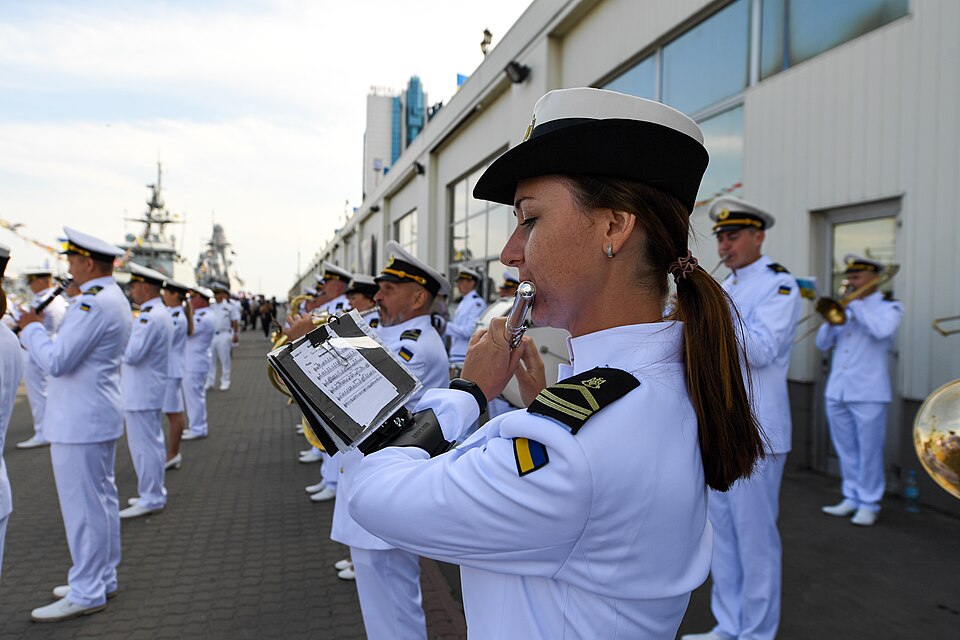
The human side of the story starts with a question the officers could not answer: whose navy is this? When the Soviet Union dissolved in December 1991, the Black Sea Fleet, roughly 800 ships and over 100,000 personnel, sat mostly at Sevastopol on the Crimean peninsula, which now belonged to newly independent Ukraine. Both states claimed succession. Ukraine saw a Russian-run fleet on its coast as a standing security wound; Russia saw the possible loss of its great warm-water base. For years the ships themselves stayed in limbo, much of the time under a so-called joint command that kept flying the flag of a country that no longer existed.
The men in the wardrooms felt it first. Officers frustrated by the silence faced crackdowns from the fleet’s commander, Admiral Igor Kasatonov, aimed at anyone showing sympathy for Ukraine. On 5 April 1992, President Leonid Kravchuk had signed a decree on building Ukraine’s armed forces, including the instruction “To form the Naval Forces of Ukraine (Ukrainian Navy) based on the assets of the Black Sea Fleet stationed on the territory of Ukraine.” Moscow struck back with a counter-decree from President Boris Yeltsin declaring the fleet under Russian jurisdiction and ordering the Russian flag raised on every hull. Then came the fleet’s own mutiny-within-a-mutiny: on 21 July 1992 the patrol ship SKR-112, her crew led by Captain-Lieutenant Serhiy Nastenko, raised the Ukrainian flag and sailed from Novoozerne to Odesa, defying a command that tried to stop them by force.
The bargaining that followed was brutal for the smaller side. Interim accords, Dagomys in June 1992 and a principles agreement that August, then urgent-measures deals in June 1993, nominally split the fleet half and half. In truth Russia held the leverage. Its State Duma passed a resolution on 9 July 1993 declaring Sevastopol Russian, vetoed by Yeltsin but unmistakable as intent; the fleet’s own command was meanwhile scrapping ageing ships in India and Turkey for cash, with a Russian bank branch opened in Sevastopol to process the payments. At Massandra on 3 September 1993 the squeeze became an ultimatum: pay the gas debts at once, or settle them with fleet shares. Defence Minister Kostyantyn Morozov objected that a fleet is no commodity for sale; Prime Minister Leonid Kuchma waved it off as his personal view, and Kravchuk conceded Ukraine’s 50 percent. The Rada condemned the deal as a betrayal of national interests.
The final arithmetic was written over two more years. An agreement of 15 April 1994 pointed to Ukraine keeping only 15 to 20 percent; the Sochi deal of 9 June 1995, signed by Kuchma and Yeltsin, fixed Ukraine’s share at 18.3%, 137 vessels against Russia’s 388 and 81.7%. Ukraine in fact ceded 117 warships and patrol boats, about 32% of what had been its better share, against a $521 million debt, while taking 12 aircraft, 30 naval helicopters and roughly 227 coastal facilities, about a quarter of the shore infrastructure. On 28 May 1997 three interlocking agreements let Russia keep Sevastopol and Streletska Bay, with up to 25,000 military personnel, 132 warships, 22 aircraft and 11 shore installations on Ukrainian soil, for a lease of about $97.75 million a year plus debt forgiveness, running to May 2017. Russia explicitly recognised Sevastopol as Ukrainian, a point later cited in legal proceedings; critics at home called the whole structure a permanent toehold that mortgaged sovereignty.
In 2010 it was mortgaged further. President Viktor Yanukovych signed the Kharkiv Accords with Putin on 21 April 2010, extending the basing rights from 2017 to 2042 in exchange for gas at $100 per thousand cubic metres, far below market. Ratification in the Verkhovna Rada came amid fistfights and smoke bombs; the Constitutional Court upheld the deal all the same, though critics noted the constitution prohibited foreign military bases and priced the discount at $3-4 billion a year. Four years later the tenant stopped pretending. When mass protests drove Yanukovych out in February 2014, unmarked Russian special forces, the “little green men” later acknowledged by Putin, seized Crimean buildings and the Belbek and Saky airbases in coordination with Black Sea Fleet Marines; Ukrainian vessels in Sevastopol were blockaded or taken under duress, crews were surrounded and pressured to surrender or defect, most of Ukraine’s modest fleet was captured, and a remnant sailed for Odesa. Russia formally repudiated the lease framework and paid nothing more.
The war since 2022 has reversed the roles in a way nobody in those wardrooms imagined. The fleet that had been the intruder shelled Ukrainian cities with cruise missiles and staged amphibious feints against Odesa in the invasion’s opening phase, and then took losses no analyst predicted: on 13 April 2022 Ukraine sank the fleet flagship Moskva, the largest warship sunk in combat since the Falklands War, with what it says were domestically developed Neptune anti-ship missiles, a strike Russia has acknowledged only as an ammunition fire. Naval drones and long-range strikes, built at home and with Western components, then hammered Sevastopol harbour, and by 2024 Russia had partially relocated fleet operations, surrendering the western Black Sea freedom it held at the war’s start. The analysis file is blunt about the road back: retaking Crimea would first require neutralising the fleet, something judged beyond Ukraine’s capability as of early 2026 even as its drones have badly degraded Russian effectiveness.
For the families and the sailors, the arc closes with a kind of grim symmetry. A navy that began with one patrol ship defecting to Odesa under fire from its own command ended up with no fleet to speak of and, from Odesa again, a drone and missile campaign that drove a far larger fleet from its anchorage. The 1997 lease papers recognised Sevastopol as Ukrainian; the ships they licensed are gone; the question those officers asked in 1992, whose navy is this, is being answered from the water.
Sources
- Black Sea Fleet Agreements History | Ukraine War Analytics
- How the Black Sea Fleet was split – The Ukrainian Week




