
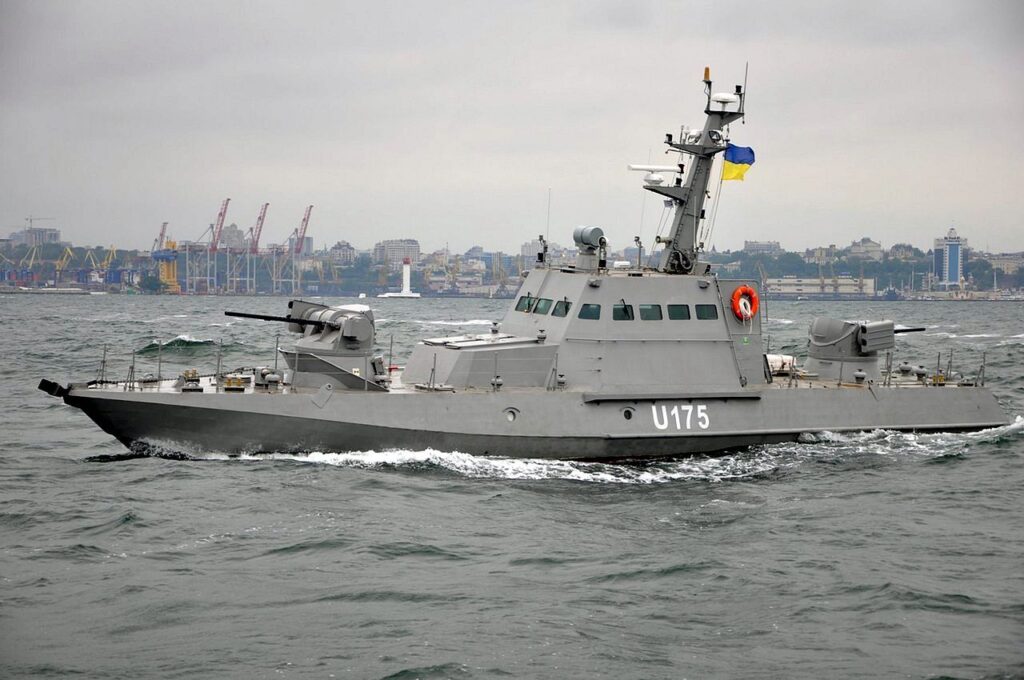
KYIV, July 9 — Ukraine has quietly built a naval weapon from scratch, and it is now reshaping the Black Sea conflict. Since early 2022, the country has developed and deployed a fleet of unmanned surface vehicles, or USVs, that are challenging a basic assumption of naval warfare: that a small, poor country cannot contest a major fleet. The mechanics here are deceptively simple.
The drones, known as the Magura V5 and Sea Baby, are small craft, roughly five to six meters long. They carry up to 200 kilograms of explosives.
Their range extends to 800 kilometers. They are not autonomous in the sci-fi sense; each is controlled via satellite link, navigating with cameras and radar. The first confirmed use came in October 2022, against Russian ships in the port of Sevastopol.
On closer reading, the strategic logic is brutal. A single USV costs an estimated $250,000.
The ships it targets cost tens of millions, often hundreds of millions. The catch for Russia is that its point-defense systems, designed to stop supersonic missiles and torpedoes, struggle to track and engage a swarm of small, fast surface drones. Ukraine has used coordinated swarm attacks to overwhelm these defenses, turning a technological vulnerability into a military method.
By August 2024, Ukrainian Defense Minister Oleksii Reznikov stated that the country had produced over 100 such drones. That is a production run, not a prototype. It signals a shift from experimental use to industrial-scale deployment.
The drones are not a one-off trick; they are an emerging capability. Follow the money, and the asymmetry becomes stark.
Ukraine has no traditional navy to speak of. It lost its only major surface combatant, the frigate Hetman Sahaidachny, scuttled at the start of the invasion to prevent capture. Building a new fleet of conventional warships would take years and billions of dollars.
Instead, Ukraine invested in USVs, a fraction of the cost, and achieved something the Russian Black Sea Fleet had not faced in decades: a credible threat to its operations. The drones have been used to strike naval targets, port infrastructure, and even the Kerch Strait Bridge.
The range of 800 kilometers means they can reach most of the Black Sea from Ukrainian-controlled coastlines. The payload of 200 kilograms is sufficient to cripple or sink a warship if placed correctly. This is asymmetric warfare in its purest form.
Ukraine is not trying to match Russia ship-for-ship. It is bypassing the entire concept of a fleet engagement. The USV allows a small, distributed force to concentrate firepower at a point of its choosing, using cheap, expendable platforms against expensive, crewed vessels.
The technology itself is not new; remote-controlled boats have existed for decades. What is new is the integration of satellite control, real-time video, and swarm tactics into a weapon system that can be produced in quantity at a price point that makes attrition acceptable.
A $250,000 drone that sinks a multi-million-dollar ship is a trade any defense ministry would take. The implications extend beyond Ukraine. Navies around the world are watching.
The US, UK, and others have experimented with USVs for mine countermeasures and surveillance, but Ukraine has done something different: it has used them as an offensive strike weapon in a high-intensity conflict. That is a proof of concept that no naval planner can ignore.
The catch for Ukraine is that this advantage is not static. Russia will adapt. Electronic warfare, better point-defense radar, and even small-caliber guns with automated targeting can reduce the effectiveness of USV swarms.
The window of vulnerability is real, but it may not stay open indefinitely. What to watch next is whether Ukraine scales up production further, or develops new variants. The existing drones are limited by speed and sea state; rough weather can render them inoperable.
A next generation might be faster, stealthier, or capable of operating in higher seas. The cost structure suggests that quantity has a quality all its own, and Ukraine has already demonstrated it can produce more than 100 units.
For now, the USV fleet gives Ukraine something it lacked at the start of the war: a way to contest the Black Sea without a navy. That is a strategic shift, and it was built on a budget.




