A Parallel Naval Command
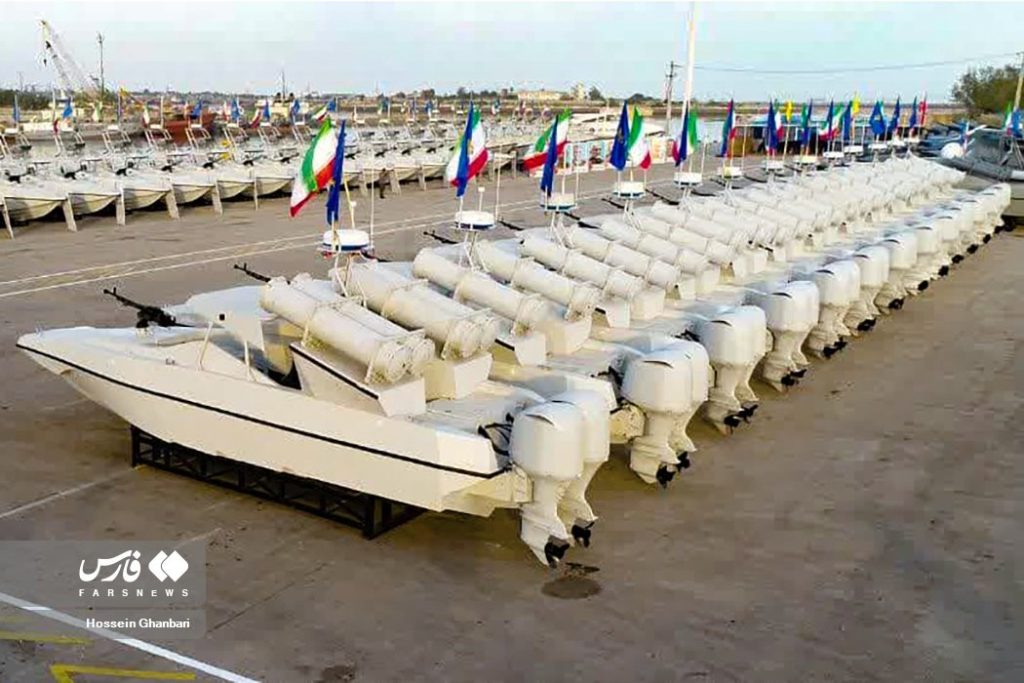
The IRGC Navy’s independence from Iran’s regular military is by design. The force was created to safeguard the Islamic system and operates with its own doctrine, training, and procurement. Unlike the conventional navy, which focuses on blue-water operations, the IRGC Navy concentrates on coastal defense, swarm tactics, and irregular warfare. Swarm attacks remain the IRGC Navy’s signature tactic. The concept involves dozens or even hundreds of small, heavily armed boats converging on a target from multiple directions at high speed. These boats can be armed with anti-ship missiles. The 2020 and 2023 exercises demonstrated this capability. The United States designated the IRGC as a terrorist organization in April 2019 under President Donald Trump, a designation that remains in effect. That designation adds legal and political weight to any confrontation with the force.
The Strait of Hormuz is bordered by Iran to the north and Oman’s Musandam Peninsula to the south. Its relatively narrow channels restrict shipping movement, making it vulnerable to disruption. While conflicts elsewhere in the Middle East have closed other straits, the Strait of Hormuz has never been blocked for an extended period during past regional wars—though Iran has repeatedly threatened to do so, and military exercises simulating such a move have occurred. The strait’s role in energy markets has grown since the mid-20th century as Persian Gulf oil production expanded. Most of the oil and liquefied natural gas bound for Europe and Asia passes through it, and several Gulf states depend entirely on its open waters for exports. Any prolonged disruption—whether from military action, sabotage, or blockades—could ripple across global energy supplies, driving price volatility and straining economies reliant on steady fuel flows.
Strait of Hormuz: A Persistent Flashpoint
The IRGC Navy has demonstrated a willingness to interdict commercial shipping. In July 2019, its forces seized the tanker Stena Impero in the Strait of Hormuz. More recently, in April 2025, the IRGC Navy seized another tanker in the same waterway. Past events also include the 2019 shootdown of a U.S. RQ-4A Global Hawk drone. The force’s deployment of mines, its anti-ship cruise missile inventory, and its demonstrated willingness to seize commercial vessels make the Strait of Hormuz a persistent flashpoint. With the U.S. designation of the IRGC as a terrorist organization still in force, any confrontation carries added legal and political weight.
The strait’s narrowness also makes it an ideal setting for asymmetric naval tactics, a reality underscored by Iran’s development of fast-attack craft and missile capabilities aimed at asserting control over the waterway. Today, the strait remains a focal point of geopolitical tension due to Iran’s assertive naval posture and its willingness to interdict commercial vessels. Recent seizures of tankers, drone shootdowns, and mining drills reflect a strategy aimed at deterring outside interference while projecting influence across the Gulf. For global consumers and regional allies alike, the strait’s stability is not just a regional concern but a linchpin of energy security. Any escalation—whether through direct conflict or calculated brinkmanship—could reshape trade routes, energy prices, and military posturing across three continents.