
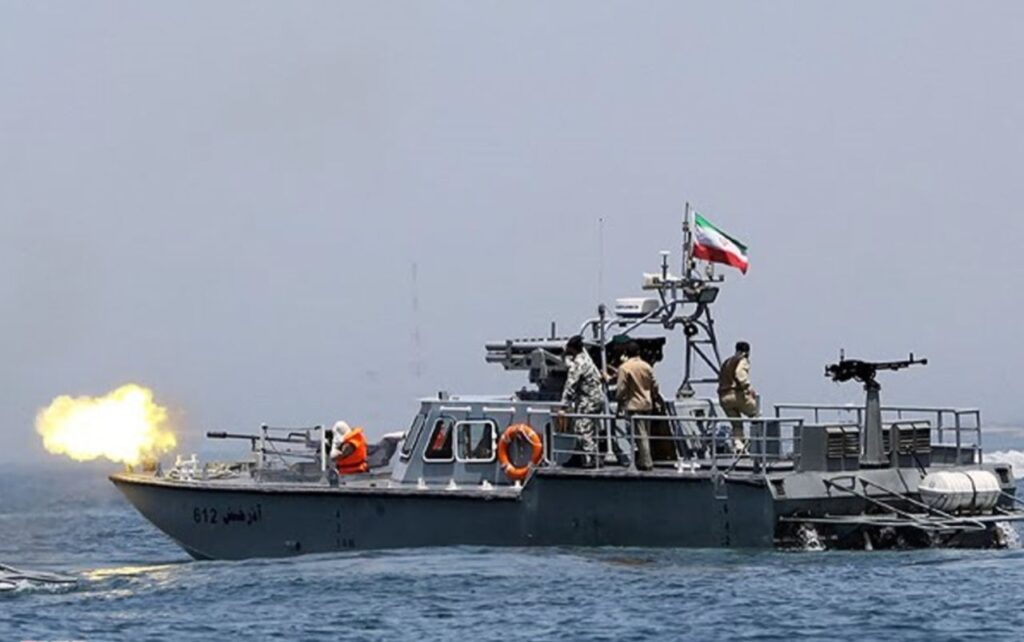
TEHRAN, July 12 — In the strategic waters of the Persian Gulf, a distinct military force operates under direct command of Iran’s Supreme Leader, and its capabilities have drawn renewed attention from regional security analysts. The Islamic Revolutionary Guard Corps navy, established in 1985 as a separate branch from Iran’s regular navy, fields approximately 20,000 personnel. Its fleet relies heavily on small fast-attack craft, including Seraj-class and Zolfaghar-class vessels, designed for speed and maneuverability rather than sustained blue-water operations.
This force does not report to Iran’s Defense Ministry. Instead, the IRGC navy answers directly to Ayatollah Ali Khamenei, the country’s Supreme Leader.
Its primary base sits at Bandar Abbas, near the Strait of Hormuz.
Swarm tactics and missile capabilities
The IRGC navy’s core operational doctrine is known as “swarm tactics.” The strategy involves using dozens of small boats simultaneously to overwhelm larger naval vessels, such as destroyers or aircraft carriers. To arm these small craft, the IRGC navy deploys anti-ship missiles including the Noor, with a range of 120 kilometers (75 miles), and the Qader, which can reach 200 kilometers (124 miles). Both are derived from Chinese designs.
The force also maintains naval mines, specifically the M-08 and M-26 types, which it previously deployed during the Iran-Iraq War.
Coastal defenses and exercises
Along the Iranian coastline, the IRGC navy controls coastal defense missile batteries. These fixed positions provide additional layers of protection and extend the force’s ability to threaten shipping in the Strait of Hormuz. The IRGC navy has conducted exercises simulating closure of the strait, including the “Great Prophet 7” exercise in 2010.
Iran maintains two distinct naval forces with different roles. The regular navy operates larger ships such as frigates and destroyers, suited for longer-range missions.
The IRGC navy, by contrast, focuses on coastal and littoral operations, using its smaller, faster vessels to patrol near Iran’s shores. This dual structure creates a complex command picture for any potential adversary. The IRGC navy’s direct reporting line to the Supreme Leader means its operational decisions may not always align with the regular military’s chain of command.
What to watch
As tensions in the Persian Gulf persist, analysts will continue monitoring IRGC navy exercises and any changes in its deployment patterns near the Strait of Hormuz. The force’s combination of small boats, anti-ship missiles, and naval mines represents a persistent challenge for naval forces operating in the region.




