
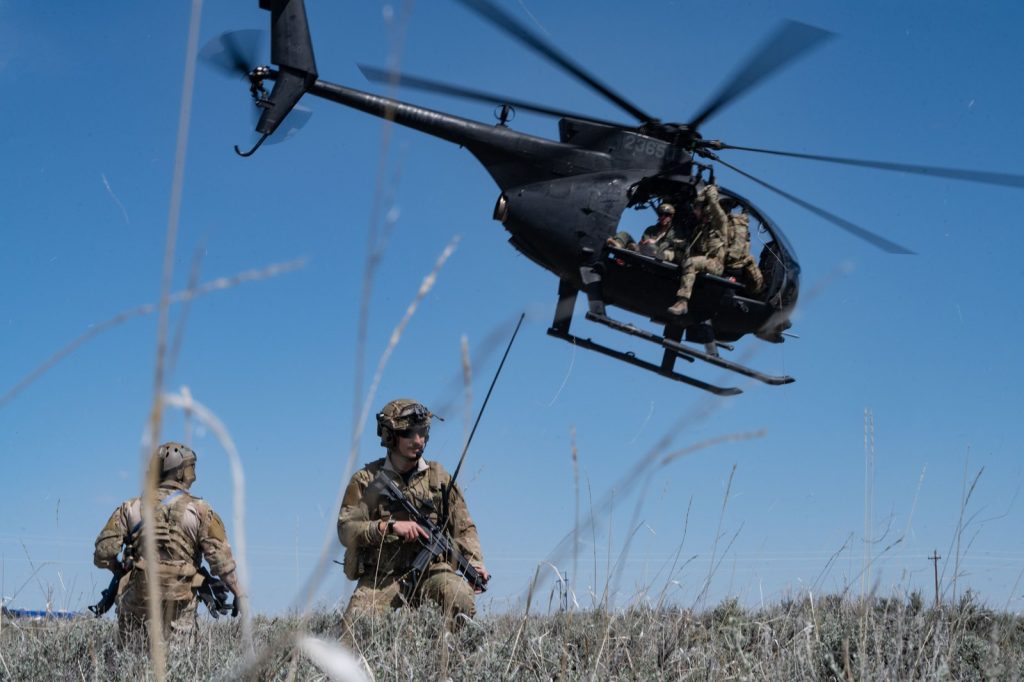
The bill for the U.S. withdrawal from Iran came due on April 5, and it was paid in burning metal. Two C-130 transport aircraft and four MH-6 Little Bird helicopters were deliberately destroyed by American troops at a temporary base inside Iran. The pilots did not fly them out.
The ground crews did not pack them up. They were torched on the tarmac to keep them out of Iranian hands.
The MH-6 Little Bird is a light helicopter built for special operations. The U.S. Army calls the latest version, the MH-6M, a “Killer Egg.” It is a modified MD 530F with a single six-bladed main rotor and a four-bladed tail rotor. That is the kind of hardware the Pentagon decided could not be captured.
The C-130s, workhorses of tactical airlift, were no less sensitive. Together, the six destroyed aircraft represent a deliberate, costly decision to deny Iran a technological windfall.
Secretary of Defense Lloyd Austin framed the destruction as a necessary measure to safeguard sensitive technology and prevent its misuse by hostile actors. General Mark Milley, Chairman of the Joint Chiefs of Staff, supported the call. The official line is clear: protecting the security of U.S. operations and personnel required this sacrifice.
The alternative—letting Iranian forces seize the aircraft intact—was deemed unacceptable. Iran had been seeking to capture and exploit these assets for its own military purposes. That is not speculation.
The report notes Iranian forces have been actively attempting to acquire advanced U.S. technology to enhance their capabilities. The destruction of these aircraft thwarts those efforts directly.
For Iran, the prize was six flyable platforms loaded with American avionics, radar signatures, and countermeasure systems. What they got instead was scrap. The consequences ripple outward.
First, the U.S. military just wrote off six aircraft in a single action. Two C-130s and four MH-6s are not trivial losses, even for the world’s largest air force.
The transport fleet takes years to build and maintain. The Little Bird fleet is small and specialized. Every destroyed airframe is one less available for the next mission.
Replacement will take time and money. Second, the decision sets a precedent. If U.S. forces are willing to destroy their own equipment during a withdrawal from Iran, future withdrawals from other contested zones may follow the same playbook.
Adversaries now know the U.S. will burn its own hardware rather than let it fall into enemy hands. That changes the calculus for any force hoping to capture American equipment as a prize of war.
Third, the Iranian military lost a chance to reverse-engineer some of the most capable special operations platforms in existence. The MH-6M’s six-bladed main rotor and four-bladed tail rotor are not off-the-shelf parts. The C-130’s electronic warfare suite is a closely guarded secret.
Iran wanted those systems. They will not get them now.
The immediate fallout is a strategic setback for Iran’s military ambitions. The longer-term effect is a hardened U.S. policy on asset denial. The burning of these aircraft sends a message that applies not just to Iran, but to any state hoping to acquire American technology through battlefield capture.
The price of withdrawal is high, but the price of letting that technology walk away would have been higher.




