
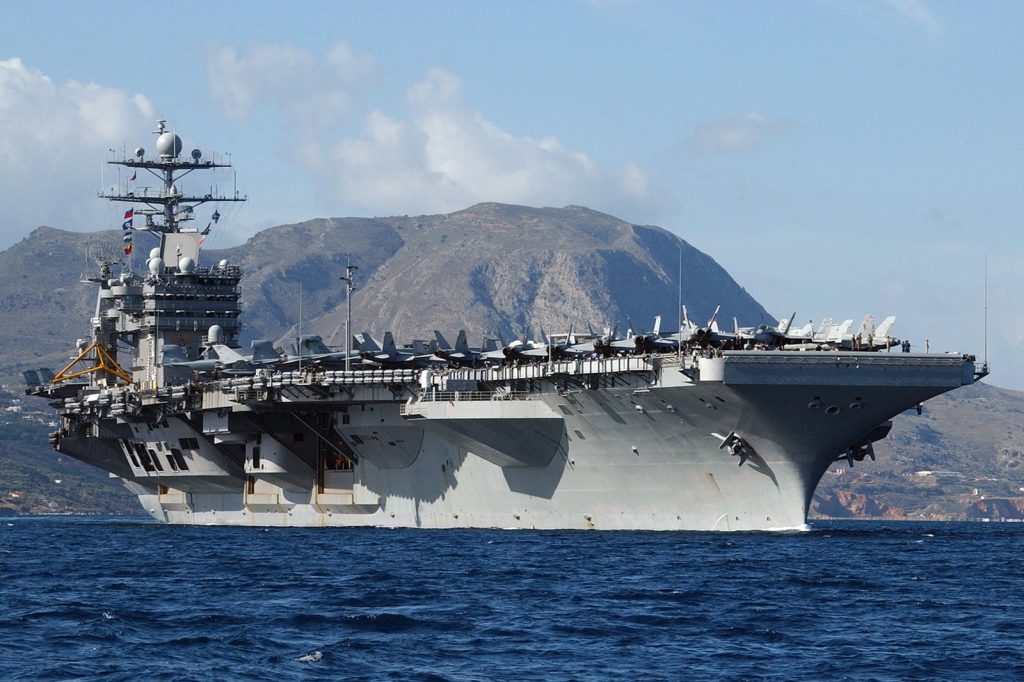
In the third week of June 2025, with Israel and Iran a second week into open fighting, the United States assembled one of the larger concentrations of American firepower seen in the Middle East in years. The USS Nimitz, “on its final operational deployment before being decommissioned”, cut short a South China Sea stint and turned for the Arabian Sea, “whose deployment to the region was moved up earlier this month”; instead of relieving the USS Carl Vinson strike group already in the theater, the two carriers would overlap. Around them stood “approximately 40,000 U.S. troops in the area”, twenty months of buildup against Iran and the Houthis, and a warning posted to social media by Ayatollah Ali Khamenei: “The harm the U.S. will suffer will definitely be irreparable if they enter this conflict militarily.”
Under the hood, the order of battle read like a catalogue. The Vinson group cruised the Arabian Sea with the cruiser USS Princeton plus the destroyers USS Sterett and the USS William P. Lawrence, and Carrier Air Wing 2, fielding “close to 50 fighters and strike aircraft across three squadrons” of Super Hornets plus F-35Cs and Growlers; the Nimitz trailed behind with its own air wing and escorts, five guided-missile destroyers by the first reporting, four by the later count. Three more destroyers held the eastern Mediterranean, the USS Thomas Hudner, the USS Arleigh Burke and the USS Sullivans, with another pair in the Red Sea and four anti-mining vessels at “In Bahrain, the headquarters of the 5th Fleet”. Ashore, ten bases anchored the footprint across Bahrain, Kuwait, Qatar and the Emirates, with 2,500 troops in Iraq and 1,500 in Syria, Patriot batteries at Irbil and al-Asad, and “two THAAD air defense systems, operated by roughly 100 American soldiers each, are deployed to Israel”.
The air bridge was the tell. In 48 hours, “at least two dozen” Air Force tankers, KC-135s and KC-46s, had “flown eastward from the continental United States”, a surge of unremarkable aircraft that signals sustained operations better than any announcement; Reuters added “an unspecified number of F-16, F-22, and F-35 fighter jets were being sent over”. Out of sight, B-2s could stage from Diego Garcia, and the target arithmetic was already public: Iran’s Fordo site sits deep enough to be “too deep for most bombing campaigns but within the destructive range of the GBU-57 bunker buster bombs, which only the B-2 can carry”. The stated purpose was stopping a nuclear weapons program; the awkward footnote, reported flatly, was that “American intelligence found in March that the country is not pursuing development of nuclear weapons”.
The technical reality is that the centerpiece of all this is a design from another era doing 2025 work. A Nimitz-class hull displaces more than 100,000 tons at full load, runs 332.8 metres overall with a flight-deck beam of 76.8, and is “designed to operate for over 20 years without refuelling” its twin reactors, which turn four shafts at better than 30 knots for a crew and air wing of more than 5,000. Four catapults and four arresting wires keep the deck moving, “typically handling over 80 aircraft during full operations”, under the watch of Sea Sparrow, Rolling Airframe and Phalanx. The detail that matters for the mission at hand is the air wing’s reach: the Super Hornet, on two F414 engines at Mach 1.6, has a “combat radius of over 390 nautical miles and can carry up to 17,750 pounds of ordnance”. A floating airport that never needs a fuel stop is, as ever, the most flexible object in the inventory.
What the buildup bought was options: the Pentagon had confirmed no intervention, but two carriers, a tanker bridge and a bomber anchorage add up to the ability to strike long, defend allies, or simply wait. The risk ledger was public too. Houthi missiles and drones had come at Navy ships for twenty months and been intercepted; militias had barraged American posts in Iraq and Syria, and three soldiers had died at Tower 22 in Jordan the year before; troops now drilled rocket attacks on simulators before deploying. Deterrence, the June posture showed, is a supply chain. The carriers would eventually steam home, the tankers would ferry back, and the bases would stay, which is the quiet constant of the American position in the Gulf: the hardware rotates, the real estate does not.
Sources
- American aircraft carriers converging on Iran
- 2 carriers, dozens of fighters: US forces gather in the Middle East




