
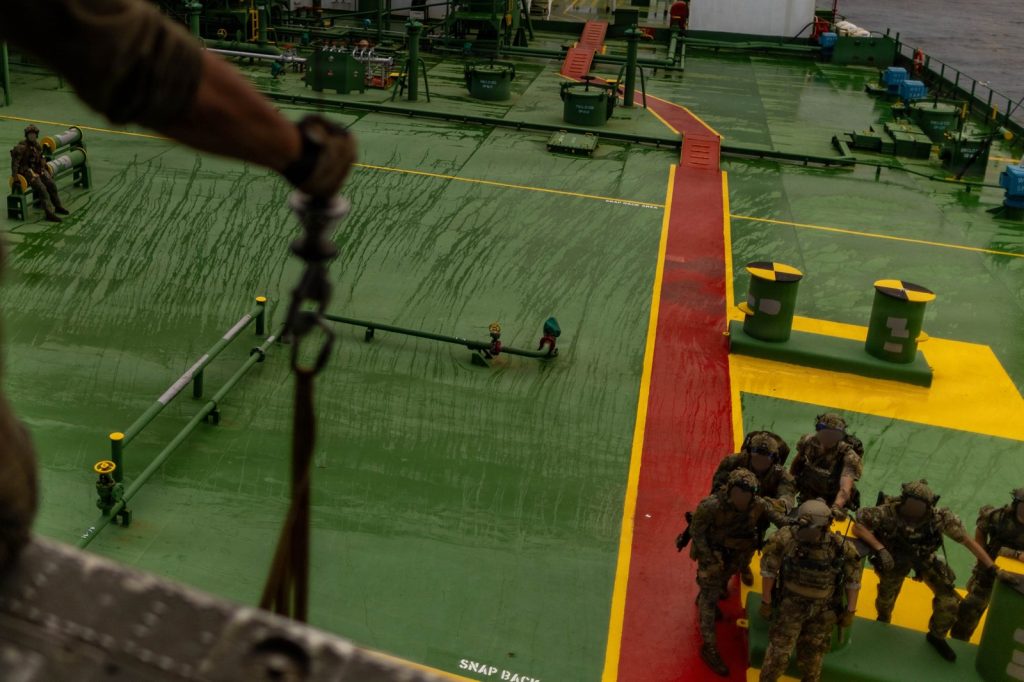
The Pentagon announced on Tuesday that U.S. forces had stopped and boarded a tanker called the Tifani in the Indo-Pacific. The boarding happened overnight, it said, and passed without incident.
The Defense Department posted its account on X. By its description, American forces used a “right-of-visit, maritime interdiction and boarding” against what it called a stateless, sanctioned vessel. Where exactly it happened was not disclosed. The post did include video of helicopters putting down on a large, bright orange tanker, and AFP identified the ship as one affiliated with Iranian activity.
The detail that matters is the word “stateless.” A ship with no flag has no government to object to a boarding, and the Pentagon leaned on that in making its case.
Whose waters
The Pentagon placed the operation inside the area of U.S. Indo-Pacific Command, or INDOPACOM, which oversees a broad region covering the Pacific and Indian oceans. It pointed out what that command does not cover: the Gulf and the Strait of Hormuz, both of which fall to U.S. Central Command.
The department framed the boarding as one piece of a wider effort against networks that supply Iran. It said Washington was determined “to disrupt illicit networks and interdict sanctioned vessels providing material support to Iran—anywhere they operate.” The post ended on a flat warning: “International waters are not a refuge for sanctioned vessels.”
Context came from the diplomacy. President Donald Trump has said he will hold a blockade on Iran “until there is a deal” to end the war, and on Tuesday nobody could say whether a second round of talks between Tehran and Washington would go ahead in Islamabad.
Sources
Sources
- US intercepts sanctioned oil tanker linked to Iran in Indo-Pacific
- U S Forces Board Sanctioned Tanker In Indo | gCaptain




