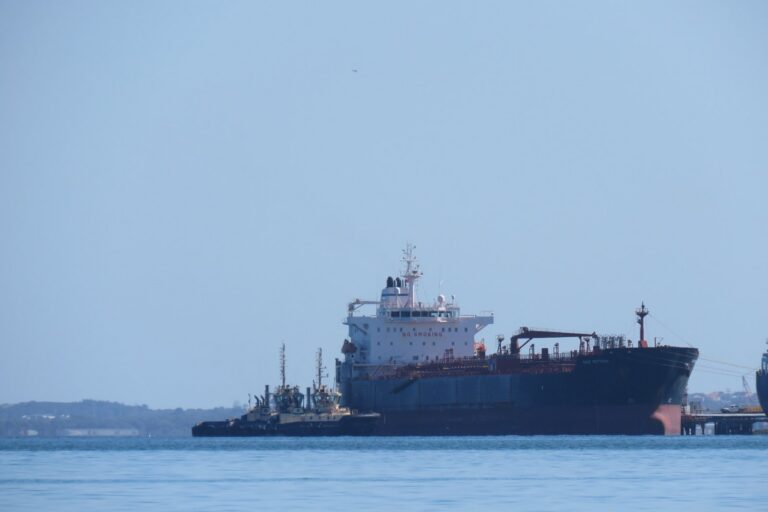
Black smoke rolled over Sochi on Tuesday evening after Ukrainian naval drones hit a laden crude tanker about 11 km offshore. Russia’s Transport Ministry confirmed the attack. The vessel, tracked by open-source watchers as the Aframax Rio and flying Liberia’s flag, was carrying up to 100,000 metric tons of Russian crude, roughly 750,000 barrels. Burning oil was visible on the water.
All 23 Indian crew members were pulled to safety. Beaches and waterfront promenades in the resort city, home to nearly 500,000 people and host of the 2014 Winter Olympics, were closed until further notice. Residents of Sochi and the neighboring Sirius federal territory were told to stay indoors as much as possible and keep windows shut. Firefighters had the blaze out by Wednesday morning, and the ministry insisted no oil had spilled.
A campaign with a name
The strike belongs to Operation MoLoChKa, a Ukrainian acronym for “Moscow will fall through Crimea.” Ukraine’s Unmanned Systems Forces started it on July 6, 2026, aiming at tankers and barges that carry Russian oil around Western sanctions. The pace was startling. In the first 11 days, drone crews hit 147 vessels, 117 of them in the Sea of Azov and 30 in the Black Sea. The tally stood at 201 by July 28. By September 22 the force claimed 300 strikes, including 285 shadow-fleet vessels in ten weeks: 215 in July, 54 in August and 16 in the first half of September.
The unit’s commander, Robert “Madyar” Brovdi, says the point is to squeeze logistics rather than run up a score. “We turn every self-propelled watercraft into a blind and deaf barge drifting at sea,” he said in July. His crews deliberately avoid cracking hulls. “The goal is not to pollute the waters with oil slicks.”
Brovdi also says the Kerch Strait has been effectively blockaded for an indefinite period, and that shipping in the northern and northeastern Black Sea is “significantly hampered.”
The shift: cheap boats against a whole export route
Ukraine has no real Black Sea navy. Russia’s fleet pushed it out of open water early in the 2022 invasion, and the first drone-boat raid on Sevastopol came that October. Since then Kyiv has leaned on uncrewed surface vessels, chiefly the MAGURA family built by Ukraine’s military intelligence directorate, HUR, with UFORCE. The V5 reaches 800 kilometers at 42 knots. The V7, shown in May 2025, stretches to 800 nautical miles on a 270-horsepower diesel and can run on its own for 48 hours. That same month, V7 drones shot down two Russian Su-30SM jets, the first such kill by a naval drone.
Aerial drones, which the force calls “Birds,” help find ships that switch off their AIS transponders. Satellite imagery and the Atesh partisan network fill other gaps.
The economics are lopsided. A MAGURA V5 costs a fraction of what a loaded Aframax carries; the Aframax Rio’s cargo alone was reportedly worth well over $50 million.
Moscow has had to react. Russia has pulled frontline drone teams into convoy duty, with up to 200 protection groups from the Rubicon unit escorting tankers. USF spokeswoman Olha Meloshyna told LIGA.net that “the occupiers have already understood the level of threat.” In September, footage showed a Ukrainian drone dodging fire from a Russian helicopter sent to stop it, then hitting the tanker Armada Leader near Sochi.
The shadow fleet and the spill risk
Russia assembled the shadow fleet after 2022 to dodge the G7 price cap. By Kyiv’s count it numbered 1,337 ships in February 2026, and Kyiv School of Economics data put its share of Russia’s seaborne oil exports at roughly 70 percent. Ukraine sanctioned the Aframax Rio, built in 2004, in February 2026.
The ships are old and sail outside Western insurance systems. In December 2024 two of them, the Volgoneft-212 and Volgoneft-239, broke apart in a storm near the Kerch Strait and released over 4,000 metric tons of heavy fuel oil. Maritime analyst Michelle Wiese Bockmann calls the whole fleet “a billion-dollar oil spill catastrophe waiting to happen.” Greenpeace Bulgaria says the tanker Caroline Bezengi, hit off Oman earlier this year with a nearly full 160,000-ton cargo, was reported leaking.
Ukraine describes its strikes on Russian oil as fair payback for Moscow’s nightly barrages on its cities. The International Maritime Organization’s Secretary-General, Arsenio Dominguez, condemned attacks on commercial shipping in the Black and Azov Seas in July 2026, saying civilian seafarers should never become casualties of geopolitical conflict.
Former US Navy SEAL Chuck Pfarrer, writing for Kyiv Post after the first two months, counted “more than 170 vessels struck without Ukraine deploying a single large surface warship.”
Sources
- Ukraine’s drone revolution shows Russia is dangerously unprepared. But, so is America
- Ukrainian Sea Drones Set Sochi Ablaze, Hitting Russia Where Sanctions Failed