
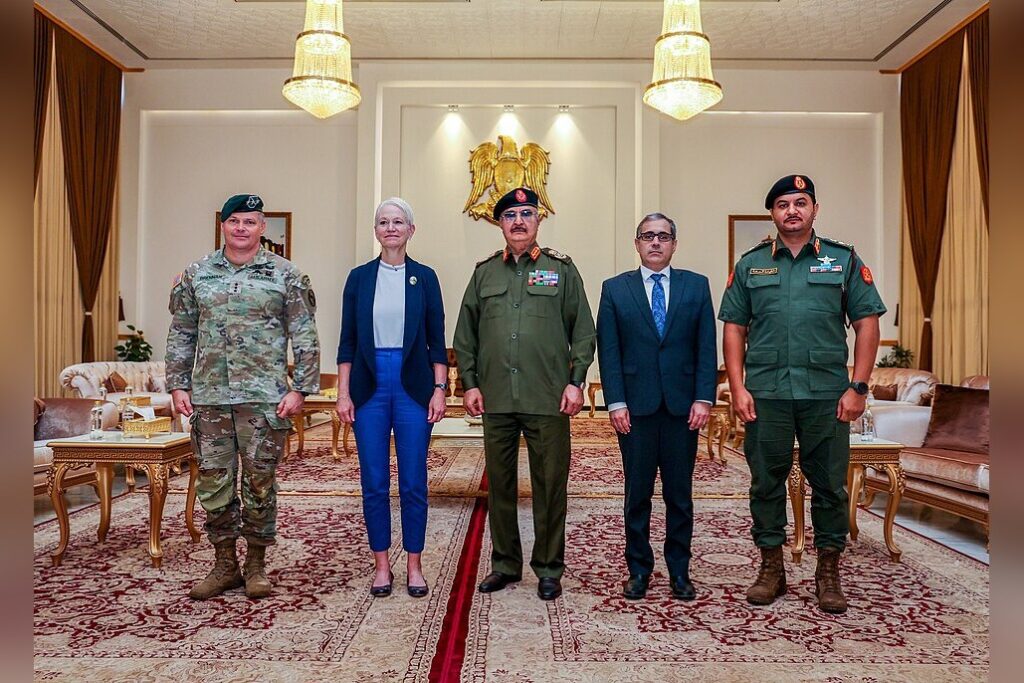
BENGHAZI, September 10 — Turkish Foreign Minister Hakan Fidan travelled to Benghazi on August 12 for talks with Libyan military commander Khalifa Haftar, Haftar’s son Saddam, and senior eastern officials, one day after meeting Prime Minister Abdul Hamid Dbeibah and other officials in Tripoli. The back-to-back visits underscored Ankara’s evolving “One Libya” strategy, a shift beyond Libya’s east-west divide. Turkey is maintaining its foothold in the west through military presence, political relationships, and commercial ties, while also building direct links with the eastern camp it once opposed.
Six years ago, Turkey helped Haftar’s rivals repel his 2019 assault on Tripoli. Turkish military support was decisive in halting the offensive, and a 2020 ceasefire ended the fighting but left Libya’s institutions fragmented.
The contrast with 2019 is stark. After intervening to stop Haftar’s advance, Ankara now appears focused on leveraging its presence to engage both sides rather than pursuing direct confrontation. Fidan’s July 24 meeting with Saddam Haftar in Ankara, and the participation of eastern and western Libyan forces in EFES 2026, Turkey’s major military exercise, further reflect efforts to foster coordination between the rival camps.
Regional powers expand contacts
The outreach comes as other regional powers expand contacts across Libya’s divide. Egypt stepped up engagement last month, with Egyptian intelligence chief Hassan Rashad meeting Saddam Haftar in Alamein on August 22, three days after President Abdel-Fattah el-Sisi met Haftar, amid growing calls to end Libya’s institutional split. Libya has remained divided since the 2011 uprising and military intervention that toppled Muammar Gaddafi, with Dbeibah’s government controlling much of the west, while Haftar’s forces and an eastern administration dominate the east and much of the south.
The UN has for years pursued a political settlement and elections to end Libya’s institutional divisions, but repeated efforts have stalled.
Energy, trade and a maritime deal
The rapprochement is not just about diplomacy. Turkey’s Libya strategy increasingly combines political, security, and defense interests with long-term ambitions in energy, infrastructure, and reconstruction. The economic relationship is substantial.
Since 1972 Ankara has carried out 633 projects worth around $31 billion, while bilateral trade reached about $4.4 billion in 2025. In February, state energy firm TPAO secured rights to jointly operate two Libyan oil fields.
Turkey’s overture to the east also seeks to safeguard the 2019 maritime deal with Tripoli, which gives Ankara rights over potentially energy-rich waters but is opposed by Greece, Cyprus, Egypt, and Israel. With the eastern parliament yet to ratify it, closer ties with Haftar could broaden Libyan backing and strengthen Turkey’s position in the Eastern Mediterranean. Turkey’s rapprochement with Haftar exposes the limits of a Libya policy long centered on Tripoli.
While that approach secured Turkey considerable influence in western Libya, it gave Ankara far less reach in the east and south, making a broader strategy increasingly necessary. The shift therefore represents a pragmatic attempt to close that gap, with Haftar’s camp offering Turkey an opening to become an important eastern partner and a potential facilitator in Libya’s political and security landscape, according to Burak Can Çelik, a political affairs researcher specializing in Turkish foreign policy.
What to watch next is whether the eastern parliament moves on the maritime deal, and whether Ankara’s parallel engagement with Tripoli and Benghazi translates into the coordination that has eluded Libya’s rival camps for years.




