
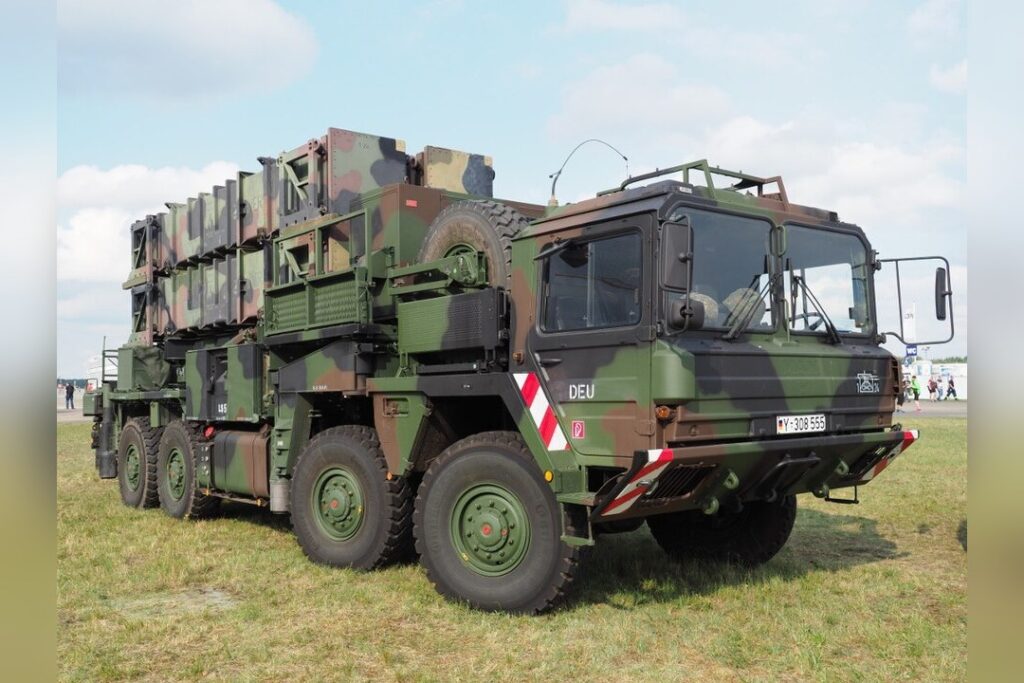
WASHINGTON, July 8 — Former U.S. President Donald Trump has reportedly given Ukrainian President Volodymyr Zelensky the green light to produce Patriot missile systems on Ukrainian soil, a move that would fundamentally alter the logistics of the war and the business of air defense. The mechanics here are worth unpacking. The Patriot system, developed by Raytheon (now folded into RTX Corporation), is not a simple piece of kit.
It is a long-range, all-altitude, all-weather air defense system that first entered U.S. Army service in 1981. It gained its battlefield reputation during the 1991 Gulf War, intercepting Scud missiles.
The system fires MIM-104 missiles and has been upgraded through multiple configurations, including the PAC-2 and PAC-3 variants. Ukraine has been operating at least three Patriot batteries since 2024, supplied by the United States, Germany, and the Netherlands beginning in 2023. Those batteries have been used to defend against Russian missile and drone attacks.
But the catch has always been supply: every interceptor fired is one that must be shipped from a foreign factory, a process governed by export controls, production schedules, and political will. On closer reading, Trump’s reported approval for local production aims to bypass that bottleneck.
The proposal would allow Ukraine to manufacture the missiles domestically, reducing dependency on foreign supplies and potentially accelerating deployment. No specific timeline or production capacity has been announced, so the scale of any future Ukrainian factory remains unknown. Follow the money, and the politics becomes clearer.
Trump has stated a goal of reducing the U.S. military aid burden while strengthening Ukraine’s self-defense capabilities. The offer aligns with that calculus: shift the production cost and risk to Kyiv, while keeping the strategic benefit of a capable Ukrainian air defense network. The question is whether the economics work for a country under bombardment.
But the proposal is not a done deal. It requires approval from the U.S. Congress, which controls arms export policy, and it must comply with the International Traffic in Arms Regulations (ITAR), the complex set of rules governing the transfer of defense articles.
ITAR compliance alone can take years and millions in legal and administrative costs. A Ukrainian production line would need to satisfy U.S. inspectors that no technology leaks to unauthorized parties — a non-trivial requirement in a war zone. The Patriot system’s technical complexity adds another layer.
The PAC-3 variant, the most modern in Ukrainian service, uses hit-to-kill technology that requires precision manufacturing. Setting up that capability from scratch in a country under daily attack is a different proposition from assembling imported components in a secure facility.
The source material does not specify which variant Ukraine would produce, nor whether the deal covers the complete missile or just assembly of subcomponents. For RTX Corporation, the parent company, the implications are mixed. A Ukrainian production line could mean licensing fees and technology transfer revenue, but it also means ceding control over production to a foreign government in the middle of an active conflict.
The company’s shareholders will be watching the congressional debate closely. The timing is notable. Trump’s reported approval comes as the war enters its fourth year, with both sides facing attrition in equipment and ammunition.
Ukraine has proven adept at adapting Western systems to its own tactical needs, but it has not previously attempted to manufacture a complex Western missile system. The proposal represents a significant vote of confidence in Ukrainian engineering and industrial capacity.
What to watch next is the congressional reaction. The U.S. Congress has historically been protective of ITAR and skeptical of licensing sensitive technology to countries with weaker intellectual property regimes. The debate will likely center on whether the strategic benefit of Ukrainian self-sufficiency outweighs the risk of technology loss.
The source material gives no indication of where key committee chairs stand, so the outcome remains uncertain. For now, the announcement exists as a political signal: Trump is willing to go further than previous administrations in empowering Ukraine’s own defense industry.
Whether that signal translates into actual missiles rolling off a Ukrainian assembly line depends on a chain of approvals, investments, and technical milestones that have not yet been specified.




