
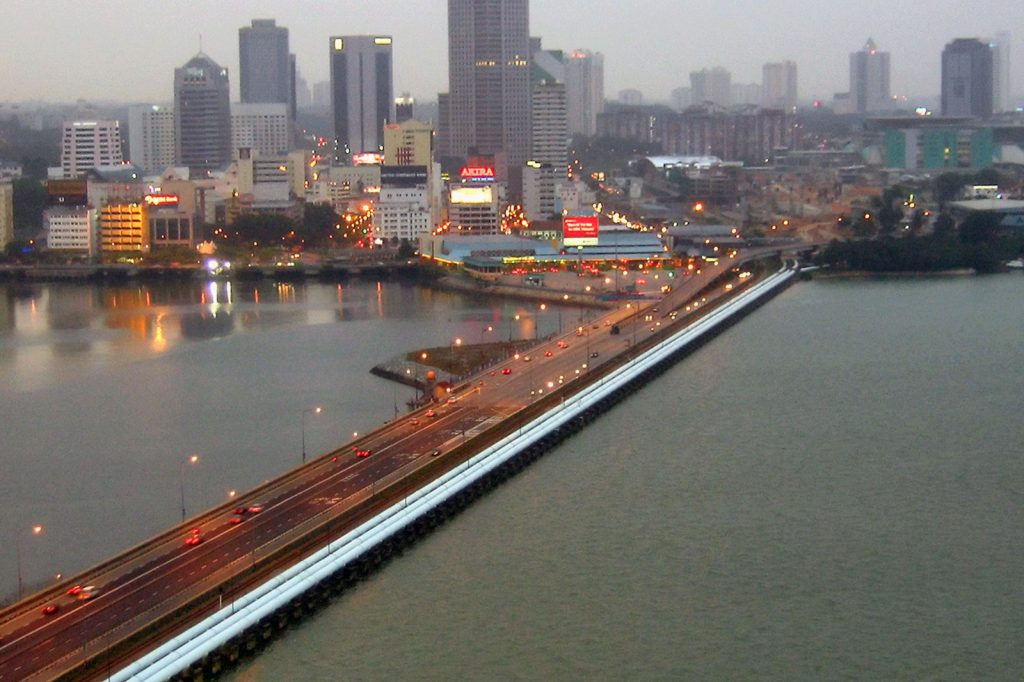
Singapore pays 3 sen for every thousand gallons of raw water it takes from the Johor River. That price was set in 1962, and as of July 2018 neither government could change it on its own.
Here’s what the 1962 Water Agreement actually says. Singapore holds the full and exclusive right to draw up to 250 million imperial gallons a day (mgd) from the river. Johor, in return, may buy treated water back, capped at 2 per cent of the total Singapore imports on a given day. In plain terms, that is about 5 mgd, and only if Singapore can pull its full 250 mgd. The price Johor pays for that treated water is 50 sen per thousand gallons, which Singapore’s government describes as a fraction of what treatment really costs.
Singapore has been sending more than the deal requires. At Malaysia’s request, it has regularly supplied Johor with 16 mgd, and at times up to 22 mgd. The extra water is billed at the same 50 sen rate. Singapore calls this goodwill and says it does not weaken its rights under the agreement.
Why the price is stuck
Singapore’s argument is blunt. Both countries must follow every provision of the 1962 text, price included, and a breach would call into question the Separation Agreement, which Singapore treats as the basis of its existence as an independent state. Neither side can rewrite the terms alone.
The agreement did leave a door open. It allowed a joint price review after 25 years, in 1987. Malaysia did not use that right, and according to Singapore it has lapsed.
Singapore says it acted on that basis. It built the Linggiu Dam at a cost of over S$300 million, which raised the yield of the Johor River, and Malaysia benefits from that too. The two countries last reaffirmed the 1962 terms in January 2018, at the 8th Singapore-Malaysia Leaders’ Retreat.
Where Singapore’s water comes from
The 250 mgd ceiling matters because it caps what Singapore can import. Local catchment cannot grow much, since two-thirds of the island is already catchment area. Any new supply has to come from NEWater or desalination. Both are weather-resilient. Both cost more to produce.
Demand is heading up. Singapore uses 430 mgd today, and the government projects that figure will roughly double by 2060. Three desalination plants were running at the time of writing, with two more due at Marina East and Jurong Island by 2020. Work had begun on Phase Two of the Deep Tunnel Sewerage System, which is meant to boost NEWater output once it is finished in 2025. By 2060, the government says, desalination and NEWater together should cover up to 85 per cent of the country’s needs.
Households are part of the plan. Daily use fell from 148 litres per person in 2016 to 143 litres in 2017. The government’s message to residents: “Save water where you can. Make every drop count.”




