
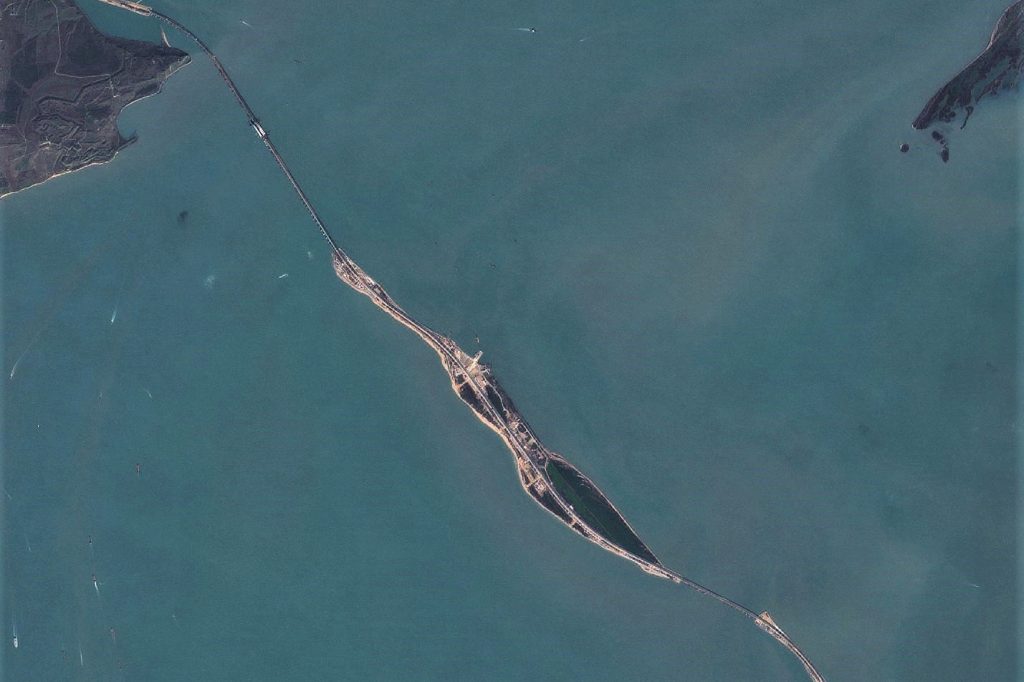
Ukraine Strikes Underwater Supports of the Crimean Bridge Again
On June 3, 2025, Ukrainian forces attacked the submerged foundations of the Crimean Bridge, the 12‑mile span that links the annexed peninsula to the Russian mainland. The strike hit the underwater supports, forcing the structure to close for several hours and temporarily severing a vital supply line. The Security Service of Ukraine took responsibility for the operation, saying it was aimed at weakening Moscow’s hold on the territory.
This is not the first time the bridge has been targeted. In October 2022 a truck bomb damaged the roadway, and in July 2023 naval drones struck the same crossing.
Each attack has chipped away at the Kremlin’s narrative that Crimea is securely and permanently Russian, and each has obliged Moscow to divert resources to protect a fixed, vulnerable point while it continues fighting on land. The timing fits the broader pattern of a war of attrition. Ukraine has been engaged in combat for more than three years, and Western military assistance, though substantial, has arrived in irregular bursts.
The effectiveness of that aid is now under close examination. A successful hit on a heavily defended piece of infrastructure indicates that Ukrainian intelligence and special‑operations capabilities have not been degraded.
It also suggests that the tools employed—likely a mix of domestically produced drones or missiles, or adapted naval systems—are able to penetrate Russian defenses. Russia’s reaction so far has been restrained, but history shows that will not last. After the earlier assaults on the Kerch Strait bridge, Moscow responded with large‑scale missile barrages against Ukrainian energy grids and urban centers. A similar escalation is expected this time, with the Kremlin likely using the explosion as justification for further strikes.
The Kremlin continues to deny any wrongdoing in the region, even as its forces occupy Ukrainian territory. The blast gives it a pretext to intensify its campaign.
For the United States, the situation presents a delicate calculation. The administration has been a vocal supporter of Kyiv’s sovereignty and has taken a firm stance against Russian aggression. At the same time, the White House worries about escalation, recognizing that strikes on Russian‑occupied Crimea—territory Moscow claims as its own—walk a fine line.
Washington supplies the weapons and intelligence but does not dictate exactly how they are employed. The president is expected to comment on the matter in the coming days.
Historically, the administration’s public line has been to condemn Russian actions in the area while refraining from criticizing Ukraine’s defensive measures. From a military perspective, the bridge is far more than a symbolic monument. It functions as a key supply route, carrying tanks, fuel, ammunition, and troops from the Russian mainland into Crimea.
From there, those forces move south into the Kherson and Zaporizhzhia regions. Disrupting that flow is a direct military objective, and the Ukrainian operation explicitly aims to weaken Russia’s grip on the occupied territories.
Western allies are watching closely. They are likely to condemn Russia’s behavior in the region while refraining from blaming Ukraine for defending itself. The narrative remains that the explosion is a reminder that the conflict has no imminent end; front lines shift slowly, but the deeper struggle—targeting logistics, command posts, and symbolic assets—continues at a relentless pace.
The Crimean Bridge, both a piece of propaganda and a genuine logistic artery, was struck again on June 3. The water beneath it trembled, and the war pressed on.




