
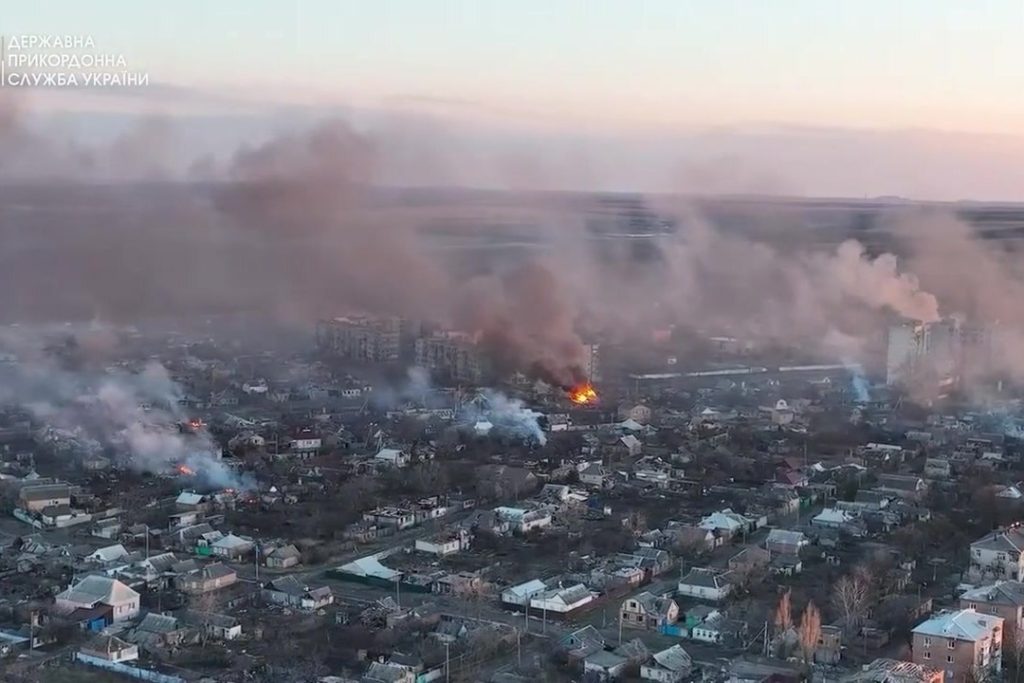
The shift is that the map barely matters now. Four years after the full-scale invasion launched on February 24, 2022, the war in Ukraine has settled into lines that hardly move: a front of roughly 1,000 kilometers from Kharkiv down to Kherson, static since late 2023, with fighting measured in daily attack counts rather than district captures.
By the numbers, as of January 2026: Russia holds roughly 18 percent of Ukraine’s internationally recognized territory, about 110,000 square kilometers including Crimea, of which some 42,000 square kilometers were taken since 2022. Around four-fifths of the country remains under Kyiv’s control. Day to day, the count runs to 100 to 150 attacks along the front.
How the Front Froze
The line was not always still. The invasion’s first push reached the outskirts of Kyiv before Russia withdrew from northern Ukraine in March-April 2022, with Bucha, Irpin and Hostomel freed. That September brought a double shock: the Nord Stream pipeline sabotage in the Baltic, attribution still disputed, and annexation referendums across four Ukrainian oblasts, votes widely rejected internationally, even as Ukraine rolled up more than 6,000 square kilometers in a lightning Kharkiv advance that took Izium, Kupiansk and Lyman. In November, Russia pulled back across the Dnipro and Kherson became the sole regional capital to be liberated.
Then the geometry locked. Bakhmut fell in May 2023 after a ten-month siege led by the Wagner Group; the Kakhovka dam collapsed that June with each side blaming the other; the summer counteroffensive broke on dense minefields with only limited gains. Russia’s reward was Avdiivka in February 2024. Ukraine’s answer was asymmetric: the August 2024 Kursk incursion, the first taking of Russian soil by a foreign force since WWII, which at its peak covered 1,300 square kilometers, forced Russian redeployments and evacuations of 100,000-plus civilians, and still leaves Kyiv holding roughly 600 square kilometers as a bargaining chip.
By early 2026, Russia claims to have “annexed” Donetsk, Luhansk, Zaporizhzhia and Kherson oblasts yet fully controls none of them: about three-fifths of Donetsk, all but small pockets near Kreminna in Luhansk, and seven-tenths each of Zaporizhzhia and Kherson. The hottest spots are the Pokrovsk logistics hub, the Kupiansk sector and urban fighting in the Toretsk mining towns.
What Is Changing Underneath
The trend underneath the frozen line is technology and reach. Ukrainian strikes have pushed the Black Sea Fleet largely to Novorossiysk, put multiple S-400 systems out of action, and damaged the Kerch bridge twice, in October 2022 and July 2023, though it stays operational. The official Kyiv line has not moved either: “Crimea is Ukraine. Its liberation remains our goal, whether by military force or negotiation.”
Diplomacy, meanwhile, runs alongside the guns without joining them. February 2025 brought the first Trump-Putin phone contact and plans for Saudi Arabia talks. The August 15, 2025 Alaska summit, Putin’s first US visit in a decade, produced warm words, not paper: Trump called it “extremely productive” but said “there’s no deal until there’s a deal,” and Putin confirmed nothing was signed while citing “certain possibilities”. US envoys Witkoff and Kushner held overnight talks with Putin in Moscow on January 22, 2026, and in May 2026 Putin traveled to Beijing to reaffirm a “strategic partnership” with China.
Watch this space: the front is frozen, the strikes keep lengthening, and the two tracks, attrition and negotiation, have yet to meet. A war that began with a dash for the capital is now a test of who runs out of endurance first.
Sources
- Ukraine War Map 2026: Current Frontlines & Territorial Control | Ukraine Analytics
- The Russia–Ukraine War: Geopolitical Coverage Report




