The number that frames this war: Russia holds about 18% of Ukraine, roughly 110,000 sq km of the country’s 603,628, by some counts up to 20%, and the BBC now counts the conflict in its fifth year. The shift is slow and measurable in only one direction. The Institute for the Study of War, a US-based tracker, credits Russia with about 4,700 sq km of new ground in 2025, some 1,800 sq miles, roughly twice the footprint of Moscow itself; Moscow’s own claim runs to 6,000 sq km. What’s changing is not the shape of the map but the pace: grind, not collapse.
The oblast ledger, as of February 2026, reads like a war long since frozen into layers. Crimea: fully held since 2014. Luhansk: effectively all of it. Donetsk: about 80%, with fighting still grinding near Pokrovsk and Chasiv Yar. Zaporizhzhia: around 70%, nuclear plant region included. Kherson: about 60%, meaning the east bank of the Dnipro, while the city itself was liberated in November 2022. Kharkiv region is down to about 3%, Sumy to roughly 1%, and Ukraine still clings to a 200 to 400 sq km slice of Russia’s Kursk region. The occupied zone is not one block; it is a set of fronts with a decade of history stacked behind each line.
The legal layer is thinner than the military one. Shortly after the invasion, Russia staged referendums meant to annexe Luhansk, Donetsk, Zaporizhzhia and Kherson, copying its 2014 Crimea playbook, but it has never fully controlled any of the four. An American-backed peace plan unveiled in November would have had Kyiv cede Luhansk, Donetsk and Crimea entirely, plus the Russian-occupied slices of Zaporizhzhia and Kherson, with Ukraine’s remaining holdings in Donetsk becoming a demilitarised zone under de facto Russian control. Zelensky has consistently refused to trade the Donbas for peace, calling it a launchpad for the next war.
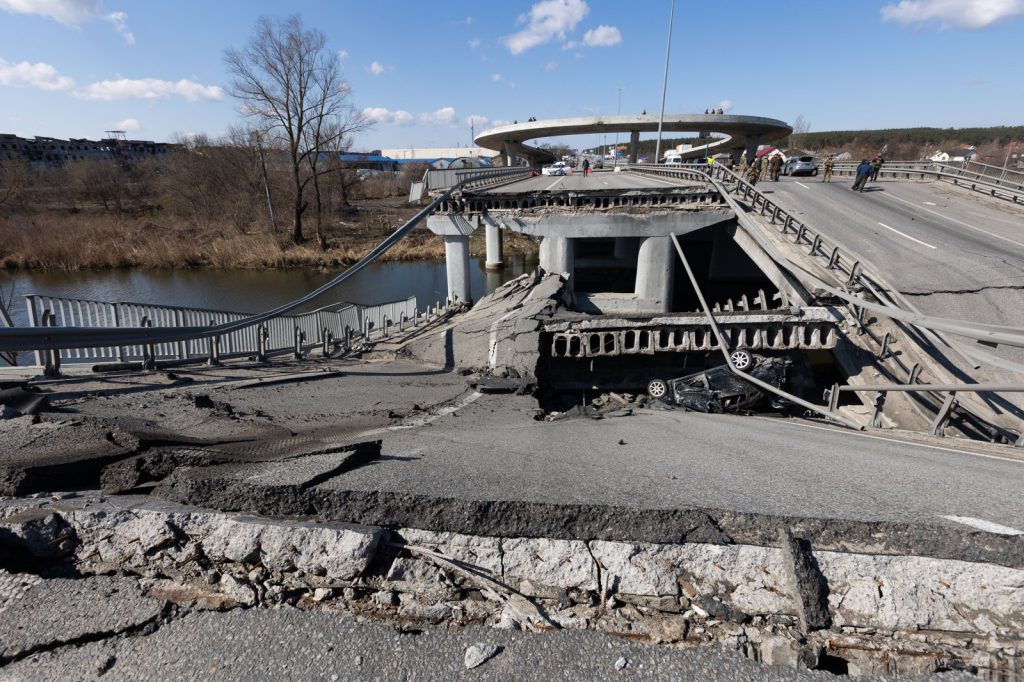
Rewind the tape and the map has swung hard both ways. Russia’s occupation peaked at about 27% in early March 2022. Ukraine has since taken back about 54,000 sq km: the Kyiv, Chernihiv and Sumy areas in that first spring, roughly a tenth of the country; the September 2022 Kharkiv counteroffensive, some 12,000 sq km in days; Kherson city and the right bank that November. The 2023 push added just 300 sq km. In 2024 Russia ground out about 1,500 sq km in Donetsk and took back most of its Kursk losses. The occupied-city roll tells the same story in names: Mariupol since May 2022, Bakhmut since May 2023, Avdiivka since February 2024, Melitopol and Berdyansk in the south, Donetsk and Luhansk cities since 2014.
Where the map still moves, the “fortress belt” is the word that matters. A recent ISW report describes a fortified line some 50km, or 31 miles, across western Donetsk. “Ukraine has spent the last 11 years pouring time, money, and effort into reinforcing the fortress belt and establishing significant defence industrial and defensive infrastructure,” it writes. The hinge is Pokrovsk, a town of roughly 23 sq km that Russia has hunted for close to two years, once a logistics hub for Kyiv’s army and now in ruins; Moscow claims it taken, Ukraine says it still holds the northern edge. Its fall would be Russia’s largest battlefield win since Avdiivka, about 40km to the east, in early 2024, opening the road toward Kramatorsk and Sloviansk. But the ISW notes the fortress-belt cities are “significantly larger”, and figures Russia would need two more years to swallow the rest of Donetsk “at great cost”.
Two other axes run through the data. In the north, Russia is pushing toward Kupyansk and a buffer strip inside northern Ukraine that would bring Kharkiv, Ukraine’s second city, into artillery range; Putin wants the zone, he says, because of Ukraine’s summer 2024 grab of land in Kursk, since reversed with the help of North Korean troops. And both sides strike deep: Ukraine sent 100 drones after Russia’s nuclear-capable long-range bombers across five regions, with damage confirmed only in Murmansk and Irkutsk, plus a mass drone attack on Volzhsky on 11 February. Russia’s answer lands on the grid: dozens of hits on energy infrastructure around Kyiv overnight on 22 February, leaving tens of thousands with blackouts, dry taps and cold homes in the worst weeks of winter, until a week’s pause followed a direct request from Donald Trump to Putin.
Watch the negotiating table next. Trump is leading the push; Zelensky says Washington wanted the war over by June. The latest Russia-Ukraine-US round in Geneva ended 18 February with no breakthrough, though a Ukrainian diplomatic source counted progress on “military issues” such as where the front line sits and who monitors a ceasefire, and White House spokeswoman Karoline Leavitt said “there was meaningful progress” and an agreement to “continue to work towards a peace deal together”. Territory, the issue without which no truce holds, remains stuck. The human ledger behind it: 55,000 Ukrainian soldiers killed by Zelensky’s own February count, almost 160,000 names of Russia’s dead confirmed by the BBC, more than 70,000 people officially missing, 6 million refugees registered across Europe and 5 million displaced inside Ukraine. The 18% has held for years now. The history of this map says it can move again, fast. Watch this space.
Sources
- Ukraine in maps: Tracking the war with Russia
- Ukraine Territorial Control — Data & Maps 2026 | Ukraine War Analytics