
The drone war in Ukraine gets narrated as a story of gadgets. The mechanics here are really an exchange rate. The aircraft that opened the war was a prestige purchase; the one that defines it now costs less than a good laptop. Follow the record across four years and you watch a market reprice itself in real time.
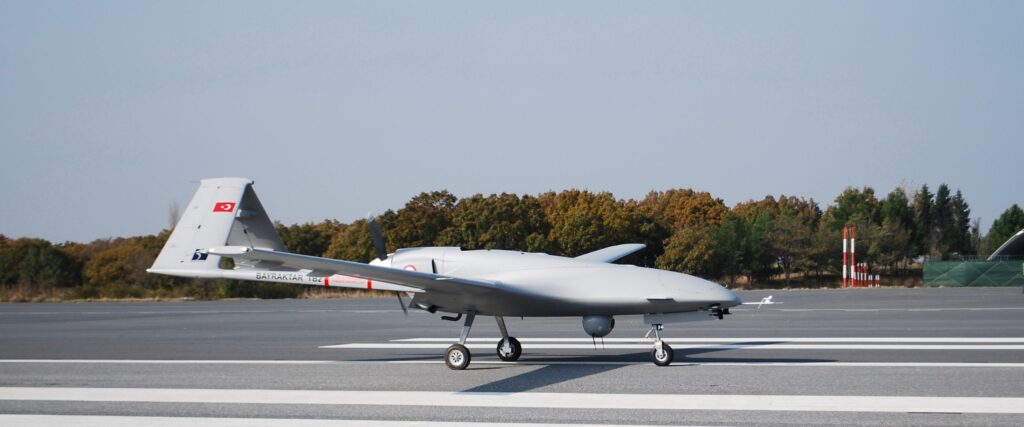
Ukraine entered 2022 with approximately 36 Bayraktar TB2s, and between February and May those drones achieved dramatic results against columns of Russian armor and supply convoys on the Kyiv and Sumy axes, later over Kherson and Snake Island, firing MAM-L micro-munitions. The catch showed up by mid-2022: Russia fielded more electronic-warfare jamming and short-range air defenses built for the altitudes the TB2 worked at, and the fleet drifted toward reconnaissance. By May 2023 its use was so restricted that when a TB2 lost control on a scheduled evening flight over Kyiv, the air force destroyed it rather than let it wander, after the presidential office had first billed it as an enemy drone. Shooting down your own emblem is a market signal.
Then the arithmetic moved to the attacker’s side. Russia’s Shahed-136, a delta-wing machine with a piston engine and the “lawnmower” sound, carries roughly a 50 kg warhead 2,000 km at low altitude, and costs $20,000-50,000 against cruise missiles at $1-3M. Nightly waves of 50 to more than 100 came by winter 2022-23, rising to 100-200 in the 2024 to 2025 period, with domestic output at the Alabuga plant. Follow the money on interception: each NASAMS AMRAAM missile runs about $400,000 against a $50,000 target, an exchange rate of eight to one in Moscow’s favor. Attrition, priced as strategy.
The counter was not a better TB2 but a cheaper everything. Volunteer engineers turned FPV racing quadrotors into delivery vehicles for PG-7V rocket-grenade warheads: 90-150 km/h, 3-5 km of range, $300-800 in components, production climbing from tens of thousands per month in 2023 to hundreds of thousands by 2024, and more armored-vehicle kills than any other platform. A T-90M at $4-5 million destroyed by a $500 drone is a 10,000:1 ratio; that is why the M1 Abrams left the front line, why Leopard 2 crews developed drone-escort tactics, and why tanks carry “cope cages”.
Defences answer in kind: volunteer “drone hunters” with shotguns along the Shahed corridors, mobile jamming vehicles, adapted ZU-23-2 autocannon, Western Skyranger-type guns and net launchers, armour working from “drone dead zones” and moving at night. Against jamming, the next bet is autonomy: GPS-independent optical navigation and scene recognition. The layering is the point: no single system survives. In this market, the cheap and many keep beating the expensive and few, and the repricing is the war.
Sources
- Ukraine Drone Warfare Evolution 2022–2026: From Reconnaissance to Mass Attack | Ukraine War Analytics
- Ukraine Air Force 'Shoots Down' Its Very Own Bayraktar TB-2 Drone Over Kyiv; Bystanders Cheer The Sky Spectacle




