
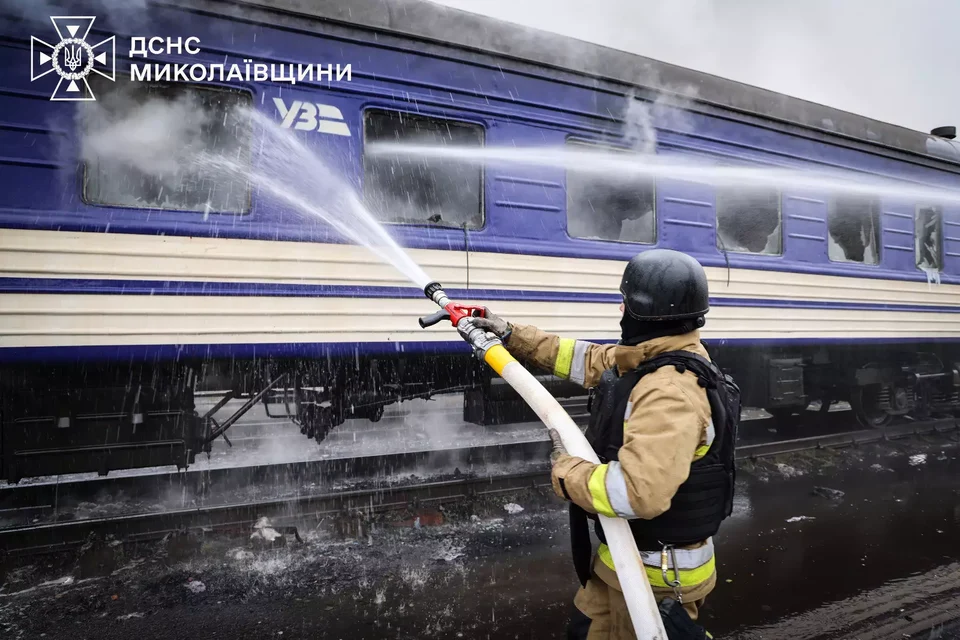
“This wasn’t our train, but the one just minutes after us by the border crossing.” That is how Carl Bildt, the former Swedish prime minister, described Sunday’s drone strike on a passenger train in western Ukraine. He had been heading back to Europe by rail after a conference in Kyiv, and he said on X that the train behind his was evacuated as the drone closed in. No one was hurt.
The train was hit on September 13, in Ukraine’s Volyn region, about two kilometres (1.2 miles) from the Polish frontier near the Yahodyn-Dorohusk crossing, according to the Financial Times and Notes from Poland. Poland’s PKP Intercity said the service ran from Kyiv to Warsaw with 206 passengers aboard. Reports said the locomotive was damaged. Ukrainian railway staff had received an early warning of a drone threat, and the carriages were emptied before impact.
Was a diplomatic train the target?
Ukraine’s railway operator, Ukrzaliznytsia, floated an explanation on Telegram. Timetables on the line are adjusted in real time because of the constant threat of strikes, and a service carrying diplomats had left earlier than scheduled. “It is entirely possible that the Russian drone’s intended target was the diplomatic train,” the company wrote. Boris Johnson, also on that earlier train, called the attack “random and senseless” in an Instagram post.
President Volodymyr Zelensky went further and said Moscow struck the train “deliberately”. Russia’s Defence Ministry offered its own framing: it said it had hit infrastructure that helps move military cargo from Europe into western Ukraine.
Strikes along the border
The train was not the only target near the crossing. Earlier that day a truck was hit less than one kilometre from the border, and Ukrainian officials put the spot at around 800 metres from a Polish checkpoint. A petrol station near Yahodyn was damaged as well. Border guards briefly halted traffic at the Dorohusk-Yahodyn crossing. Reuters noted that Russia has begun going after Ukraine’s border crossings with its Western allies in recent weeks, part of a wider contest in which each side tries to wear down the other’s economy more than four years into the invasion.
Polish Foreign Minister Radoslaw Sikorski, speaking at a press briefing in Kyiv, called the strikes “an escalation” and “another great challenge for Ukraine and for the hypothetical future victims of Russian aggression”. He urged Ukraine’s partners to “double our efforts to support victims of aggression.”
Ukrainian Foreign Minister Andrii Sybiha used sharper language. “This is Putin’s terror, ‘knocking’ directly on the doors of the EU and NATO,” he said, and asked allies to respond. Kyiv has pressed for more sanctions on Moscow as the air campaign continues.
A wider night of strikes
The train attack came amid a broader assault that included hundreds of drones and hits on civilian infrastructure across Ukraine. With the front line largely static, both Moscow and Kyiv have stepped up long-range strikes to try to shift momentum. Overnight, the head of Rosatom accused Ukraine of striking fuel trucks near the Zaporizhzhia nuclear power station, and the mayor of Nizhnekamsk in Tatarstan reported at least two deaths after Ukrainian drones hit “civilian and industrial” targets in his city.
Sources
- Russian drone hits Kyiv-Warsaw train near Polish border, Poland FM calls attacks escalation
- Russia hits passenger train on Ukraine’s border with Poland, just misses ‘diplomatic train’




