
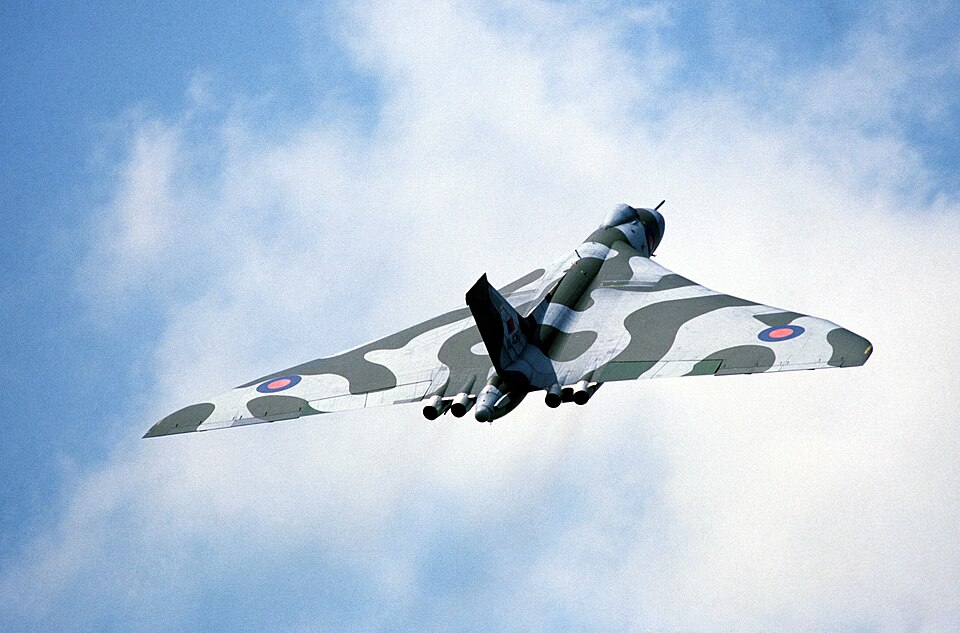
Eleven Victor tankers took off from Ascension Island to put one Vulcan bomber over a runway in the Falklands. Most of them never went near the target. They existed to hand each other fuel, in the dark, in a chain that stretched across the South Atlantic.
That was Operation Black Buck, the RAF’s answer to a problem of pure distance. Argentina had invaded the islands on 2 April 1982, and the nearest usable British airfield was Wideawake on Ascension. The Vulcan had been built as a nuclear bomber for the Cold War and was meant for medium-range work in Europe. It could not reach Port Stanley without being refuelled several times, and the tankers, mostly converted Victor bombers, had to be refuelled themselves. By the numbers, the round trip came to almost 6,600 nautical miles and 16 hours. At that point, no bombing raid had ever flown farther.
A rushed plan for old aircraft
Britain’s War Cabinet under Margaret Thatcher approved the concept on 27 April. Vulcan crews from No. 44, No. 50 and No. 101 Squadron had barely practised conventional bombing or air-to-air refuelling in years, so they relearned both in a hurry. The target was the Port Stanley runway, the only strip on the islands that could one day take Argentine fast jets.
The first raid ran on 30 April into 1 May. Flight Lieutenant Martin Withers flew the Vulcan that went in, with 21 bombs of 1,000 pounds each. His aircraft was the reserve; the intended lead jet lost cabin pressure after takeoff and he took over at short notice. One bomb hit the runway and left a crater. Three Argentine personnel are believed to have died.
Five raids that finished, two that did not
Seven missions were planned and five were flown to completion. Three went after the runway and its facilities. The other two, Black Buck 5 and 6, used American-supplied Shrike missiles against Argentine radar. The target was a Westinghouse AN/TPS-43, but its operators kept switching it off when the Vulcan closed in. On 3 June the crew of Black Buck 6 circled for 40 minutes, then fired two of their four missiles at a Skyguard fire-control radar instead, killing four operators.
The flight home went badly. The Vulcan’s refuelling probe broke, and it diverted to Rio de Janeiro, where Brazil interned the crew. It was also awkward diplomatically, since the episode showed Washington had supplied the Shrikes. A deal on 4 June freed the aircraft in return for Lynx helicopter spares.
The last mission, on 12 June, went for Argentine troop positions around the airport. The bombs had been fused to explode on impact by mistake, and all 21 missed what they were aimed at. The Argentine garrison gave up two days after that.
What it achieved
Less than the effort suggested. The single crater stopped fast jets from using the runway, but Argentine ground crews patched it within twenty-four hours well enough for C-130 Hercules transports, and the British knew the strip stayed in use. Damaged radars were quickly replaced. It has also been suggested that the RAF wanted a bigger role in the war to protect itself from further cuts after the late 1970s.
Black Buck did leave one lasting trace in tactics: the improvised hunt for a radar that kept turning itself off is an early version of the suppression of enemy air defences that anti-radiation missiles are built for today.




