
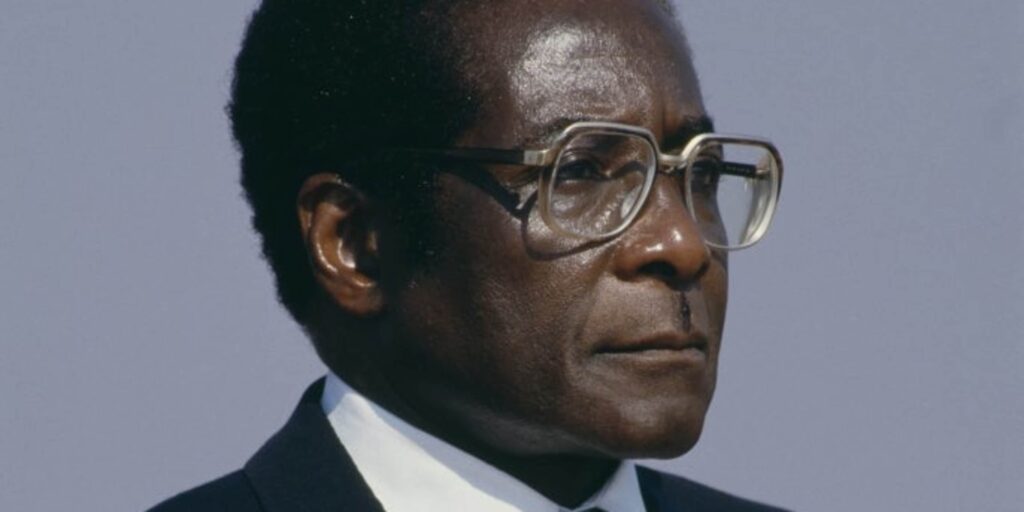
Robert Mugabe once joked that he would govern Zimbabwe until he reached 100. By mid-November 2017 he was 93, and ARY News reported that his hold on power looked to be slipping as friction grew between his ZANU-PF party and the military that had kept him in office for so long.
From political prisoner to prime minister
Mugabe was born on February 21, 1924, into a Catholic family at Kutama Mission, northwest of Harare. He was a solitary, bookish boy who reportedly read even while minding cattle. His carpenter father left when he was 10, and he qualified as a schoolteacher at 17. He enrolled at Fort Hare University in South Africa, where he met many of the region’s future nationalist leaders, and he taught in Ghana, where Kwame Nkrumah influenced him.
Back in Rhodesia, he was detained in 1964 for nationalist activity and spent the next ten years in prison camps or jail. He earned three degrees by correspondence in that time. His four-year-old son by his first wife, Sally Hayfron, died while he was locked up, and Ian Smith refused him leave to attend the funeral.
After his release in 1974 he took control of one wing of the guerrilla war, the Zimbabwe African National Union and its armed forces. A violent insurgency and sanctions eventually pushed the Rhodesian government to negotiate, and Mugabe won the 1980 elections. At first he drew praise abroad for preaching racial reconciliation and for expanding schooling and health care for the black majority. The goodwill did not last.
Gukurahundi
His partner in the war, Joshua Nkomo of ZAPU, was among the first to fall foul of him. Nkomo held the home affairs portfolio until 1982, when an arms cache turned up in his Matabeleland stronghold and he was dismissed. Mugabe, whose support came mostly from the Shona majority, then sent the North Korean-trained Fifth Brigade against Nkomo’s Ndebele people. The campaign, known as Gukurahundi, killed an estimated 20,000 suspected dissidents.
Land seizures and economic decline
Nearly two decades later, the seizure of white-owned farms turned the man the West had once courted into an international outcast. The policy was meant largely to calm war veterans who threatened to destabilise his government. It wrecked agriculture, sent investors running and pushed the country into hardship. Critics say he stayed in office through tighter repression and rigged elections. Biographer Martin Meredith put it bluntly: “His real obsession was not with personal wealth but with power.”
Mugabe leaned into his role as the West’s antagonist and blamed the slide on sanctions, although those targeted him and his associates personally, not the wider economy. In a 2013 documentary he waved off the dictator label as an attempt to “tarnish and demean” him. Shadrack Gutto, a professor at the University of South Africa, described a great leader whose leadership degenerated until he “brought Zimbabwe to its knees.”
Peter Carrington, the former British foreign secretary who mediated the Lancaster House talks, was harsher in his private judgment. He told biographer Heidi Holland that Mugabe had “a sort of reptilian quality” and that you could admire his intellect, but he was an “awfully slippery” man.
Frailty and the succession fight
Succession was long a forbidden subject. As Mugabe passed 90 and grew visibly frail, a bitter contest among party elites became obvious. Rumours of prostate cancer persisted for years, though the official line held that his frequent trips to Singapore were for cataract treatment. He fell more than once and read the wrong speech at the opening of parliament the year before.
His second wife, Grace, his former secretary and 41 years his junior, was widely seen as a front-runner to take over. Mugabe, characteristically, mocked the death rumours in 2016: “It’s true I was dead. I resurrected as I always do.”




