
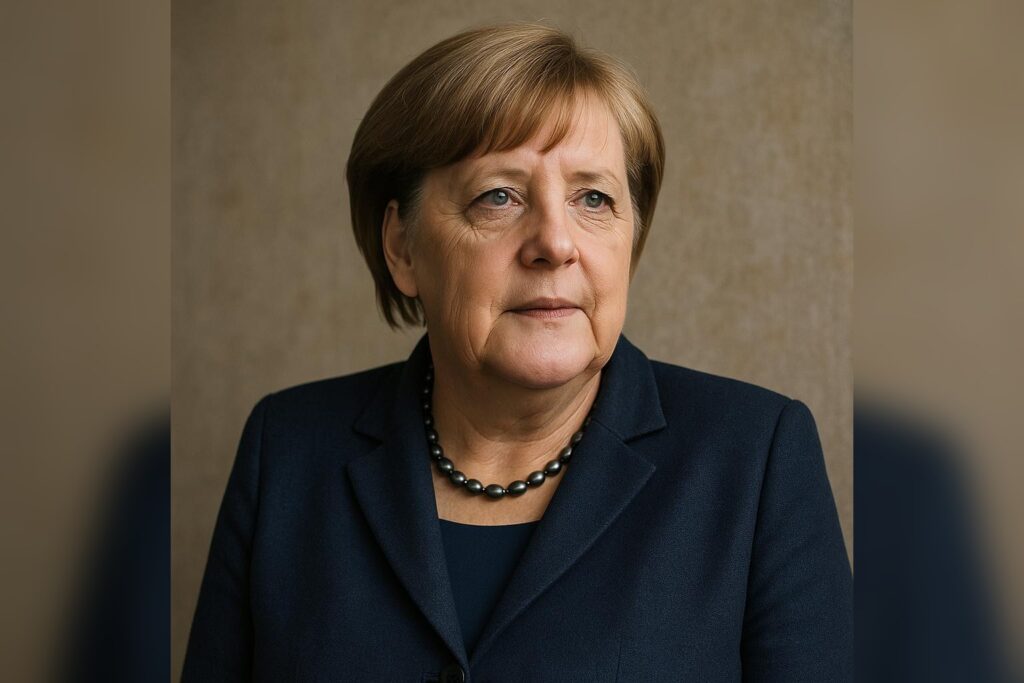
At nine years old, Angela Kasner stood on the edge of a 3-metre diving board and stared at the water for 45 minutes, her class waiting below. She jumped only when the school bell rang. “That’s just how I am, not particularly courageous,” she said later. “It always takes me a while to weigh the risks.” She would become Angela Merkel, and the habit stayed with her for 16 years as German chancellor.
Growing up in the GDR
Merkel was born in Hamburg in 1954 but grew up in the German Democratic Republic, in the small town of Templin north of Berlin, among forests and glacial lakes. Childhood was not always idyllic. Food queues were common, and the impression lasted: she later admitted to a habit of hoarding and buying things she did not need. Yet she also reflected that life in the GDR, where so much was out of her control, was “almost comfortable in a certain way.”
A quiet, studious child, she mastered Russian. Like many others she joined the Free German Youth, and managed the communist system with a wistful eye on the West, fed by films and books smuggled into the parsonage by relatives. An aunt in the West sent her the jeans she could not buy at home. She later chose physics because “there, the truth isn’t so easily bent.” When a Stasi officer tried to recruit her at a university job in the 1970s, she declined, saying she could not keep her mouth shut. She never joined the ruling SED party, and never joined the opposition either. She earned a doctorate in quantum chemistry from the Academy of Sciences in East Berlin in 1986.
When the Berlin Wall fell in 1989, she did not rush west. She went to her usual Thursday sauna with a friend. “I figured if the wall had opened, it was hardly going to close again, so I decided to wait,” she recalled.
An unlikely rise
At 35, a scientist with no political base, Merkel seemed an unlikely recruit to politics. Within a year of reunification she was in the Bundestag and minister for women and youth, chaperoned throughout by Chancellor Helmut Kohl, said Judy Dempsey, author of The Merkel Phenomenon. The CDU was then mostly Catholic men from the West. “They thought they could really walk over her, but she saw her male opponents off one by one,” Dempsey said.
She had also learned to take risks. In 1999 she criticised Kohl, her mentor, in a newspaper article, something unthinkable inside the CDU. Scandals engulfed other party leaders, and she ended up, in POLITICO journalist Matthew Karnitschnig’s words, “the last woman standing.” A narrow victory of about 1% in the 2005 election made her Germany’s first female chancellor, on November 22, 2005. Uneasy in the spotlight, she began holding her hands together, a pose that became known as the “Merkel Raute.”
Crises
Her first major test was the euro crisis. As Greece, Spain, Ireland and Portugal faced collapse under huge debts, she refused to bail them out without structural change. Greeks loathed her, and some compared her to a Nazi. She held her line and won a reputation as the “Iron Chancellor.”
The 2015 refugee crisis turned that image on its head. As 1.3 million migrants, mostly fleeing Syria, reached Europe that summer, she was criticised after telling a 14-year-old Palestinian girl she might be deported, a viral clip showing an uncomfortable Merkel trying to console her. A month later, after visiting a refugee camp in Dresden, she gave the speech of her tenure: “Wir schaffen das!” More than 1 million people came to Germany, and the decision inspired and divided the nation. Karnitschnig said it was made in the heat of the moment, when she believed fewer people would come. “If we start having to apologise for showing a friendly face in emergencies, then this is not my country,” she said.
It had a political cost. In her final election, the CDU/CSU vote fell by more than eight points, and the far-right Alternative for Germany entered the Bundestag with more than 12%. “We will hunt Frau Merkel,” AfD leader Alexander Gauland told supporters. She served through the global financial crisis, Europe’s debt crisis, the refugee arrivals of 2015-16 and the COVID-19 pandemic, and across populism’s rise from Brexit to Donald Trump. Their relationship was acrimonious, and she was dubbed the “liberal West’s last defender.”
Leaving
She left office aged 67 in December 2021, about a week short of Kohl’s record for longevity, handing over to Olaf Scholz. She served alongside four US presidents, four French presidents and five British prime ministers. At home she left lower unemployment and healthier finances, but also shortcomings in digitisation, with health offices using fax machines during the pandemic, and criticism of weak infrastructure investment. She had announced in 2018 that she would not seek a fifth term, but failed to secure a smooth handover in her own party, which slumped to defeat in September 2021.
Even so, her popularity outstripped that of her three would-be successors during the campaign she largely sat out. She took her own shopping, lived in the same Berlin apartment as before taking the job, and chose the moment of her departure, unlike her seven postwar predecessors. In German, the verb “merkeln” now means holding off on a decision.
Sources
- 'They thought they could really walk over her': The many men who underestimated Angela Merkel
- Angela Merkel the Physicist: How a Scientist Ran Germany
- End of an era: Angela Merkel's last full day as Germany's leader after 16 years




