
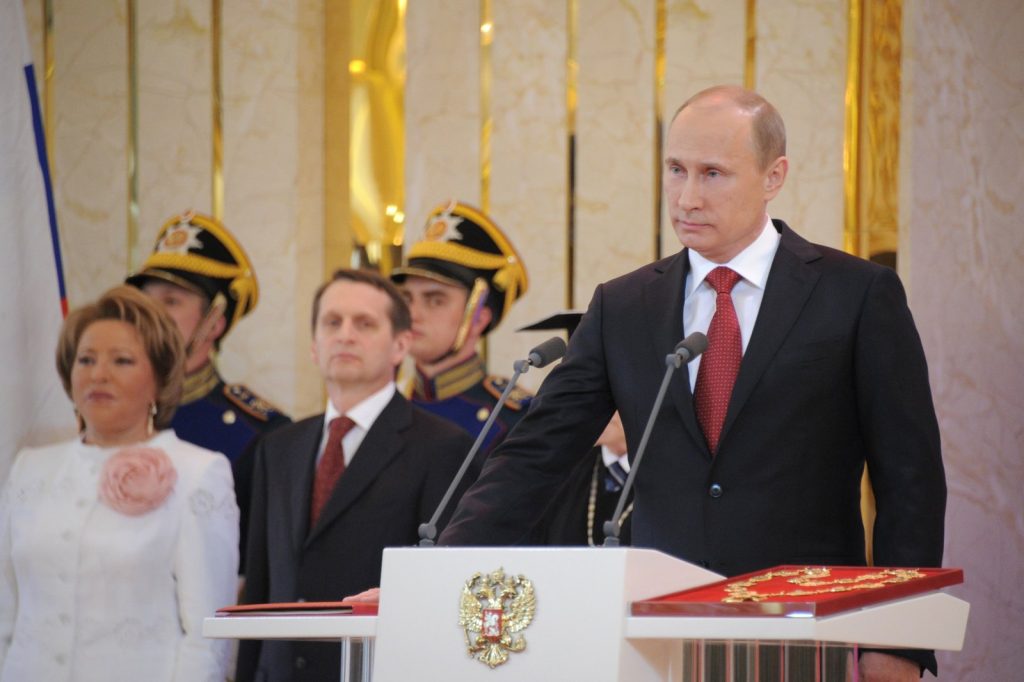
Boris Yeltsin resigned without warning on December 31, 1999, and Vladimir Putin was running Russia before midnight. “There will be no vacuum of power, not for a minute,” the new acting president told the country. He won the election that followed by a wide margin. One of his first acts was to give Yeltsin immunity from prosecution.
Taming the oligarchs
The next move came on July 29, 2000. Putin called 21 of Russia’s richest businessmen to the Kremlin and told them to stay out of politics. Boris Berezovsky and Vladimir Gusinsky would not comply, and both ended up under criminal investigation and in exile. Mikhail Khodorkovsky, the oil magnate, went to prison for fraud in 2003. His assets were shared out among people close to Putin.
Those people were mostly from his own past. Putin staffed government posts with colleagues from his KGB years and from St. Petersburg. Arkady Rotenberg, his judo partner, picked up lucrative state contracts, among them the Kerch Strait bridge.
Protests, Crimea and war
Winter 2011-2012 brought the biggest street protests of his era, with crowds in Moscow’s Bolotnaya Square challenging his reelection. Al Jazeera reports that Putin was also shaken by NATO’s 2011 intervention in Libya and the death of Gaddafi, which he read as a pattern of regime change aimed at leaders he saw as allies.
After the Maidan Revolution toppled Ukraine’s president, Viktor Yanukovych, unmarked soldiers, the so-called “little green men”, took over Crimea, and Russia annexed it. A separatist rebellion backed by Moscow then spread through the Donbas. On February 24, 2022, Putin announced a “special military operation” against Ukraine and called NATO expansion a “fundamental threat” to Russian security.
Rewriting the rules at the top
On January 15, 2020, in his annual state-of-the-nation address, Putin proposed constitutional amendments that could let him keep power after his term ended in 2024. Three hours later the whole Russian government resigned. Dmitry Medvedev, prime minister for eight years, moved to a new post as deputy chairman of the Security Council. Putin offered a short farewell: “Not everything worked out, of course, but nothing ever works out completely.”
His pick for prime minister was Mikhail Mishustin, head of the Federal Tax Service. Analysts quoted by RFE/L read the reshuffle as preparation for Putin’s own future. Tatyana Stanovaya said he seemed to be “creating a safety mechanism for his successor”. Dmitry Oreshkin was blunter, warning that any successor president would be “soft, plush, and tightly swaddled in Putin’s hands.” The ruble dropped sharply after the announcement.
Al Jazeera, writing in 2025, put Putin at 72 and still focused on personal power and Russia’s standing as a great power. Kremlin watchers quoted there say he works on a “cornered rat” principle and trusts few people. A profile from his KGB academy days noted a “diminished sense of danger”.
Sources
- Vladimir Putin: After 25 years in power, what next for Russia's president?
- Putin Speaks, Medvedev Resigns, And Russia's Political World Turns Upside Down




