
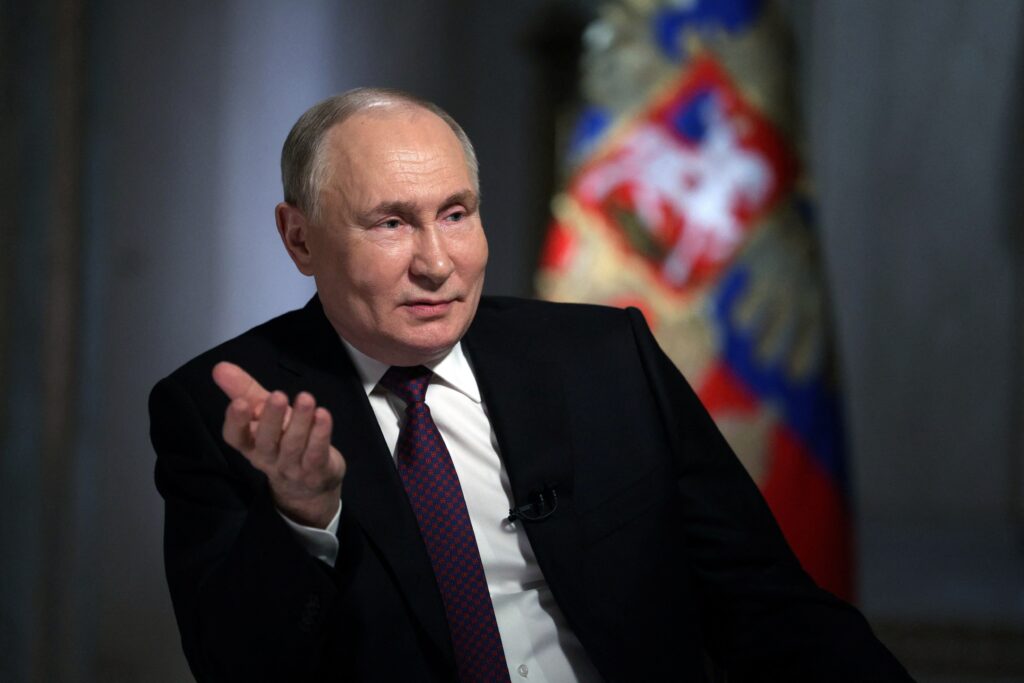
In the last week of August, Russia’s state-run pollster VTsIOM asked 1,600 adults how they rated Vladimir Putin. Some 66.9% approved. That would please most leaders. For Putin it was a slip of 0.8 percentage points on the week, after a summer in which the same pollster logged 65.1% in early July.
So is the grip loosening? Not by much, according to people who watch Russia closely. John Hardie, a Russia specialist at the think tank Foundation for Defense of Democracies, said there is “a strong desire to end the war,” but “it’s not likely that this trend will lead to major unrest or a palace coup.”
A warrant that changed little at home
On March 17, 2023, judges at the International Criminal Court issued an arrest warrant for Putin over the alleged unlawful transfer of children out of occupied Ukraine. A warrant went out for Maria Lvova-Belova, Russia’s children’s rights commissioner, too. Prosecutor Karim Khan said his office had identified “at least hundreds” of children removed from orphanages and children’s homes, many of whom, he alleged, were later placed for adoption in Russia. Putin’s decrees, he said, made it easier for them to get Russian citizenship. Neither Russia nor Ukraine is a party to the statute that created the court.
The warrant did not bring a rebellion. The state’s near-total control of television helps. Political scientists call what followed the war’s outbreak a “rally around the flag” effect: approval was about 61% in December 2021, hit 80% by March 2022 and settled at 74% by the year’s end, according to VCIOM figures cited by UNITED24. The same cycle played out in 1999 and 2000, in 2008 and after Crimea in 2014. Gains tend to fade.
Nuclear words
Putin has leaned on nuclear language more than once. On September 21, 2022, announcing a partial mobilisation, the first in Russia since the Second World War, he said the country had “lots of weapons to reply” to Western threats and “we will certainly use all the means at our disposal.” He insisted he was not bluffing. Defence Minister Sergei Shoigu said 300,000 reservists would be called up.
The Moscow Times reported in November 2024 on a revised nuclear doctrine. It says a nuclear response could be justified by aggression from a non-nuclear state “with the participation or support of a nuclear state.” The wording on the threshold changed, too: instead of aggression that “puts the very existence of the state in jeopardy,” the text now speaks of a “critical threat to the sovereignty and/or territorial integrity” of Russia or Belarus, as arms control researcher Pavel Podvig pointed out.
What people feel at home
The war now reaches ordinary Russians directly. The Associated Press tallied Russian Defense Ministry data: over 43,300 Ukrainian drones shot down over Russia and occupied Crimea between June and August, versus about 7,700 a year earlier. Refinery strikes have brought fuel shortages and queues at the pumps, and drone alerts have shut airports. Reports from Penza and other regions describe men pulled off the street and pressed to sign military contracts. Residents there have set up Telegram channels to warn each other where recruiters are standing.
Parliamentary elections were set for September 18 to 20, the first since the invasion began, with few opposition candidates allowed to run.
Sources
- Putin Approval Rating Slips as Ukraine War Fatigue Grows in Russia
- Russia: International Criminal Court issues arrest warrant for Putin | UN News
- Putin Lowers Threshold for Using Nuclear Weapons in Updated Doctrine, Sparking Escalation Concerns – The Moscow Times
- Putin announces partial mobilisation and threatens nuclear retaliation in escalation of Ukraine war | Vladimir Putin | The Guardian
- Putin's Approval Rating Explained: What Russians Really Think — UNITED24 Media




