
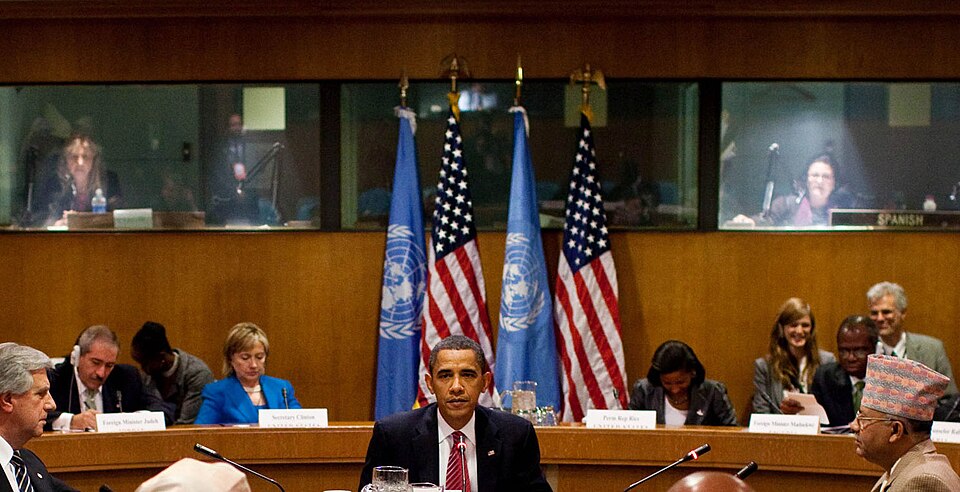
The escalator stopped working as Donald Trump stepped onto it, on his way to address the United Nations in September 2025. Then the teleprompter died mid-speech. the president half-joked to the assembled heads of state: “These are the two things I got from the United Nations: A bad escalator and a bad teleprompter.” The UN, for its part, said its escalator had been halted accidentally by Trump’s own camera operator, and rejected the blame.
The scene has aged into a parable. The United Nations, founded in 1945 to prevent war and later stretched across health, development and climate, is more than 80 years old now, and its institutions — the Security Council above all — are widely judged to be in need of an overhaul, much like the headquarters building itself. The question underneath, as The Business Standard relayed in early September 2026, syndicating a DW analysis by David Ehl, is whether Trump’s America First posture is merely a symptom of a crumbling multilateral order or the wrecking ball itself.
Interregnum Or Vacuum?
Finnish President Alexander Stubb, one of the few heads of state holding a doctorate in international relations, sees a power vacuum from which a new world order will likely emerge within five years. Mark Leonard of the European Council on Foreign Relations expects something longer and uglier. “It is time to acknowledge that the old order really has disappeared and to plot a new approach to geopolitics. This moment does not constitute a short interregnum between a US-led order and a Chinese-led one,” he wrote in Foreign Affairs. “For some time, the world will be without any order at all, swept by fragmentation, contagion, and strangulation or the temptation to weaponise a wide variety of geographic, economic, and technological chokepoints.”
Teresa Nogueira Pinto, a globalisation expert at Lusofona University in Lisbon, is blunter about the machinery. “That framework of multilateralism, which is connected with the world after World War II […] and a golden period of then the United Nations, I would say that it’s all over,” she said. “It’s not working,” she added. Peacekeeping and peacebuilding missions have mostly failed, in her reading, and the Security Council no longer represents the world of 2026 — though any expansion stalls on arithmetic. “But who would join?” she asked, ticking off India, Pakistan, Nigeria, Ethiopia before conceding that it is very hard to even imagine a reform.
Johannes Thimm of the German Institute for International and Security Affairs pushes back. “I do not agree that this era is already completely over,” he said, pointing to the dense, unspectacular web of diplomatic conventions and treaties still holding. Yet he counts the pressures clearly: wars of aggression in Ukraine and Iran, humanitarian law violated in Gaza, and American withdrawals from the World Health Organization, the Paris climate agreement, the UN Framework Convention on Climate Change and UNESCO, plus intensified pressure on the International Criminal Court. “If the still most powerful state acts this way,” he said, “then that poses a threat to the system as a whole. So, I would say, a greater threat than when Russia, for example, wages a war of aggression.”
The World Reorganizes Anyway
On the ground, the realignment has begun. Trump’s invocations of the 1823 Monroe Doctrine point to a Western Hemisphere sphere and, implicitly, a multipolar rest. Within NATO, allies openly worry about further American withdrawal — or worse, should his claims to Danish-administered Greenland harden. In early August, Saudi Arabia, Turkey and nuclear-armed Pakistan launched the Mecca Defense Pact with NATO-style mutual guarantees, one of the smaller, faster formats now called “minilateralism.” BRICS has expanded its membership and ambition as a counterweight to the Western-led order, and Pinto sees African states repositioning accordingly: “Many African countries are realising that the previous models were not so advantageous for them, and especially for growth and sustainable growth,” she said. With the World Trade Organization stalled, she points to the African Continental Free Trade Area — ratified by nearly all African states since 2018, though slow to implement — as the more promising template.
Her three levers for the coming power map are sovereignty, resources and demographics, with young, growing societies in Africa and Asia making themselves indispensable. “India could become a superpower by the end of the century,” she said.
The near term, Thimm warned, trends dark. “A world without rules only helps the strong,” he said — the moderately strong and the weak get crushed, which is precisely why Europe has a stake in preserving some order. His forecast: “the world will become more violent. There will be more wars. The wars will become more brutal. It will be more difficult to organise cooperation. So I don’t know what will happen when the next pandemic breaks out. I don’t know what will happen when the next global financial crisis breaks out.” And the climate crisis, he noted, still waits on the collective action the old order was built to provide.




