
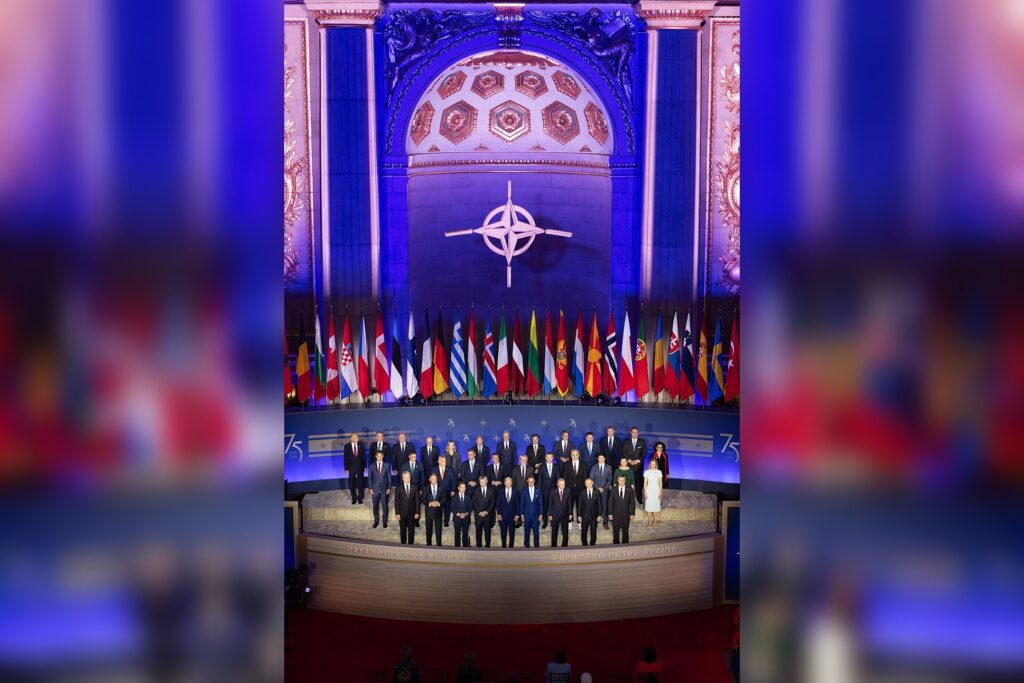
The record shows what NATO’s Washington summit marking seventy-five years of the alliance set in motion. Over three days, July 9-11, 2024, all 32 allies met for the first time with Sweden at the table, sealed Mark Rutte’s succession to Jens Stoltenberg as secretary general, and restated the founding bargain plainly: “an attack on one is an attack on all.” Two years on, that gathering remains the reference point for every argument since about Ukraine, money and enlargement.
Ukraine sat at the center of the agenda. According to the statement issued by the White House at the time, allies convened the second NATO-Ukraine Council at leaders’ level with President Volodymyr Zelenskyy present, announced a €40 billion baseline of support for the following year, established a Security Assistance and Training command under a three-star general based in Germany, and put a senior civilian representative on the ground in Kyiv. The formula of the moment described those steps, with bilateral aid, as the bridge to Ukraine’s future membership. No date came with the bridge.
The money and the machinery moved in parallel. Twenty-three allies were meeting the two-percent spending benchmark by the summit, against nine when the Biden administration took office and three a decade earlier; NATO had let contracts worth $10 billion for arms and ammunition; and the alliance put its first comprehensive defense plans since the Cold War into practice, spanning air, land, sea, cyber and space. A new integrated cyber defense center, four flagship projects alongside Japan, Australia, the Republic of Korea and New Zealand, the Indo-Pacific partner group, and a pointed reference to China’s support for Russia’s defense industrial base rounded out the program.
Dissent ran through the margins. Hungarian Prime Minister Viktor Orban left Washington on the summit’s final day, July 11, and flew to Florida to meet Donald Trump, the presumptive Republican nominee, the last stop of a self-styled “peace mission” that had already taken him to Kyiv, Moscow and Beijing. “The good news of the day: he’s going to solve it!” he wrote afterward. European Union partners distanced themselves from the tour, and Orban conceded he had no mandate to negotiate for them. His foreign minister, Peter Szijjarto, said that “Ukraine’s admission wouldn’t strengthen but weaken the alliance’s unity”. Officials confirmed that allies nonetheless saw none of it denting Kyiv’s eventual path in.
What Washington settled, and what it left open, is now part of the alliance’s inheritance. The funding baseline and the training command gave support to Ukraine a permanent institutional spine; membership itself was deferred, with bridge language standing in for a timetable. Before the November election, Trump suggested he could resolve the conflict even before taking office, without elaborating. Two years on, the summit’s decisions still frame the argument inside the alliance: how much, how fast, and on whose terms Ukraine’s future arrives.
Sources
- FACT SHEET: The 2024 NATO Summit in Washington | The American Presidency Project
- Orban Takes Solo 'Peace Mission' To Mar-A-Lago, Says Trump Is 'Going To Solve It'
Sources
- NATO summit 2024 – Key declarations for Ukraine and anticipations…
- Planning crimes: 2024 NATO Summit’s agenda – MR Online




