
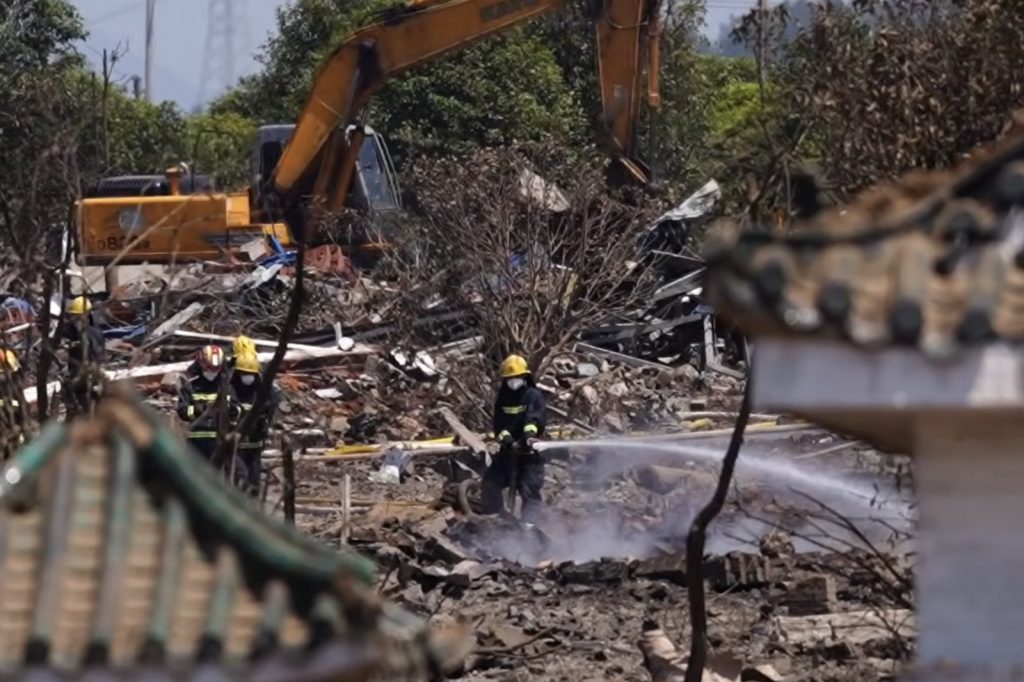
Liuyang, China, May 8, 2026 — cybernewschronicle.com — Liuyang, China, produces the fireworks that light up New Year’s skies from Sydney to London. That supply chain just took a direct hit. Three days ago, an explosion ripped through a fireworks factory here in Hunan Province.
The confirmed death toll now stands at 37. Fifty-one people are injured.
One person remains missing. Rescue crews are still working the site. Liuyang is not just any manufacturing town.
It is the fireworks capital of China, and by extension, the world. The city accounts for roughly 60% of China’s domestic firework production and a staggering 70% of its exports.
When a factory blows up here, the shockwaves travel through global supply chains. The numbers make plain what is at stake. In 2025, Liuyang’s fireworks industry generated an output value of 50.58 billion Yuan — roughly 7.4 billion U.S. dollars.
That is not pocket change. That is the economic backbone of a city whose production skills have been recognized as part of China’s national intangible cultural heritage, a tradition stretching back to the Tang and Song dynasties. Now that tradition has a body count.
Local official Wang Yibo called the explosion “a tragic reminder of the risks associated with the fireworks industry.” He is not wrong. But the risks here are not abstract.
They are measured in lives lost and families shattered. They are also measured in the potential disruption to an industry that ships product to the EU, the UK, Israel, and the United States. The U.S. President issued a statement expressing sympathy for the victims and their families, and stressed the importance of prioritizing safety.
Taiwan, Japan, and the Philippines are monitoring the situation. So is the broader international community, which relies on Liuyang for its New Year’s Eve displays, its Fourth of July celebrations, and its Diwali festivals.
The Chinese government has launched an investigation into the cause of the explosion. Officials are working to support the families of the victims. Those are necessary steps.
But the question hanging over Liuyang is whether this tragedy will force real change in safety standards and regulations across an industry that has long operated with a known risk profile. Fireworks are inherently dangerous. Mix gunpowder, friction, and human labor in a factory setting, and accidents are a statistical certainty.
The question is frequency and scale. A blast that kills 37 people is not a minor incident.
It is a catastrophe that demands answers. For the families of the dead, those answers cannot come soon enough. For the injured, the road ahead is long.
For the one person still missing, hope is fading with each passing hour. For the rest of the world, the calculation is colder.
Liuyang supplies 70% of the world’s fireworks exports. If production slows, if regulations tighten, if factories close for safety inspections, the price of fireworks will rise. Delivery dates may slip.
The global celebration calendar could face a supply crunch. That is the stakes piece. A fireworks factory explosion in a Chinese city does not just kill 37 people.
It exposes the fragility of a supply chain the world depends on for its most visible moments of joy. Safety standards in that supply chain are now under a microscope.
The outcome of the investigation will determine whether Liuyang’s dominance continues uninterrupted — or whether the industry faces a reckoning it has long avoided.




