
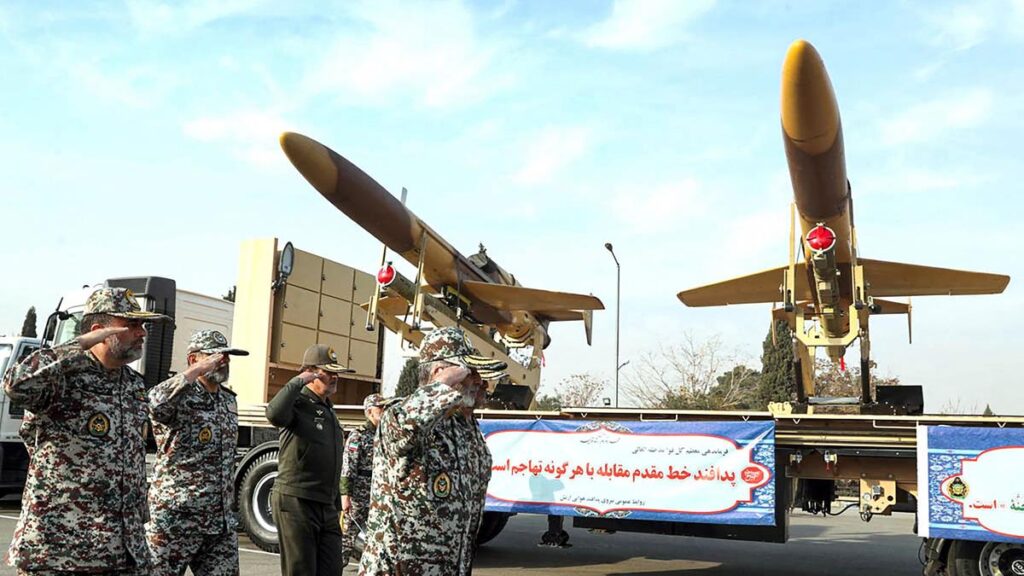
Iran’s longest-range missiles can reportedly reach targets 2,000 kilometers away, about 1,240 miles. Draw that circle on a map and it takes in the whole Middle East and part of Europe. Here’s what that means in plain terms: the country’s weapons are built to hit its neighbors from a distance, and they’ve been used that way.
Missiles first
U.S. intelligence analysts say Iran holds the largest ballistic missile inventory in the Middle East, according to the Council on Foreign Relations. Ballistic missiles climb and then fall on a curved path. They are much faster than drones or cruise missiles and generally harder to stop.
Iran showed the mix in two attacks on Israel in 2024. The April strike used drones, cruise missiles and ballistic missiles, and Tehran reportedly signaled its plans days ahead. Israel and its partners had hours to track the slower weapons. The October strike came without warning and was mostly ballistic missiles, which can land in minutes.
Most of it was stopped. U.S. and Israeli officials said defensive systems largely neutralized both attacks, though some projectiles got through. One satellite imagery analysis found more than thirty Iranian missiles hitting an air base in southern Israel in October. Analysts warned that later strikes could be larger, especially if Iran fired newer designs such as the Fattah-1 and Kheybar Shekan.
Drones, and why Iran leans on them
Iran has few modern warplanes to show for itself. Bishara Bahbah, writing for the Arab Center Washington DC in 2022, argued that drones fill that gap: cheap, small enough to fly under radar, and useful for spying. Think of it like a poor man’s air force.
The technology travels. Bahbah wrote that Hamas, Islamic Jihad, Hezbollah, the Houthis and pro-Iran militias in Iraq assemble and often improve on drone kits sent by Iran. Between 2015 and 2021, the Houthis fired 430 ballistic missiles and launched 851 armed drones into Saudi Arabia, killing 59 Saudi civilians, according to the Saudi-led coalition’s spokesperson. In July 2022, Israel’s military said it shot down three Hezbollah drones aimed at a gas exploration rig in disputed waters off Lebanon.
Iran opened a drone factory in Tajikistan in May 2022 that builds the Ababil-2, a reconnaissance and combat model. That same month Iranian television showed a drone base under the Zagros mountains said to hold “more than 100 combat, reconnaissance and attack drones.” The Council on Foreign Relations adds that Iran has since supplied Russia with drones and shorter-range ballistic missiles for its war in Ukraine.
The nuclear question and the 2026 war
In December 2024, IAEA Director General Rafael Grossi told Reuters that Iran was “dramatically” ramping up enrichment to up to 60 percent. Weapons-grade is roughly 90 percent.
The picture shifted in 2026. The United States and Israel launched a large-scale offensive on February 28 aimed at Iran’s nuclear and missile capabilities, and the Council on Foreign Relations reported that the strikes killed Supreme Leader Ayatollah Ali Khamenei. The Institute for the Study of War estimated that around half of the missile launchers Iran used in the conflict had been destroyed. The council also noted that many of Iran’s proxies have been weakened, which leaves the nuclear program as one of Tehran’s last sources of leverage.
Sources
- What Are Iran’s Nuclear and Missile Capabilities? | Council on Foreign Relations
- Iran-Israel Drone Competition and the Changing Nature of Warfare in the Middle East | Arab Center Washington DC (Bishara A. Bahbah)




