
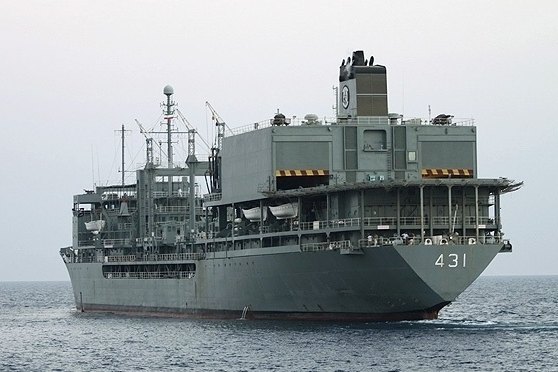
TEHRAN, July 25 — The Islamic Republic of Iran Navy’s largest fleet replenishment oiler, IRIS Kharg, remains a notable case study in Tehran’s maritime logistics despite its loss five years ago. Built by Swan Hunter in the United Kingdom and launched in 1977, the vessel was delivered to Iran in 1984. At the time of its sinking, it was Iran’s largest naval ship by tonnage, a distinction later claimed by IRIS Makran after its commissioning in early 2021.
The vessel displaced 11,242 tonnes standard and up to 33,544 tonnes full load. Its dimensions were recorded by Jane’s Fighting Ships as 207.2 meters in length, 26.5 meters in beam, and 9.2 meters in draft.
Combat Fleets of the World recorded slightly different measurements: 207.15 meters in length, 25.50 meters in beam, and 9.14 meters in draft. Powered by two Babcock & Wilcox boilers and two Westinghouse geared turbine sets, Kharg generated 7,000 kW of electricity and 20.04 megawatts for its single shaft, achieving a top speed of 21.5 knots.
Replenishment at Sea Capability
The International Institute for Strategic Studies classified Kharg as an AORH—an auxiliary oiler replenishment vessel with hangar facilities. Only two other Iranian ships, IRIS Bushehr and IRIS Makran, shared this capability. A 2014 Stratfor assessment described Kharg as essential for extending the operational range of Iranian warships.
Without it, Iranian frigates could not conduct extended deployments without frequent port visits. Eric H.
Arnett of the Stockholm International Peace Research Institute (SIPRI) noted that Kharg’s capacity to carry large helicopters such as the Sikorsky SH-3 Sea King enhanced its anti-submarine warfare role. The ship’s helipad and twin hangars allowed it to embark up to three helicopters, improving its versatility in open-water operations.
Military and Logistical Role
Christopher Harmer of the Institute for the Study of War highlighted Kharg’s heavy-cargo lift ability, which made it suitable for the safe transfer of sensitive assets under sanctions. These included imported military equipment, gold, or currency, all of which required secure and discreet handling. The vessel’s armament included one OTO Melara 76 mm/62 compact gun mounted on the forecastle.
Two Bofors 40 mm anti-aircraft guns were planned but never installed. Instead, Kharg carried four Soviet 23 mm/80 anti-aircraft autocannons in two twin mounts, along with two 12.7 mm heavy machine guns.
Its crew numbered 248. The ship’s navigation radar was a Decca 1229 I-band system. It also carried a U.S.-made URN 20 tactical air navigation system and was fitted with Inmarsat satellite communications.
Loss and Aftermath
On June 2, 2021, Kharg caught fire and sank in the Gulf of Oman near the Iranian town of Jask, approximately 140 kilometers from the Strait of Hormuz. The incident marked the end of a vessel that had played a central role in Iran’s ability to project naval power across the region. Analysts have since debated the strategic implications of Kharg’s loss.
The U.S. administration under President Donald Trump had previously designated Iran’s naval expansion as a regional concern. The absence of Kharg removed a key logistical node that had enabled Iranian frigates to operate farther from home ports without frequent resupply.
Strategic Context and Ongoing Concerns
The loss of Kharg has not diminished Iran’s efforts to maintain a presence across the Gulf of Oman and the Arabian Sea. Since 2021, Iran has relied on smaller vessels and alternative logistics chains to sustain its naval operations. However, the absence of a large replenishment oiler like Kharg has constrained the endurance and operational reach of its surface fleet.
Analysts such as those at the Institute for the Study of War have noted that Iran continues to use auxiliary ships for resupply missions, but these lack the capacity and protection offered by a dedicated replenishment oiler. The result is a naval posture that remains active but limited in scope and sustainability.
As of July 2026, Iran has not commissioned a direct replacement for Kharg. The closest comparable vessel, IRIS Makran, serves primarily as a floating base and has limited replenishment capabilities. The gap left by Kharg’s sinking continues to shape Iran’s naval strategy and its interactions with regional and international stakeholders.
Observers will continue to monitor Iran’s efforts to rebuild its replenishment-at-sea capacity. Any new construction or




