
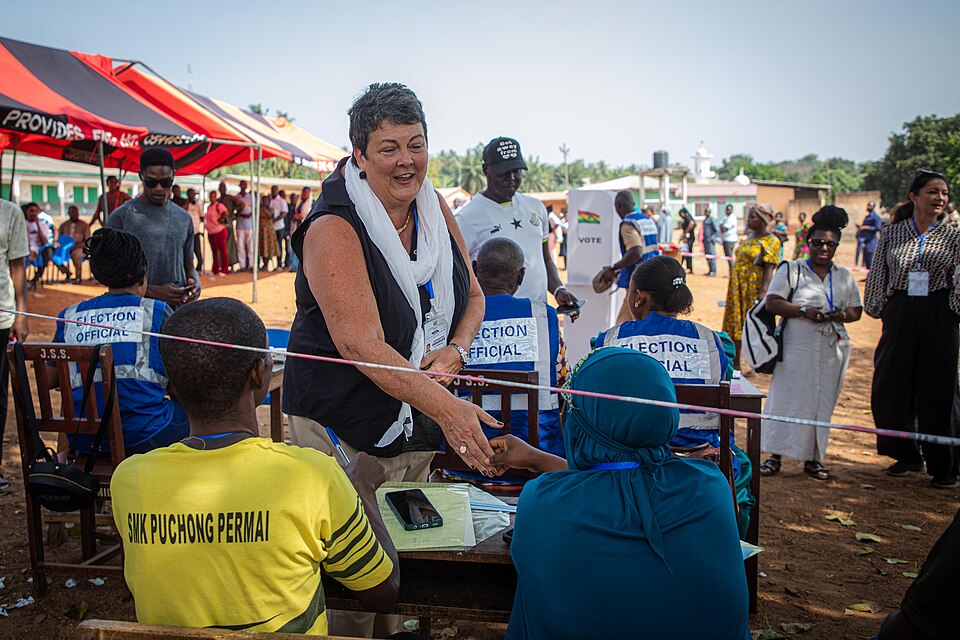
Between 1973 and 1976, not one election was observed. That gap sits in the middle of the early history of international monitoring, as Susan Hyde tells it, and it is a reminder of how thin the practice once was. Before the 1960s, outside observers had mostly appeared at plebiscites in territories that were not sovereign states or were held in trust. The first missions in sovereign states, Costa Rica among them, in the 1960s, were slow to multiply: fewer than five observed elections a year, a rate that held until the early 1970s.
Thin missions, mixed motives
Those early missions were modest. With several exceptions, a pair of observers, or just one, turned up in the capital for election day, and criticism was rare. Motives varied. Most leaders who invited monitors wanted to show they were guiding a genuine transition to democracy. A few were electoral autocrats borrowing legitimacy. Hyde names Nicaragua in 1963, the Dominican Republic in 1966 and Bolivia in 1978, where a managed handover to a puppet president was staged.
Then the practice spread. Observers were invited most readily to high-profile votes after a break with authoritarian rule, when nobody could be sure the new government meant it. The 1984 Guatemalan elections, observed by the Organization of American States after a 1983 coup, are an example. By 2006, among elections in the developing world where there were domestic worries about fraud before the vote, which averaged about 40% of the total, the share that had observers approached 100%.
The catch
That sounds like a success story. On closer reading, the number of observers is no longer the right thing to count. A 2024 working paper from the University of California’s Institute on Global Conflict and Cooperation, by Sarah Sunn Bush, Christina Cottiero and Lauren Prather, argues that the monitoring regime has become far more complex. The count of organizations doing high-quality work has plateaued. The count of what the authors call zombie monitors, groups that validate flawed elections, kept growing.
The authors define the good ones by two traits: willing and able to report fraud. The groups that drove the expansion of monitoring as the Cold War ended, among them the EU, the OSCE, the Carter Center and the National Democratic Institute, fit. Their teams visit many polling stations, follow the process from registering voters through campaigning to counting, and use statistical checks such as parallel vote tabulation. The OSCE’s ODIHR handbook first appeared in 1996, the European Union’s in 2002.
The middle tier is messier. Some groups are willing but not able, as with one-time monitors that never develop professional standards. Others are able but not willing. The authors cite the West African regional economic community, which does criticize elections at times but is usually lenient with members that are not democratic.
At the bottom are monitors that can neither spot fraud nor say so when they do, a failing the authors often link to support for authoritarianism. This growth became a distinct phenomenon in the first years of the 2000s. Following the Color Revolutions, the authors write, autocrats worried about democratic diffusion, stepped up their opposition to Western-led missions, and one of their tactics was to sponsor or invite low-quality observers.
Sources
- Zombies Ahead: Explaining the Rise of Low-Quality Election Monitoring (Bush, Cottiero, Prather; UC IGCC working paper)
- The Pseudo-Democrat's Dilemma: Why Election Observation Became an International Norm (Susan D. Hyde, Cornell University Press)




