
In 1776, according to a book note in the Journal of Peace Research, the French foreign minister Delacroix ordered that every available means be used to swap George Washington for a “friend of France.” Election meddling by great powers is older than the Cold War, and older than the 2016 American campaign that revived the argument.
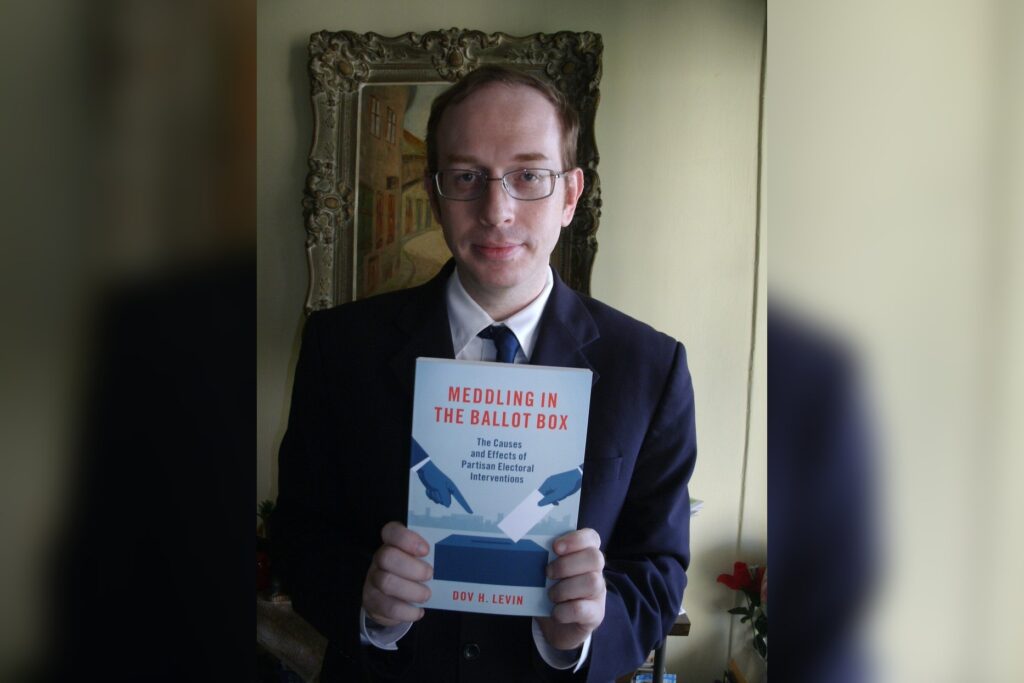
The best systematic count of it comes from Dov H. Levin, whose 2020 book, “Meddling in the Ballot Box,” was published by Oxford University Press. He compiled a data set of 117 interventions between 1946 and 2000, made either by the Soviet Union and Russia or by the United States. In Levin’s words, they occurred in “one of every nine competitive national-level executive elections” of those decades, and in sixty different countries.
Two conditions
Why do they do it? Levin finds that nearly every case meets one of two conditions. The outside power sees its interests gravely threatened by a candidate or party in the target country. Or, and the reviewer Bernt Aardal considers this the more important factor, someone significant inside that country is willing to take the help. Another reviewer, Kyle Scott, frames it as a pair of requirements. A player inside the target country has to ask for the help, openly or by implication, and the intervening state has to believe the other side’s victory would hurt its interests. Scott adds that few readers will be surprised, and offers Haiti as an example. If the candidate Washington prefers also welcomes American involvement, the outcome can be affected.
Did it work?
This is where the book makes its claim. According to Levin, the party that received outside help gained 3 per cent in vote share. He tested the result on the full data set, then on selected elections, and in most of those cases intervention did lift the favored side. Aardal notes a result many would not expect: Levin finds open interventions work better than hidden ones.
Aardal flags a limit. It is extremely hard to separate the effect of an intervention from the other things that move voters, and that applies to Levin’s own attempts too. He still calls the theoretical framework and empirical work impressive.
The cases behind the numbers
The statistics sit beside close studies of six votes: West Germany in 1953, Argentina in 1946, Venezuela and Guatemala in 1958, the Philippines in 1965 and Greece in 1967. Two further chapters test what intervention actually did, drawing on the 1992 Israeli election, the 1953 West German election and the American presidential election of 2016. Aardal finds that the case stories read like thrillers.
Levin traces the practice back further than the dataset does. He reaches back as far as the sixteenth century, when the selection of Pope Clement VII drew outside meddling.
Sources
- Book note: Meddling in the Ballot Box (Bernt Aardal, Journal of Peace Research / PRIO)
- Book Review: Meddling in the Ballot Box (LSE Review of Books)




